 National Parks of China
← World Heritage map · ← North America
Cultural 16Natural 9Mixed 2
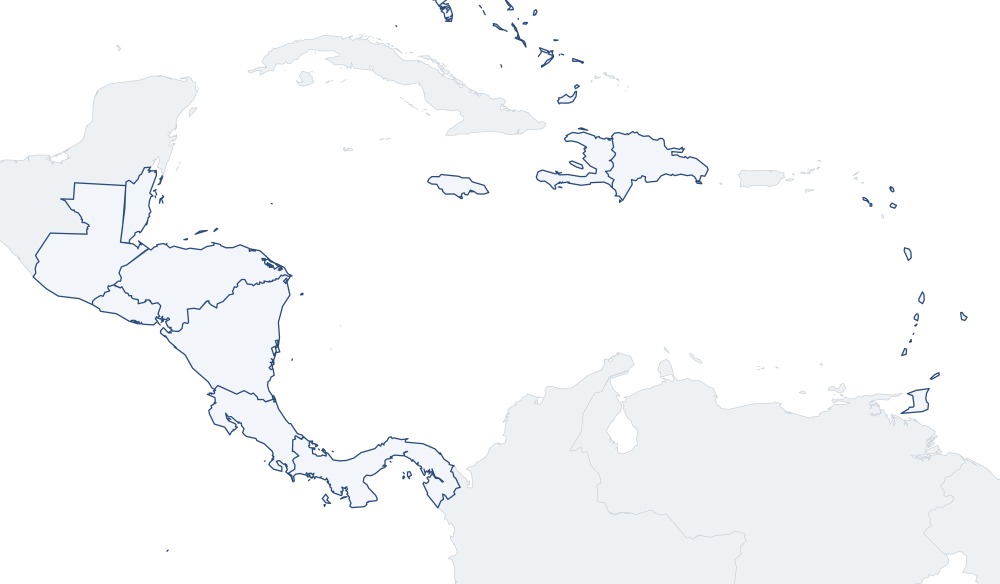
Central America and the Caribbean has 27 World Heritage Sites (16 cultural, 9 natural, 2 mixed) in 15 countries. Hover over or tap a dot to see its name; click a name in the list to show it on the map. Listed by year of inscription.
- Tikal National Park Tikal, in the jungle of Petén in northern Guatemala, is one of the major sites of Mayan civilisation, inhabited from the 6th century BC to the 10th century AD. Its ceremonial centre has temples, palaces and public squares reached by ramps, and remains of dwellings are scattered across the surrounding countryside.
- Antigua Guatemala Antigua, capital of the Captaincy-General of Guatemala, was founded in the early 16th century at 1,500 m above sea level in an earthquake-prone region. An earthquake in 1773 largely destroyed it, but its principal monuments survive as ruins. Laid out on a grid pattern inspired by the Italian Renaissance, it developed a distinctive character in under three centuries.
- Maya Site of Copan Copán, one of the most important sites of Mayan civilisation, is in western Honduras. It was found in 1570 by Diego García de Palacio and excavated from the 19th century. Its ruined citadel and imposing public squares show the three main stages of development of the city before it was abandoned in the early 10th century.
- Fortifications on the Caribbean Side of Panama: Portobelo-San Lorenzo The forts of Portobelo and San Lorenzo on the Caribbean coast of Panama are fine examples of 17th- and 18th-century military architecture, built as part of the defence system the Spanish Crown created to protect transatlantic trade.
- Archaeological Park and Ruins of Quirigua Quirigua, in eastern Guatemala, was inhabited from the 2nd century AD and became the capital of an autonomous, prosperous state under Cauac Sky (723-84). Its outstanding 8th-century monuments, carved stelae and sculpted calendars are an essential source for the study of Mayan civilisation.
- Darien National Park Darien National Park, in eastern Panama on the border with Colombia, forms a bridge between the two continents of the New World and has an exceptional variety of habitats, from sandy beaches and mangroves to lowland and upland tropical forests. It is rich in wildlife, and two Indigenous groups live in the park.
- National History Park – Citadel, Sans Souci, Ramiers These monuments in northern Haiti date from the early 19th century, when Haiti proclaimed its independence: the Palace of Sans Souci, the buildings at Ramiers and, above all, the Citadel. They were the first monuments built by formerly enslaved people who had won their freedom, and serve as universal symbols of liberty.
- Río Plátano Biosphere Reserve The Río Plátano Biosphere Reserve, in north-eastern Honduras, is centred on the Río Plátano watershed and is one of the few remaining tropical rainforests in Central America, with abundant plant and animal life. Its mountainous landscape slopes down to the Caribbean coast, and over 2,000 Indigenous people maintain a traditional way of life there.
- Talamanca Range-La Amistad Reserves / La Amistad National Park The Talamanca Range-La Amistad Reserves straddle Costa Rica and Panama. In this mountainous part of Central America, marked by Quaternary glaciers, the fauna and flora of North and South America have mixed. Tropical rainforest covers most of it, four Indigenous peoples live there, and the two countries co-operate in its management.
- Colonial City of Santo Domingo Santo Domingo, in the Dominican Republic, was founded in 1498, after Columbus arrived on the island in 1492. It was the site of the first cathedral, hospital, customs house and university in the Americas, and its grid layout became the model for most town planning in the New World.
- Joya de Cerén Archaeological Site Joya de Cerén in El Salvador is a pre-Hispanic farming village buried by a volcanic eruption around AD 600. Its remains are so well preserved that it has been compared to Pompeii, giving a clear picture of the houses and daily life of ordinary people.
- Belize Barrier Reef Reserve System The Belize Barrier Reef Reserve System lies off the coast of Belize and includes the largest barrier reef in the northern hemisphere, offshore atolls, several hundred sand cays, mangrove forests, coastal lagoons and estuaries. Its seven sites illustrate the evolutionary history of reef development and are significant habitat for threatened species, including marine turtles, manatees and the American crocodile.
- Morne Trois Pitons National Park Morne Trois Pitons National Park in Dominica is centred on the 1,342 m volcano of the same name and covers nearly 7,000 ha. It combines luxuriant tropical forest with 50 fumaroles, hot springs, three freshwater lakes, a boiling lake and five volcanoes, and has the richest biodiversity in the Lesser Antilles.
- Cocos Island National Park Cocos Island National Park lies 550 km off the Pacific coast of Costa Rica and is the only island in the tropical eastern Pacific with tropical rainforest. The close interaction between island and surrounding sea makes it a natural laboratory for biological processes, and its large pelagic fish attract divers.
- Brimstone Hill Fortress National Park Brimstone Hill Fortress stands on the Caribbean island of Saint Kitts. Built by the British in the 17th and 18th centuries using enslaved African labour, it is a well-preserved example of military architecture in the Caribbean and a testimony to European colonial expansion and the African experience of slavery.
- Area de Conservación Guanacaste The Area de Conservación Guanacaste, in north-western Costa Rica, protects the best dry forest habitat from Central America to northern Mexico, along with key habitats of endangered or rare plants and animals. Both its land and its coastal and marine areas show significant ecological processes.
- Ruins of León Viejo The Ruins of León Viejo, in western Nicaragua, are those of one of the oldest Spanish colonial settlements in the Americas. Because the town did not develop further, the site is outstanding testimony to the social and economic structures of the Spanish Empire in the 16th century, and has great archaeological value.
- Pitons Management Area The Pitons Management Area, near the town of Soufrière on the south-west coast of Saint Lucia, covers 2,909 ha. Its two volcanic spires, 770 m and 743 m high, rise side by side from the sea, and the site includes a geothermal field, coral reefs and varied land and marine ecosystems.
- Coiba National Park and its Special Zone of Marine Protection Coiba National Park, off the south-west coast of Panama, protects Coiba Island, 38 smaller islands and the surrounding waters of the Gulf of Chiriquí. Sheltered from cold winds and El Niño effects, Coiba's tropical moist forest is well preserved and home to many endemic species.
- León Cathedral León Cathedral, in León in western Nicaragua, was built from 1747 to the early 19th century to a design by the Guatemalan architect Diego José de Porres Esquivel. Its style marks the transition from Baroque to Neoclassical, and it is one of the largest cathedrals in Central America.
- Historic Bridgetown and its Garrison Historic Bridgetown, the capital of Barbados, and its nearby Garrison form an outstanding example of British colonial architecture. The old town dates from the 17th to 19th centuries, and its winding street layout differs from the grid plans of Spanish and Dutch colonial cities in the region, testifying to the spread of Britain's Atlantic empire.
- Precolumbian Chiefdom Settlements with Stone Spheres of the Diquís Four archaeological sites in the Diquís Delta of southern Costa Rica record chiefdom settlements of AD 500 to 1500. They include artificial mounds, paved areas and burial sites, and above all stone spheres 0.7 to 2.57 m in diameter, whose meaning, use and production remain largely unknown.
- Blue and John Crow Mountains The Blue and John Crow Mountains are a rugged, heavily forested region in south-east Jamaica that sheltered first Tainos fleeing slavery and then Maroons, formerly enslaved people. They resisted the colonial system here through a network of trails, hiding places and settlements known as the Nanny Town Heritage Route.
- Antigua Naval Dockyard and Related Archaeological Sites Set on the southern side of Antigua, the site is a walled group of Georgian-style British naval buildings with related archaeological sites. Its deep, sheltered bays suited ship repair and hurricane shelter, and the dockyard was built from the mid-18th century by enslaved Africans during European rivalry for control of the eastern Caribbean.
- National Archaeological Park Tak’alik Ab’aj Tak'alik Ab'aj is an archaeological site on the Pacific coast of Guatemala. Its 1,700-year history spans the transition from Olmec civilisation to early Mayan culture, in which it played a primary role, partly because it lay on the long-distance trade route linking the Isthmus of Tehuantepec in Mexico with Central America.
- The Colonial Transisthmian Route of Panamá The Colonial Transisthmian Route crosses the isthmus of Panama, which from the 16th century enabled the movement of goods and people between the Iberian Peninsula, Spain's American colonies, the Philippines and the Canary Islands. It comprises roads, towns and ports and marks an important node in early global trade.
- The Archaeological Ensemble of 17th Century Port Royal Port Royal is located at the mouth of Kingston Harbour in south-eastern Jamaica and was a major English port city in the 17th century. A devastating earthquake in 1692 submerged much of the town under water and sand, and its land and underwater remains now give rare insight into colonial urban life. It was a key hub of transatlantic trade, including the trade in enslaved Africans.