 National Parks of China
← World Heritage map · ← Europe
Cultural 52Natural 3
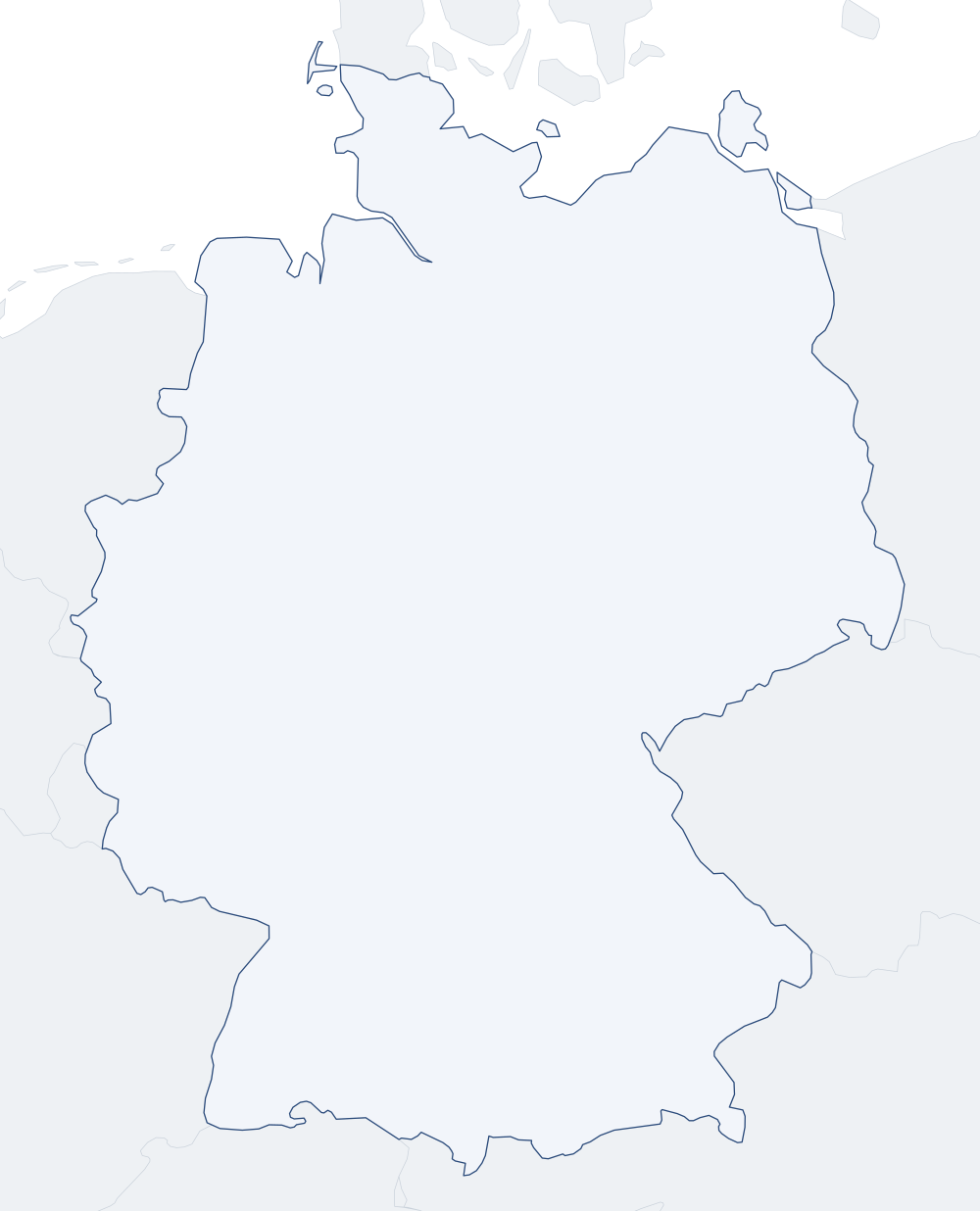
Germany has 55 World Heritage Sites (52 cultural, 3 natural), the 4th most in the world. Hover over or tap a dot to see its name; click a name in the list to show it on the map. Listed by year of inscription.
- Aachen Cathedral Aachen Cathedral in Germany began around 790–800 as Charlemagne's palatine chapel, with an octagonal basilica and cupola. It was enlarged in the Middle Ages.
- Speyer Cathedral Speyer Cathedral in Rhineland-Palatinate, Germany, was founded in 1030. It is one of the most important Romanesque monuments of the Holy Roman Empire and was the burial place of emperors for almost 300 years.
- Würzburg Residence with the Court Gardens and Residence Square The Würzburg Residence in Bavaria, Germany, was built in the 18th century and is one of the largest Baroque palaces in the country. It has frescoes by Tiepolo and surrounding court gardens.
- Pilgrimage Church of Wies The Pilgrimage Church of Wies, in the Alpine foothills of Bavaria, Germany, was built in 1745–54 by Dominikus Zimmermann. It is a masterpiece of Bavarian Rococo.
- Castles of Augustusburg and Falkenlust at Brühl Augustusburg and Falkenlust at Brühl, near Cologne in Germany, were the residence and hunting lodge of the prince-archbishops of Cologne. They are among Germany's earliest Rococo buildings.
- St Mary's Cathedral and St Michael's Church at Hildesheim St Mary's Cathedral and St Michael's Church in Hildesheim, Lower Saxony, are masterpieces of Ottonian Romanesque art. St Michael's, built 1010–20, is known for its bronze doors and the Bernward column.
- Roman Monuments, Cathedral of St Peter and Church of Our Lady in Trier Trier on the Moselle in Germany was a Roman colony from the 1st century and one of the capitals of the Tetrarchy. It preserves Roman monuments together with the Cathedral of St Peter and the Church of Our Lady.
- Hanseatic City of Lübeck Lübeck in northern Germany, founded in the 12th century, was the capital of the Hanseatic League and the main trading centre of northern Europe until the 16th century. Its brick old town retains merchants' houses and churches.
- Frontiers of the Roman Empire These frontier sites include Hadrian's Wall and the Antonine Wall in Britain and the Upper German-Raetian Limes in Germany. They are parts of the Roman Empire's border at its greatest extent in the 2nd century AD.
- Palaces and Parks of Potsdam and Berlin The palaces and parks of Potsdam and Berlin line the River Havel in Germany. About 500 ha of parkland hold 150 buildings built between 1730 and 1916, including Sanssouci.
- Abbey and Altenmünster of Lorsch The Abbey of Lorsch in Hesse, Germany, preserves rare Carolingian architecture, notably the Torhall gatehouse, with sculpture and paintings from the period.
- Mines of Rammelsberg, Historic Town of Goslar and Upper Harz Water Management System The Rammelsberg mines, the town of Goslar and the Upper Harz water management system in Lower Saxony, Germany, document some 800 years of non-ferrous metal mining.
- Maulbronn Monastery Complex Maulbronn Monastery in Baden-Württemberg, Germany, founded in 1147, is the most complete and best-preserved medieval Cistercian monastic complex north of the Alps.
- Town of Bamberg Bamberg in northern Bavaria, Germany, has been an important link to the Slavic lands since the 10th century. Its well-preserved old town influenced architecture in northern Germany and Hungary.
- Collegiate Church, Castle and Old Town of Quedlinburg Quedlinburg in Saxony-Anhalt, Germany, was a capital of the Ottonian dynasty. It has many timber-framed buildings, and its collegiate church is a Romanesque landmark.
- Völklingen Ironworks The Völklingen Ironworks in Saarland, Germany, cover about 6 ha. They are the only intact integrated ironworks of the 19th and 20th centuries in western Europe and North America.
- Messel Pit Fossil Site Messel Pit in Hesse, Germany, is one of the richest fossil sites for understanding the Eocene (57 to 36 million years ago), with well-preserved mammal fossils that shed light on early mammal evolution.
- Cologne Cathedral Cologne Cathedral in Germany was begun in 1248 and completed only in 1880. It is a Gothic masterpiece that successive builders carried out faithfully to the original plans.
- Bauhaus and its Sites in Weimar, Dessau and Bernau The Bauhaus sites in Weimar, Dessau and Bernau, Germany, represent the movement that between 1919 and 1933 reshaped architecture and design, and are key works of Classical Modernism.
- Luther Memorials in Eisleben and Wittenberg The Luther Memorials in Eisleben and Wittenberg, Saxony-Anhalt, Germany, include the houses where Luther was born and died, his room in Wittenberg and the castle church linked to the 1517 Ninety-five Theses.
- Classical Weimar Weimar in Thuringia, Germany, saw a cultural flowering in the late 18th and early 19th centuries around Goethe and Schiller. Its buildings and parks reflect that period.
- Museumsinsel (Museum Island), Berlin Berlin's Museum Island has five museums built between 1824 and 1930, showing the evolution of museum design. Each was designed around the collections it houses.
- Wartburg Castle Wartburg Castle stands on a hill near Eisenach in Thuringia, Germany. Rebuilt in the 19th century, it is also where Martin Luther translated the New Testament.
- Garden Kingdom of Dessau-Wörlitz The Garden Kingdom of Dessau-Wörlitz in Saxony-Anhalt, Germany, is an outstanding example of Enlightenment landscape design, with English-style parks combined with farmland.
- Monastic Island of Reichenau Reichenau Island on Lake Constance in southern Germany had a Benedictine monastery founded in 724. Its churches, mostly of the 9th to 11th centuries, illustrate early medieval monastic architecture.
- Zollverein Coal Mine Industrial Complex in Essen The Zollverein Coal Mine Industrial Complex in Essen, Germany, preserves a complete coal-mining site, with some architecturally notable 20th-century buildings, and documents 150 years of the industry's rise and decline.
- Upper Middle Rhine Valley The Upper Middle Rhine Valley in Germany is a 65 km stretch lined with castles, historic towns and vineyards. It has long inspired writers and artists and is rich in legend.
- Historic Centres of Stralsund and Wismar Stralsund and Wismar on Germany's Baltic coast were major Hanseatic trading towns in the 14th and 15th centuries, and later Swedish administrative and defensive centres.
- Town Hall and Roland on the Marketplace of Bremen The Town Hall and Roland statue on Bremen's marketplace in north-west Germany express the civic autonomy of cities in the Holy Roman Empire. The Gothic town hall dates from the early 15th century.
- Muskauer Park / Park Mużakowski Muskauer Park, about 560 ha, straddles the Neisse River on the German-Polish border. Created by Prince Pückler-Muskau between 1815 and 1844, it was influential in landscape design.
- Old town of Regensburg with Stadtamhof The old town of Regensburg, on the Danube in Bavaria, Germany, preserves Roman, Romanesque and Gothic buildings. It shows the city's history as a trading centre.
- Ancient and Primeval Beech Forests of the Carpathians and Other Regions of Europe This transnational serial property consists of beech forests spread across 18 European countries. Since the end of the last Ice Age, European beech has spread from a few refuges across the continent, and these forests record that ongoing ecological process.
- Berlin Modernism Housing Estates This group of seven housing estates in Berlin, built between 1910 and 1933, represents modernist urban planning and social housing of the Weimar period.
- Wadden Sea The Wadden Sea on the southern North Sea coast, shared by the Netherlands, Germany and Denmark, is the largest unbroken system of intertidal sand and mud flats in the world and an important habitat for migratory birds.
- Prehistoric Pile Dwellings around the Alps This serial property comprises 111 small sites around the Alps, on lake shores and in wetlands, with the remains of prehistoric pile-dwelling settlements. Dating from about 5000 to 500 BCE, they preserve everyday objects and organic material that are a key source on early farming societies in the Alpine region.
- Fagus Factory in Alfeld The Fagus Factory in Alfeld, Lower Saxony, Germany, was begun around 1910 to a design by Walter Gropius. It is a landmark of modern architecture and industrial design.
- Margravial Opera House Bayreuth The Margravial Opera House in Bayreuth, Bavaria, built in 1745–50, is a fully preserved Baroque court theatre. Its auditorium keeps the original wood and canvas materials.
- Bergpark Wilhelmshöhe Bergpark Wilhelmshöhe in Kassel, Germany, was begun in 1689 by the Landgrave of Hesse-Kassel. A hillside crowned by a Hercules statue carries a large system of water displays.
- Carolingian Westwork and Civitas Corvey Corvey, on the Weser near Höxter in Germany, was built between 822 and 885. Its Carolingian Westwork is the only standing structure from that era, and the rest of the abbey survives as archaeology.
- Speicherstadt and Kontorhaus District with Chilehaus Speicherstadt and the Kontorhaus District lie in Hamburg's port area in Germany. Speicherstadt, built from 1885 to 1927, is one of the largest coherent port warehouse complexes, and the Chilehaus is a landmark of the office district.
- Moravian Church Settlements This serial site consists of four Moravian Church settlements in Denmark, Germany, the United Kingdom and the United States, including Herrnhut and Christiansfeld, reflecting the church's global network.
- The Architectural Work of Le Corbusier, an Outstanding Contribution to the Modern Movement This transnational serial property comprises 17 works by Le Corbusier in seven countries: Argentina, Belgium, France, Germany, India, Japan and Switzerland. They reflect the new architectural ideas of the 20th-century Modern Movement and its spread across the world.
- Caves and Ice Age Art in the Swabian Jura Six caves in the Swabian Jura of southern Germany yielded figurines and musical instruments made 43,000 to 33,000 years ago, among the earliest known Ice Age art in Europe.
- Naumburg Cathedral Naumburg Cathedral in eastern Germany was begun in 1028. Its Romanesque structure with two Gothic choirs shows the transition from late Romanesque to early Gothic.
- Archaeological Border complex of Hedeby and the Danevirke Hedeby is the site of a Viking-Age trading town at the base of the Jutland peninsula in northern Germany, enclosed by part of the Danevirke fortification line.
- Erzgebirge/Krušnohoří Mining Region The Ore Mountains Mining Region straddles Czechia and Germany. Metals were mined there from the Middle Ages, and it was Europe's most important source of silver from 1460 to 1560.
- Water Management System of Augsburg The water management system of Augsburg, Bavaria, developed from the 14th century. It includes canals, water towers, monumental fountains and hydroelectric plants.
- Frontiers of the Roman Empire – The Danube Limes (Western Segment) This is the western segment of the Roman Empire's Danube frontier, running for almost 600 km through Austria, Germany and Slovakia. It includes forts, military camps, watchtowers and civilian settlements, and shows how Rome organised and defended its borders.
- The Great Spa Towns of Europe This transnational serial property consists of 11 spa towns in seven European countries, including Baden bei Wien, Spa, Mariánské Lázně and Bath. From the 18th to the 20th century they developed buildings and parks designed for therapy, leisure and social life.
- Mathildenhöhe Darmstadt Mathildenhöhe in Darmstadt, Germany, was founded as an artists' colony in 1897 by the Grand Duke of Hesse. Its buildings were experiments in reform architecture and the applied arts.
- Frontiers of the Roman Empire – The Lower German Limes The Lower German Limes follows the left bank of the Lower Rhine for about 400 km from Germany to the Dutch North Sea coast. Its 102 components form one section of the Roman Empire's 2nd-century frontier.
- ShUM Sites of Speyer, Worms and Mainz In the Upper Rhine cities of Speyer, Worms and Mainz in Germany, the sites of medieval Jewish communities include synagogues, a religious school, ritual baths and cemeteries.
- Jewish-Medieval Heritage of Erfurt The Jewish-Medieval Heritage of Erfurt in Thuringia, Germany, comprises the Old Synagogue, the mikveh and the Stone House. They show the life of the Jewish community in medieval Erfurt.
- Schwerin Residence Ensemble The Schwerin Residence Ensemble stands on Lake Schwerin in north-east Germany. Created mostly in the 19th century, it is a leading example of European historicist architecture.
- The Palaces of King Ludwig II of Bavaria: Neuschwanstein, Linderhof, Schachen and Herrenchiemsee The four palaces of King Ludwig II of Bavaria, Neuschwanstein, Linderhof, Herrenchiemsee and Schachen, were built between 1868 and 1886 in the Bavarian Alps as romantic personal retreats.