 National Parks of China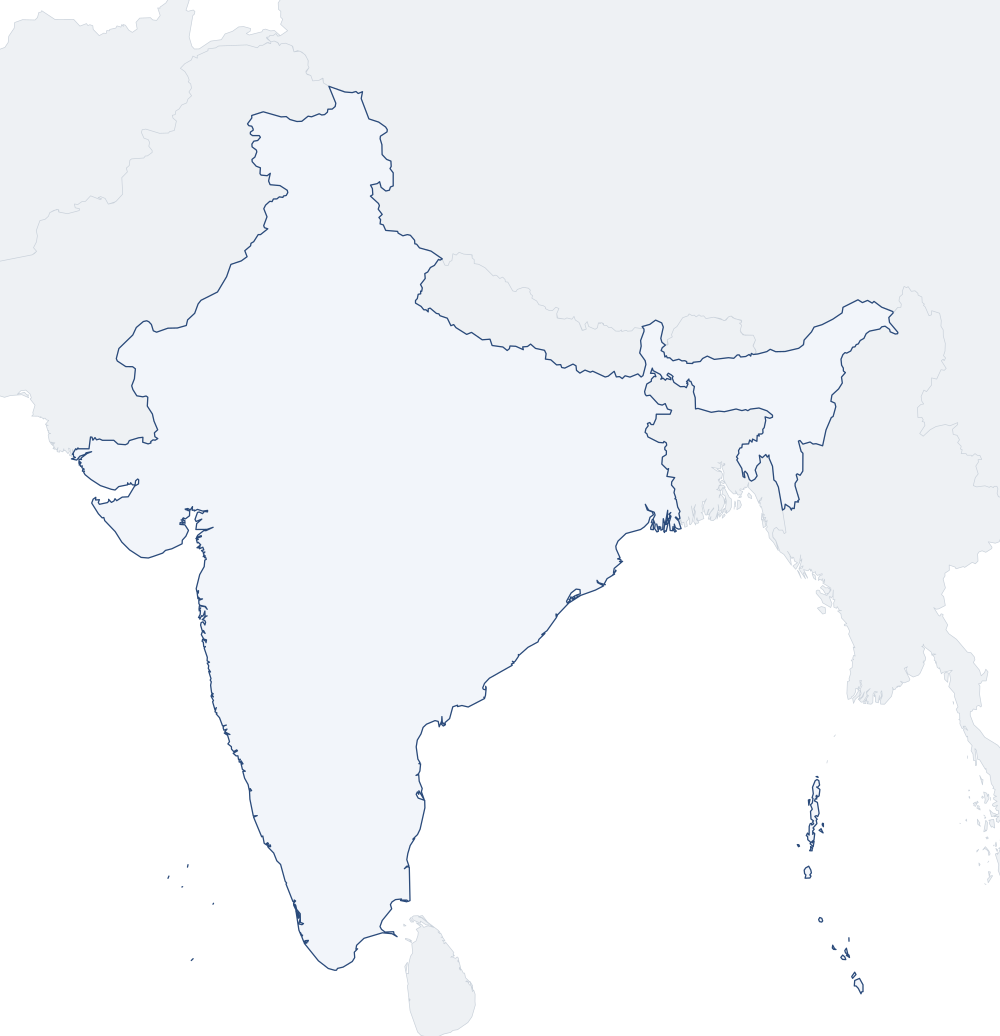
Cultural 37Natural 7Mixed 1
India has 45 World Heritage Sites (37 cultural, 7 natural, 1 mixed), the 6th most in the world. Hover over or tap a dot to see its name; click a name in the list to show it on the map. Listed by year of inscription.
- Ajanta Caves The Ajanta Caves, in Maharashtra, began with Buddhist cave monuments of the 2nd and 1st centuries BC, and many richly decorated caves were added in the Gupta period (5th–6th centuries AD). Their paintings and sculptures are considered masterpieces of Buddhist art and had a wide influence in Asia.
- Ellora Caves The Ellora Caves, near Aurangabad in Maharashtra, are 34 monasteries and temples dug side by side into a basalt cliff over more than 2 km. The sequence of monuments from AD 600 to 1000 includes Buddhist, Hindu and Jain works and shows the religious coexistence of ancient India.
- Agra Fort A Mughal fortress of red sandstone in Agra, India, close to the Taj Mahal. Its walls, about 2.5 km long, enclose palaces, audience halls and mosques of the imperial court, and the fort was a centre of Mughal power.
- Taj Mahal A white marble mausoleum in Agra, India, built between 1631 and 1648 by the Mughal emperor Shah Jahan in memory of his wife. It is regarded as the finest achievement of Islamic art in India.
- Sun Temple, Konârak The Sun Temple at Konârak, on the Bay of Bengal coast in Odisha, was built in the 13th century as a monumental representation of the chariot of the sun god Surya, with 24 decorated wheels and six horses. It is an outstanding example of Odisha-style temple architecture.
- Group of Monuments at Mahabalipuram The monuments at Mahabalipuram, on the Coromandel coast of Tamil Nadu, were carved from rock by the Pallava kings in the 7th and 8th centuries. They are known for the rathas (temples in the form of chariots), cave sanctuaries and giant open-air reliefs, and the Shore Temple is among the early structural stone temples of southern India.
- Kaziranga National Park A park of tall grassland and wetland on the Brahmaputra floodplain in Assam, India. It holds the world's largest population of the one-horned rhinoceros, along with tigers, elephants and wild water buffalo.
- Manas Wildlife Sanctuary A sanctuary in the Himalayan foothills of northern Assam, India, bordering Bhutan, where wooded hills give way to grasslands and tropical forest. It shelters many endangered species, including the tiger, Asian elephant, Indian rhinoceros and pygmy hog.
- Keoladeo National Park A wetland near Bharatpur in Rajasthan, India, once a hunting reserve of the maharajas. It is a major wintering ground for waterbirds from Central Asia and Siberia, and around 360 bird species have been recorded.
- Churches and Convents of Goa Goa was the capital of the Portuguese Indies, and its churches and convents, particularly the Church of Bom Jesus, which holds the tomb of St Francis Xavier, illustrate the spread of Christianity in Asia. Their Manueline, Mannerist and Baroque styles influenced church building across the continent.
- Khajuraho Group of Monuments The temples at Khajuraho, in Madhya Pradesh, were built under the Chandella dynasty at its height between 950 and 1050. About 20 remain, in three groups, belonging to Hinduism and Jainism. They combine architecture and sculpture closely and are noted for their finely carved stonework.
- Group of Monuments at Hampi Hampi, in Karnataka, was the last capital of the Vijayanagara Empire, the last great Hindu kingdom. Between the 14th and 16th centuries its rulers built Dravidian temples and palaces, and the city fell to the Deccan sultanates in 1565.
- Fatehpur Sikri A city built in the later 16th century by the Mughal emperor Akbar, near Agra in Uttar Pradesh, India. It served as the imperial capital for only about ten years, but its palaces and mosques, in a consistent architectural style, survive well.
- Group of Monuments at Pattadakal Pattadakal, in Karnataka, represents the high point of the eclectic art of the Chalukya dynasty in the 7th and 8th centuries, which blended architectural forms of northern and southern India. It has nine Hindu temples and a Jain sanctuary, of which the Virupaksha Temple is the most notable.
- Elephanta Caves The Elephanta Caves are on an island near Mumbai, in a group known as the 'City of Caves', with rock-cut art linked to the cult of Shiva. The large high reliefs in the main cave, especially the three-faced Shiva, are among the finest expressions of Indian art.
- Great Living Chola Temples The Great Living Chola Temples comprise the Brihadisvara temples at Thanjavur and Gangaikondacholisvaram and the Airavatesvara Temple at Darasuram, built by kings of the Chola Empire in the 11th and 12th centuries. They are still in worship and are masterpieces of Dravidian architecture.
- Sundarbans National Park Part of the Ganges delta, covering about 10,000 km2, more than half of it in West Bengal, India and the rest in Bangladesh. It contains the world's largest area of mangrove forest and is home to the Bengal tiger and other endangered species.
- Nanda Devi and Valley of Flowers National Parks Two adjoining areas in the western Himalaya of Uttarakhand, India: the Nanda Devi massif and the Valley of Flowers. The valley is known for its alpine meadows and endemic flowers, and the high country shelters rare animals such as the snow leopard and Asiatic black bear.
- Buddhist Monuments at Sanchi A group of Buddhist monuments on a hill about 40 km from Bhopal, Madhya Pradesh, India, among the oldest Buddhist structures to survive in the country. Begun in the 3rd century BCE under Ashoka, it includes stupas, pillars, temples and monasteries, and the carved gateways of the Great Stupa are well known.
- Humayun's Tomb, Delhi Humayun's Tomb in Delhi, built in 1570, is the first garden-tomb on the Indian subcontinent. It inspired several major architectural innovations that culminated in the Taj Mahal.
- Qutb Minar and its Monuments, Delhi The Qutb Minar stands a few kilometres south of Delhi and was built in the early 13th century. This red sandstone tower is 72.5 m high, with alternating angular and rounded flutings. The surrounding archaeological area includes early mosques, tombs and an iron pillar, and shows the architecture of the early Delhi Sultanate.
- Mountain Railways of India Three railways in the hills of India: the Darjeeling Himalayan Railway, the Nilgiri Mountain Railway and the Kalka–Shimla Railway. The Darjeeling line opened in 1881, and the group shows ingenious engineering solutions for building lines through steep terrain.
- Mahabodhi Temple Complex at Bodh Gaya The Mahabodhi Temple Complex at Bodh Gaya in Bihar is one of the four holy sites associated with the life of the Buddha, and marks the place of his Enlightenment. The first temple was built by Emperor Ashoka in the 3rd century BC, and the present temple dates from the 5th–6th century, one of the earliest brick structures in India.
- Rock Shelters of Bhimbetka A group of sandstone rock shelters in the foothills of the Vindhya Range, Madhya Pradesh, India, in five clusters with some 700 shelters. Their paintings span from the Palaeolithic into historical times and record prehistoric life in South Asia.
- Champaner-Pavagadh Archaeological Park Champaner-Pavagadh Archaeological Park in Gujarat contains largely unexcavated archaeological, historic and living heritage sites in a hill landscape, including prehistoric sites, a hill fortress of an early Hindu capital, and the remains of a 16th-century capital of the Gujarat sultanate with mosques and palaces.
- Chhatrapati Shivaji Terminus (formerly Victoria Terminus) A railway terminus in Mumbai, India, formerly Victoria Terminus, and an outstanding example of Victorian Gothic Revival architecture blended with Indian traditional elements. Completed in the late 19th century, it remains a busy station.
- Red Fort Complex The Red Fort Complex was the palace fort of Shahjahanabad, the new capital of the Mughal emperor Shah Jahan, and is named for its massive red sandstone walls. It adjoins the older Salimgarh fort. Its architecture combines Persian, Timurid and Indian traditions and influenced later buildings and gardens in India.
- The Jantar Mantar, Jaipur The Jantar Mantar in Jaipur is an astronomical observation site built in the early 18th century, with about 20 main fixed instruments. They are monumental masonry versions of known instruments, many with distinctive forms, and reflect the astronomical knowledge and cosmological ideas of the period.
- Western Ghats The Western Ghats run along the west coast of India and are older than the Himalaya. Their high montane forests influence the Indian monsoon, and the range has many endemic plants and animals, making it one of the world's richest areas of biodiversity.
- Hill Forts of Rajasthan The serial property in Rajasthan includes six forts at Chittorgarh, Kumbhalgarh, Sawai Madhopur, Jhalawar, Jaipur and Jaisalmer. Their varied architecture, with some walls up to 20 km in circumference, bears witness to the power of the Rajput kingdoms.
- Great Himalayan National Park Conservation Area Great Himalayan National Park, in Himachal Pradesh in the western Himalaya, covers 90,540 ha of high alpine peaks, meadows and riverine forests, including glacial and snow melt sources of several rivers. It protects a wide range of Himalayan plants and animals, including habitat for threatened species such as the western tragopan.
- Rani-ki-Vav (the Queen’s Stepwell) at Patan, Gujarat A stepwell on the Saraswati River at Patan, Gujarat, India, built in the 11th century as a memorial to a king. Stepwells are a distinctive form of subterranean water storage on the Indian subcontinent, and this one is notable for its tiered design and sculpted panels.
- The Architectural Work of Le Corbusier, an Outstanding Contribution to the Modern Movement This transnational serial property comprises 17 works by Le Corbusier in seven countries: Argentina, Belgium, France, Germany, India, Japan and Switzerland. They reflect the new architectural ideas of the 20th-century Modern Movement and its spread across the world.
- Archaeological Site of Nalanda Mahavihara at Nalanda, Bihar The Nalanda Mahavihara site, in Bihar in north-eastern India, contains the archaeological remains of a monastic and scholastic institution dating from the 3rd century BCE to the 13th century CE, including stupas, shrines, residential and educational buildings and works of art. It was one of the most important Buddhist centres of learning in ancient India, attracting students from many lands, among them the Chinese monk Xuanzang.
- Khangchendzonga National Park Khangchendzonga National Park, in Sikkim in northern India, lies at the heart of the Himalaya and includes valleys, lakes, glaciers, snow-capped peaks and ancient forests. Mount Khangchendzonga, the third highest mountain in the world, has sacred significance in local beliefs.
- Historic City of Ahmadabad The walled city of Ahmadabad, in Gujarat, was founded by Sultan Ahmad Shah in the 15th century on the east bank of the Sabarmati river. It has a rich heritage from the sultanate period, including the Bhadra citadel, the fort walls and gates, many mosques and tombs, and dense neighbourhoods of traditional timber houses.
- Victorian Gothic and Art Deco Ensembles of Mumbai In the second half of the 19th century Mumbai, by then a global trading centre, carried out an ambitious urban plan that produced ensembles of public buildings around the Oval Maidan, first in Victorian Gothic and later in Art Deco style. Both styles incorporated Indian elements and reflect the city's growth.
- Jaipur City, Rajasthan Jaipur, in the north-western Indian state of Rajasthan, was founded in 1727 by Sawai Jai Singh II. Unlike other cities in the region built on hilly ground, it was laid out on a plain according to a grid plan, combining ancient Hindu urban ideas with Mughal and Western influences.
- Kakatiya Rudreshwara (Ramappa) Temple, Telangana The Rudreshwara or Ramappa Temple is in the village of Palampet in Telangana, about 200 km north-east of Hyderabad. It is the main Shiva temple of a walled complex built in the Kakatiya period (1123–1323 CE), and is noted for its fine sculpture and its tower of lightweight bricks.
- Dholavira: a Harappan City Dholavira, a Harappan city, lies on the arid island of Khadir in Gujarat and was occupied from about 3000 to 1500 BCE. It was the southern centre of the Harappan civilisation and is one of the best-preserved urban settlements of the period, noted for its planning and elaborate water management.
- Santiniketan Santiniketan, in rural West Bengal, was established in 1901 by the poet and philosopher Rabindranath Tagore as a residential school and art centre. It drew on ancient Indian traditions and a vision of human unity beyond religious and cultural divisions, and influenced modern art and education in India.
- Sacred Ensembles of the Hoysalas This serial property includes the three most representative Hoysala temple complexes in Karnataka, southern India — Belur, Halebidu and Somanathapura — dating from the 12th to 13th centuries. The temples are known for their star-shaped plans and densely carved surfaces.
- Moidams – the Mound-Burial System of the Ahom Dynasty Moidams are the royal necropolis of the Tai-Ahom in the foothills of the Patkai Ranges in eastern Assam. Over 600 years the Ahom built these burial mounds in harmony with the hills, forests and waters, and they reflect a distinctive funerary tradition.
- Maratha Military Landscapes of India The property includes twelve major forts, mostly in Maharashtra and one in Tamil Nadu, among them Raigad, Shivneri and Sindhudurg. They were built, adapted or expanded by the Marathas between the late 17th and early 19th centuries, and use hills, coasts and other terrain to illustrate Maratha military strategy.
- Ancient Buddhist Site of Sarnath A site near Varanasi, Uttar Pradesh, India, where the Buddha is believed to have given his first sermon. It preserves the remains of stupas, monasteries and an Ashokan pillar, tracing the development of Buddhism from the 3rd century BCE.