 National Parks of China
Overview
| Designation | National Park of China (first batch) |
| Province | Heilongjiang |
| Location | Wudalianchi (formerly Dedu County), Heilongjiang |
| Latitude, longitude | 48.7, 126.1 Google Maps |
| Nearby sites | Dazhan River, The Eight Ministries and Jingyue Lake, Changchun, Zhalantun, Sun Island |
| Highlights | Volcanoes |
| Area | 720 km² |
| Elevation | 300 m |
| Nearby cities | Heilongjiang, Qiqihar, Harbin, Changchun, Jilin City |
| Themes | Volcanoes, Lakes, Stamps |
About
Wudalianchi (“Five Connected Lakes”) in Heilongjiang is named for five lakes dammed by lava and linked to one another. The area has 14 volcanoes; the last eruptions were in the 18th century.
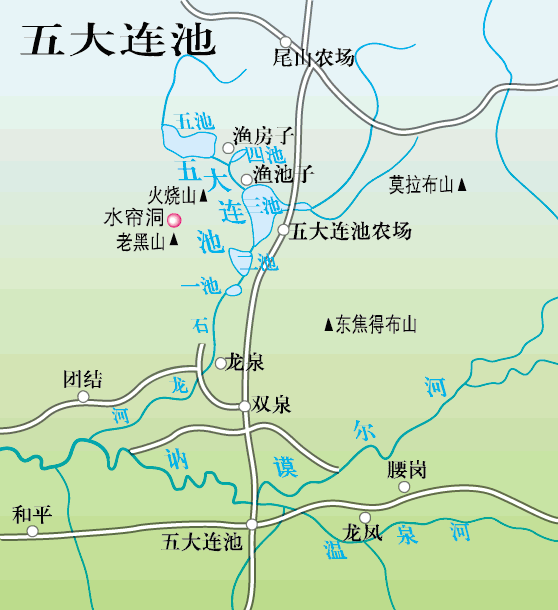
Wudalianchi lies on the Nemor River south-west of the Lesser Khingan range. In 1719–1721 the eruptions of Laohei Mountain and Huoshao Mountain blocked the Bai River with lava, forming a chain of five lakes, the First to Fifth Pools, which give the place its name. Fourteen volcanic cones stand in rows; Laohei and Huoshao are the youngest volcanoes in China, with intact craters, stone seas and lava plateaus, a “natural volcano museum”. The volcanic mineral springs, rich in trace elements, rank among the three great cold springs of the world and have drawn visitors to drink and take cures since the Qing.
It is in the first batch of national parks of China (national scenic areas) named by the State Council in 1982.
Travel tips
Getting there: go by road from Harbin, Qiqihar or Heihe to Wudalianchi city, then on to Yaoquan (Wudalianchi) town, where the scenic area is. There is a local airport, but flights are few.
Getting around: the sights are far apart and cannot be linked on foot. Private cars are not allowed into the Laohei Shan area; change to the park shuttle buses.
Laohei Shan and the Stone Sea: a path climbs to the crater rim, and boardwalks cross the lava field below.
Ice caves: lava tubes such as the Crystal Palace stay icy all year and are cold even in summer; bring warm clothes. Some caves are at times closed.
Time: allow two days for the main sights.
Season: summer, June to September, is best. Winter is severe and some sights close, but the Wenbo pools do not freeze and there is rime frost around them.
Where to stay: in Yaoquan town, which has many sanatoriums and hotels.
Caution: lava rock is sharp; wear sturdy shoes and stay on the paths.
Main sights
Laohei Mountain: 516 m, the highest and youngest of the fourteen; a path climbs to the rim of the crater, over 100 m deep. Below lies the Stone Sea, a plain of black cooled lava.
Huoshao Mountain: north-east of Laohei; the crater can be entered, and the spatter cones and “gas dishes” on the lava surface are rare volcanic forms.
Longmen Stone Fortress: heaped lava of an ancient volcano with fields of tumbled and ropy lava.
Wenbo: lakes fed by springs welling from beneath the lava plateau, 4 to 8 °C all year and never freezing.
Yaoquan Mountain and the North and South Drinking Springs: Yaoquan is the smallest volcano; the springs at its foot can be drunk straight from the source, and Yaoquan Lake and town form the spa district.
Third Pool and White Dragon Lake: the Third Pool is the largest of the five, with boat trips; the lakes are divided by lava, black rock against white water.
White Dragon Cave and Crystal Palace: lava tunnels with ice all year, columns and icicles.
Stamps
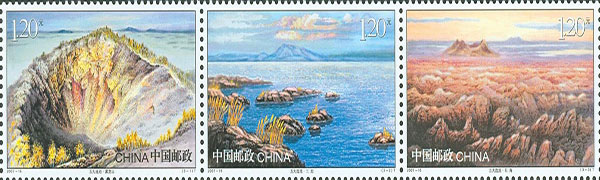
On 19 June 2007 China Post issued “Wudalianchi”, three stamps: Black Dragon Mountain, the Third Lake and the sea of stones.
Map
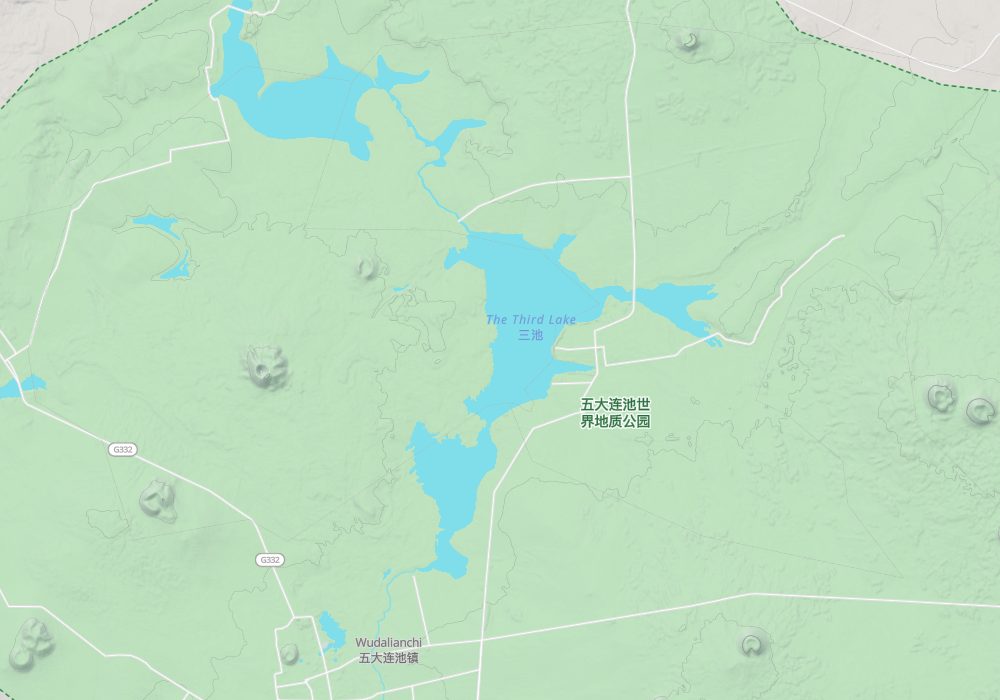
© OpenStreetMap contributors · terrain © Copernicus · Map credits