 National Parks of China
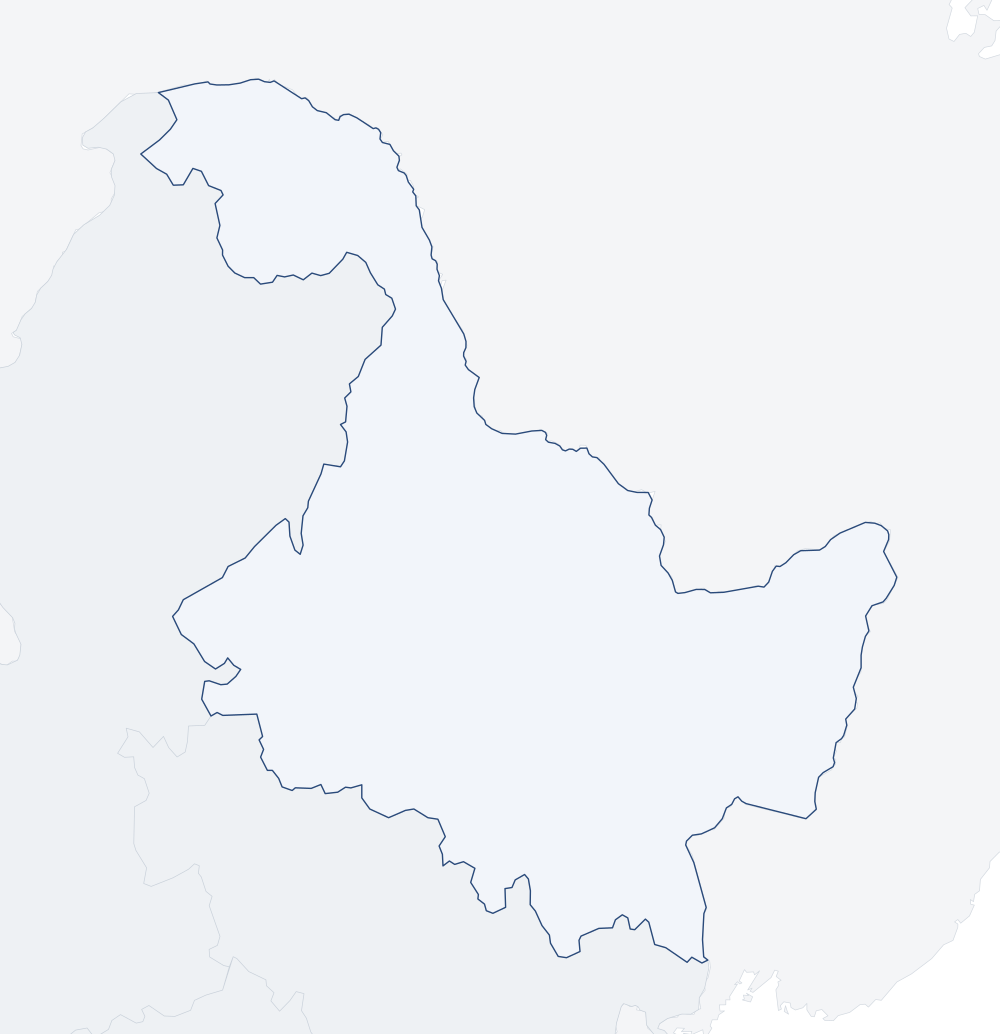
57 Major Historical and Cultural Sites Protected at the National Level in Heilongjiang (batches 1–8, named by the State Council 1961–2019; 1 of them cross provincial borders, such as the Great Wall and the Grand Canal). Dots are coloured by category; click one to jump to its entry. See also Heilongjiang and all provinces.
Batch:
Harbin (15)
- Jin Shangjing Huiningfu Site 金上京会宁府遗址Ancient sites · second batch (1982)Capital site from the first year of the Shouguo reign of Emperor Taizu of Jin (1115) to the first year of the Zhenyuan reign (1153), made up of northern and southern cities and an imperial city.
- Yagou Rock Carvings 亚沟石刻Cave temples and stone carvings · third batch (1988)Jurchen cliff carvings of the Jin dynasty depicting a man and a woman; the man is shown as a warrior holding a short sword.
- European-Style Building at No. 1 Yiyuan Street, Harbin 哈尔滨颐园街一号欧式建筑Modern historic sites · fourth batch (1996)Residential building in French classical revival style built in 1922, originally the home of a Russian timber merchant.
- Saint Sophia Cathedral 圣索菲亚教堂Modern historic sites · fourth batch (1996)The largest Orthodox church in the Far East, built from 1923 to 1932 and now the Harbin Architecture Art Museum.
- Harbin Confucian Temple 哈尔滨文庙Modern historic sites · fourth batch (1996)Confucian temple begun in the 15th year of the Republic (1926) and completed in 1929, built at the urging of the chief administrator of the Eastern Provinces Special Region of the time.
- Site of the Harbin Moscow Market 哈尔滨莫斯科商场旧址Modern historic sites · sixth batch (2006)Listed as a national key unit under this name, the building of the Heilongjiang Provincial Museum, first built in 1904 as the Moscow Market.
- Site of Unit 731 of the Japanese Imperial Army 侵华日军第七三一部队旧址Modern historic sites · sixth batch (2006)The site of Japanese Unit 731 from 1936 to 1945, now an exhibition hall of crimes, with a floor area of 9,997 square meters.
- Wangbozishan Site Group 王脖子山遗址群Ancient sites · seventh batch (2013)A site group from the Neolithic to the Han dynasty, in Bayan County.
- Qinghua Ancient Mountain Fortress Site 庆华古山寨遗址Ancient sites · seventh batch (2013)A mountain fortress site from the Warring States to the Han dynasty, in Bin County.
- Tuchengzi Site 土城子遗址Ancient sites · seventh batch (2013)A Jin-dynasty garrison town, one of the larger ancient cities along the lower Mudan River.
- Acheng Mosque 阿城清真寺Ancient buildings · seventh batch (2013)A Qing-dynasty mosque in Acheng District.
- Modern Hotel 马迭尔宾馆Modern historic sites · seventh batch (2013)A hotel built in 1906 and opened in 1913, on Zhongyang Street.
- Harbin Jewish Sites 哈尔滨犹太人活动旧址群Modern historic sites · seventh batch (2013)A series of 14 buildings left by Jews in Harbin in the first half of the 20th century.
- Site of the Manchukuo Harbin Police Bureau 伪满洲国哈尔滨警察厅旧址Modern historic sites · seventh batch (2013)The site of the police bureau in the Manchukuo period, converted into the Northeast Martyrs' Memorial Hall.
- Site of the Northeast Democratic Allied Army Front Command 东北民主联军前线指挥部旧址Modern historic sites · seventh batch (2013)The site of the front command of the Northeast Democratic Allied Army in 1946, originally a private residence begun in 1917.
Qiqihar (9)
- Angangxi Site 昂昂溪遗址Ancient sites · third batch (1988)Neolithic site with 3 sites and 39 find spots.
- Puyu Route Ancient City Site 蒲与路故城遗址Ancient sites · third batch (1988)Site of the city of Puyu Route in the Jin dynasty, oval in plan, first surveyed in 1930 and excavated in the 1970s.
- Tazi City Site 塔子城址Ancient sites · sixth batch (2006)The ancient city of the seat of Taizhou of the Liao, built in the mid-Liao, with three ancient building sites inside and surviving granite and white marble column bases.
- Bukui Mosque 卜奎清真寺Ancient buildings · sixth batch (2006)The largest and oldest mosque in Heilongjiang, divided into east and west mosques that were merged in 1958.
- Laolongtou Site 老龙头遗址Ancient sites · seventh batch (2013)A site of the Western Zhou to Spring and Autumn period found in 1982, from which a group of novel-shaped artifacts was excavated.
- Site of the Heilongjiang Military Governor's Office 黑龙江督军署旧址Modern historic sites · seventh batch (2013)The site of the highest military and administrative authority in Heilongjiang in the early Republic.
- Site of the Heilongjiang Provincial Library 黑龙江省图书馆旧址Modern historic sites · seventh batch (2013)The site of the provincial library of 1930, in Longsha District.
- Honghe Site 洪河遗址Ancient sites · eighth batch (2019)A late Neolithic site on the right bank of the Nenjiang River, about 4,000 years old, of the Angangxi Culture, with a large moated settlement.
- Site of Unit 516 of the Japanese Invading Army 侵华日军第516部队遗址Modern historic sites · eighth batch (2019)Former site of the Japanese "516" chemical-gas unit, in Tiefeng District, later used as a glass factory and homes.
Mudanjiang (8)
- Shangjing Longquanfu Site of the Bohai Kingdom 渤海国上京龙泉府遗址Ancient sites · first batch (1961)Site of Longquanfu, the capital of the Tang-era Bohai Kingdom, commonly called Shangjing City, modeled on Tang Chang'an with an outer city, inner city and palace city; it became the capital in 755.
- Wupaishan City Site 五排山城址Ancient sites · sixth batch (2006)A mountain city site from the Warring States to the Han dynasty, in Dongning City.
- Xiaosifangshan City Site 小四方山城址Ancient sites · sixth batch (2006)A city site from the Warring States to the Jin dynasty, in Muling City.
- Mudanjiang Border Wall 牡丹江边墙Ancient buildings · sixth batch (2006)A military border wall built by Balhae, the Liao and the Jin; three discontinuous sections survive.
- Chinese Eastern Railway Building Complex 中东铁路建筑群Modern historic sites · sixth batch (2006)A group of buildings along the railway network built by the Russian Empire in the Northeast; the railway was begun in 1898, in the Hailin area.
- Tuanjie Site 团结遗址Ancient sites · seventh batch (2013)Its upper layer holds Balhae-period remains and its lower layer holds Warring States to Han "Woju" culture remains, which are therefore named the "Tuanjie culture."
- Old City Site of the Ningguta General's Seat 宁古塔将军驻地旧城遗址Ancient sites · seventh batch (2013)The seat of the Ningguta general in the early Qing, a square stone city about 171 m on each side; the general's office moved to present Ning'an in 1666 and again to Jilin Ula in 1676.
- Former Northeast Old Aviation School of the People's Air Force 人民空军东北老航校旧址Modern historic sites · eighth batch (2019)Former site of the aviation school of the Northeast Democratic Allied Army, which moved in turn among Mudanjiang, Mishan, Changchun and other places.
Daqing (4)
- Baijinbao Site 白金宝遗址Ancient sites · fourth batch (1996)The type site of the Baijinbao Culture, a Bronze Age site of around 900 BC on the left bank of the Nenjiang River, discovered in 1974.
- Daqing's First Oil Well 大庆第一口油井Modern historic sites · fifth batch (2001)Also called Songji Well No. 3, the discovery well of the Daqing Oilfield, drilled to 1,461.76 m, the first strike in the oil search in the Songliao Basin.
- Xiaolaha Site 小拉哈遗址Ancient sites · seventh batch (2013)The type site of the Xiaolaha Culture; the first site on the Songnen Plain with three deposit layers of the Neolithic, Bronze and early Iron Age, yielding bone net hooks and clay net sinkers.
- Site of the Iron Man's First Well 铁人一口井井址Modern historic sites · seventh batch (2013)The first oil well drilled by Wang Jinxi, the "Iron Man" of Daqing, and his team, originally named Sa-55 Well.
Heihe (4)
- Aihun New City Site 瑷珲新城遗址Modern historic sites · fifth batch (2001)The city of Heilongjiang built in the 23rd year of Kangxi of the Qing (1684), also called Aihun New City; in Daur it means "wooden city".
- Oroqen Shenquan Altar Site 鄂伦春神泉祭坛遗址Ancient sites · seventh batch (2013)A Qing-dynasty altar site in Xunke County.
- Secret Camp Site of the Third Route Army of the Northeast Anti-Japanese Allied Army at Chaoyang Mountain 朝阳山东北抗联第三路军密营遗址Modern historic sites · eighth batch (2019)The site of a secret camp of the Third Route Army of the Northeast Anti-Japanese Allied Army in 1939-1941, in Wudalianchi City.
- Site of the Heilongjiang Provincial Work Committee and Government of the Communist Party 中共黑龙江省工作委员会和省政府旧址Modern historic sites · eighth batch (2019)The site of the Heilongjiang Provincial Work Committee of the Communist Party and the provincial government from 1945 to 1949, in Bei'an City.
Jixi (4)
- Daobeishan Cemetery 刀背山墓地Ancient tombs · sixth batch (2006)A Neolithic cemetery on a terrace on the west slope of Daobeishan, with four stone-heaped tombs.
- Xinkailiu Site 新开流遗址Ancient sites · eighth batch (2019)The representative site of the Xinkailiu Culture, on the shore of Xingkai Lake; in 1972 excavation yielded stone and bone tools, net-patterned pottery, fish cellars and tombs, and a bone-carved eagle head.
- Guokuishan Mountain City Site 锅盔山山城遗址Ancient sites · eighth batch (2019)A Tang-dynasty mountain city site in Jidong County.
- Jixi Mass Grave Site 鸡西万人坑遗址Modern historic sites · eighth batch (2019)The burial ground of miners who died under the Japanese policy of 'exchanging people for coal' during their occupation of Jixi, with a human-burning furnace and a crimes exhibition hall nearby.
Jiamusi (3)
- Walihuotun City Site 瓦里霍吞城址Ancient sites · sixth batch (2006)A city site from the Liao to the Qing dynasty, in Huachuan County.
- Taowen Wanhu Fu Ancient City 桃温万户府故城Ancient sites · sixth batch (2006)The ancient city of the Taowen Military and Civil Ten-thousand-household Office of the Yuan, also called Shuanghe ancient city, originally the ancient city of the Pennuli state, one of the Five Nations of the Liao.
- Mangjita Station Ancient City 莽吉塔站故城Ancient sites · sixth batch (2006)The ancient city site of a Ming-dynasty post station, in Fuyuan City.
Hegang (2)
- Aolimi City Site 奥里米城址Ancient sites · fifth batch (2001)Tribal fortress of the Aolimi state, one of the Five Nations tribes of the Liao and Jin, seat of the chieftain, in Suibin County.
- Zhongxing City Site 中兴城址Ancient sites · seventh batch (2013)The tribal fortress of the Aolimi state, one of the Five Nations tribes of the Liao and Jin, on Gaoli Island in Suibin County.
Suihua (2)
- Bali City Site 八里城遗址Ancient sites · fifth batch (2001)Site of a Jin-dynasty military town eight li around, commonly called Bali City; one view holds it to be the Jin city of Zhaozhou, but this is disputed.
- Haojiachengzi Ancient City Site 郝家城子古城遗址Ancient sites · seventh batch (2013)A Jin-dynasty ancient city site in Lanxi County.
Shuangyashan (2)
- Yanwodao City Site 雁窝岛城址Ancient sites · sixth batch (2006)A Sui-dynasty city site in Baoqing County.
- Xiaonanshan Site 小南山遗址Ancient sites · eighth batch (2019)Over 200 jade pieces, including jue, rings, tubes and axes, were found here; dating back about 9,000 years, it is one of the earlier jade remains in China and was among the top ten new archaeological discoveries in China in 2019.
Across several cities (3)
- Han-Wei Period Sites of the Sanjiang Plain 三江平原汉魏时期遗址Ancient sites · fifth batch (2001)Concentrated area of Han-Wei city sites and sites in the central and western Sanjiang Plain, with over a thousand found, concentrated around Jiamusi and Shuangyashan.
- Japanese Fortifications in Northeast China 侵华日军东北要塞Modern historic sites · sixth batch (2006)Groups of fortresses built by Japanese forces on the northeast frontier from 1934 to 1945, distributed in Dongning, Hulin, Sunwu and other places.
- Merjen to Mohe Ancient Post Road 墨尔根至漠河古驿站驿道Ancient sites · seventh batch (2013)A Qing-dynasty post road, part of the more than 700 km Merjen ancient post road; Merjen is the old name of Nenjiang County.
Across provinces (1)
- Jin Border Trench Site 金界壕遗址Ancient sites · fifth batch (2001)Trench works built by the Jin dynasty to defend against northern tribes, also called the Jin Great Wall, about 1,680 kilometers long, mainly in Inner Mongolia and also found in Heilongjiang, Hebei and other places.