 National Parks of China
Overview
| Designation | National Park of China (first batch) AAAAA tourist attraction |
| Province | Hebei |
| Location | Coast of Hebei |
| Latitude, longitude | 39.8, 119.5 Google Maps |
| Highlights | Beaches; summer resort |
| Top sights | Beidaihe beach, the Great Wall at Shanhaiguan |
| Nearby cities | Hebei, Tianjin, Dalian |
| Nearby sites | Xingcheng Seaside, Mount Pan, Chengde Mountain Resort and its Outlying Temples, Dalian Coast and Lüshunkou, Jinshitan |
| Themes | Sea, Beaches, Birds, City walls, Cities, Hills, Stamps |
Beidaihe
Beidaihe, on the Bohai coast of eastern Hebei, is a district of Qinhuangdao and one of China’s four great summer resorts. Its sights are Pigeon Nest, the Middle Beach, Lianfeng Hill and Tiger Rock.
Shanhaiguan
Shanhaiguan, also called Yuguan, lies north-east of the city where the Yan Mountains meet the Bohai Gulf. It is the eastern end of the Great Wall, the “First Pass under Heaven”. Nearby are the Old Dragon’s Head, where the wall enters the sea, the wall on Jiaoshan, Yansai Lake and the Temple of Meng Jiangnü, famous for a couplet made of repeated characters that can be read several ways: “the sea tide rises, every morning it rises, rises and falls; the clouds swell, often they swell, swell and disperse”.
Shanhaiguan was a military stronghold for centuries. At the end of the Ming, when the rebel Li Zicheng seized his concubine Chen Yuanyuan, the general Wu Sangui opened the pass to the Manchu army to crush Li: “a rage for a beauty that shook the crown”.
Stamps
In 2001 China Post issued “Beidaihe”, four stamps: Pigeon Nest, the Middle Beach, Lianfeng Hill and Tiger Rock.




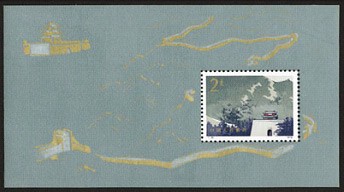
The 1979 souvenir sheet T.38M “The Great Wall” (2 yuan) shows the wall at Shanhaiguan.
In literature
Cao Cao, “Viewing the Sea”: “East I climb Jieshi to gaze on the blue sea. How the waters heave, how the island hills stand tall; trees grow thick and the hundred grasses flourish. The autumn wind sighs and great waves rise; sun and moon seem to travel out of it, the shining river of stars to rise from its depths. How fortunate I am; I sing to tell my heart.”
Nalan Xingde, “Everlasting Longing”: “A stage of mountains, a stage of rivers, I travel toward the far side of Yuguan; deep in the night, a thousand tents alight. A watch of wind, a watch of snow, shatter the homesick heart so dreams will not come; at home there was never such a sound.”