 National Parks of China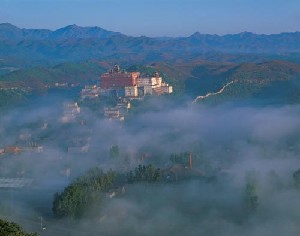
Overview
| Designation | UNESCO World Heritage (cultural, 1994) National Park of China (first batch) AAAAA tourist attraction |
| Province | Hebei |
| Location | Chengde, Hebei |
| Latitude, longitude | 41.0, 117.9 Google Maps |
| Nearby cities | Beijing, Tianjin |
| Highlights | Imperial summer palace; Tibetan Buddhist temples |
| Top sights | The Putuo Zongcheng Temple, Club Rock (Bangchui Hill) |
| Nearby sites | Mount Pan, Badaling & Thirteen Tombs of the Ming Dynasty, Beidaihe, Qinhuangdao, The Forbidden City (Palace Museum), Beijing, The Temple of Heaven, Beijing, The Summer Palace, Beijing, Beijing Central Axis |
| Themes | Palaces, Gardens, Temples, Buddhism, Hills, Cities, Historic buildings, Stamps |
About
In 1994 UNESCO inscribed the Mountain Resort and its outlying temples on the World Heritage List.
It is in the first batch of national parks of China (national scenic areas) named by the State Council in 1982.
Travel tips
Getting there: Chengde South station on the Beijing–Harbin high-speed line is about an hour from Beijing Chaoyang; it lies some way from the city centre, with buses and taxis into town. Regular trains also run to Chengde station. The Mountain Resort is in the north of the city, with the Outlying Temples to its east and north.
Mountain Resort: entry must be booked online in advance under your real name. The palace area at the south end can be seen on foot; the lakes, plain and hills to the north cover a large area, and sightseeing buses and boats run inside.
Outlying Temples: Puning Temple, the Putuo Zongcheng Temple and the Temple of Sumeru Happiness and Longevity are close together and easy to see in one trip; Puren Temple, Anyuan Temple and Pule Temple lie to the east. Each temple is entered separately.
Bangchui Peak: east of the city, reached by an open chairlift, with a view of the peak and the town.
Time: one day for the Mountain Resort and one for the temples.
Season: summer is cool and is the main season; winter is cold and the lakes are bare.
Where to stay: in Chengde city; the area near the resort's south gate is convenient.
The Mountain Resort
The Mountain Resort at Chengde, Hebei, also called the Chengde Detached Palace or the Rehe Travelling Palace, covers 5.6 km². It was the summer palace of the Qing emperors and is the largest imperial garden in China.
It was built between 1703 and 1792 and is divided into a palace area and a garden area, the latter made up of lakes, plains and hills. The hilly west and north are cooler than the city and include Club Rock and Toad Rock.
The Eight Outer Temples
The temples north-east of the resort are known collectively as the Eight Outer Temples. Twelve were built and seven survive, the most famous being the Putuo Zongcheng Temple, nicknamed the Little Potala (see the Potala Palace). The seven are the Puren, Puning, Anyuan, Pule, Putuo Zongcheng, Shuxiang and Xumi Fushou temples; the five lost are the Pushan, Puyou and Guang’an temples, the Arhat Hall and the Kuixing Tower.
Stamps
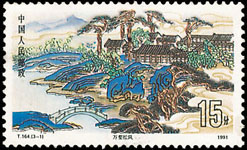
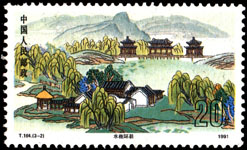
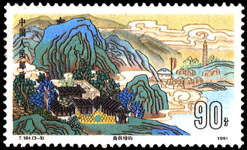
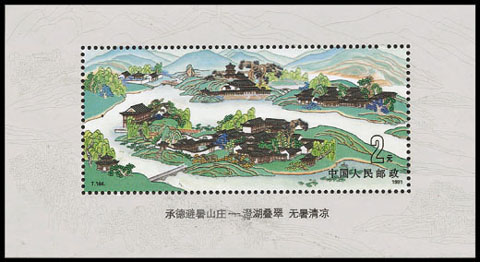
In 1991 China Post issued T.164 “Chengde Mountain Resort”, three stamps: Pines in Ten Thousand Valleys (15 fen), Water Pavilion among Greenery (20 fen) and Green Maples on the Isle (90 fen), with a 2-yuan souvenir sheet.
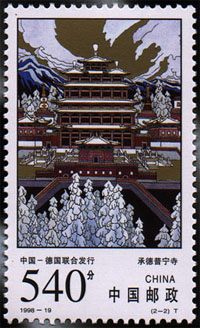
On 20 August 1998 China and Germany jointly issued 1998-19, “Puning Temple and the Würzburg Residence”, two stamps.
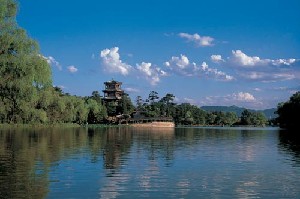
More photos
Map
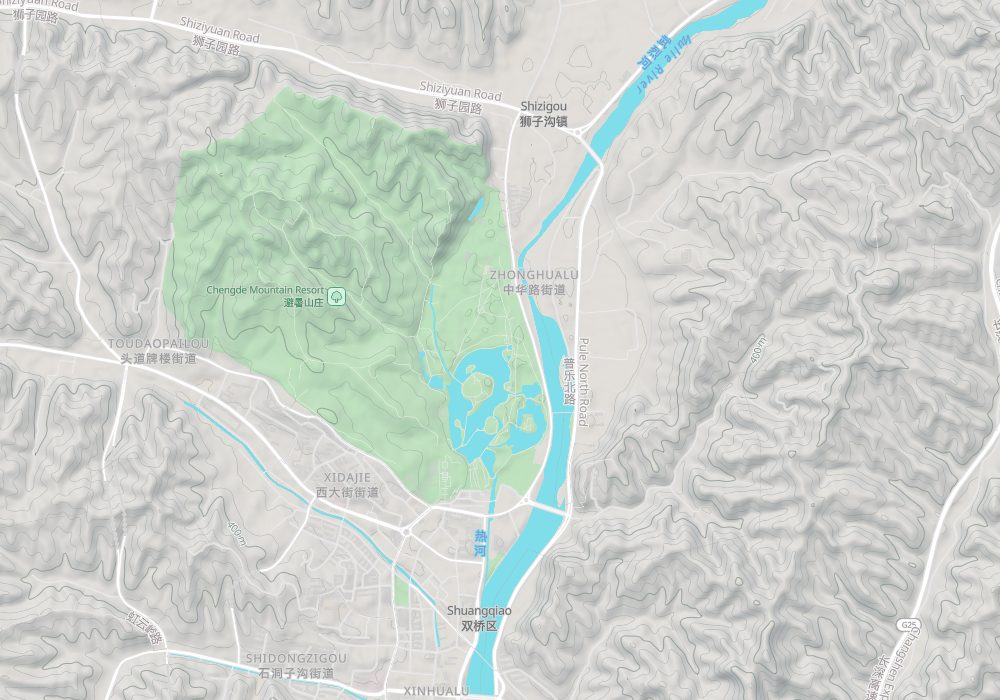
© OpenStreetMap contributors · terrain © Copernicus · Map credits