National Parks of China
Overview
| Designation | UNESCO World Heritage (cultural, 1998) AAAAA tourist attraction |
| Province | Beijing |
| Location | Haidian District, north-west Beijing |
| Latitude, longitude | 40.0, 116.3 Google Maps |
| Nearby cities | Tianjin |
| Highlights | Imperial garden |
| Top sights | Longevity Hill, Kunming Lake |
| Area | 3 km² |
| Nearby sites | Badaling & Thirteen Tombs of the Ming Dynasty, The Forbidden City (Palace Museum), Beijing, The Temple of Heaven, Beijing, Chengde Mountain Resort and its Outlying Temples, Mount Pan, Beijing Central Axis, Stone Flower Cave |
| Themes | Lakes, Gardens, Pagodas & towers, Palaces, Historic buildings, Metropolises, Culture & history, Stamps, Banknotes & coins |
About
The Summer Palace (Yiheyuan), originally the Garden of Clear Ripples, lies at the foot of the Western Hills in Haidian District, north-west Beijing. It was built in the Qianlong reign of the Qing dynasty and rebuilt under the Guangxu Emperor. Centred on Longevity Hill and Kunming Lake and covering about 3 km², it is a large imperial garden.
Longevity Hill stands on the north shore of Kunming Lake and is divided into a front and a back hill. On the front hill are the East Palace Gate, the Hall of Benevolence and Longevity, the great theatre of the Garden of Virtue and Harmony, the Long Corridor, the Hall of Dispelling Clouds, the Tower of Buddhist Incense, the Sea of Wisdom and the Marble Boat. On the back hill are Suzhou Street and the Garden of Harmonious Interest.
Nanhu Island, in the southern part of the lake, is joined to the east dyke by the Seventeen-Arch Bridge.
The east and west dykes of Kunming Lake imitate the Bai and Su causeways of West Lake in Hangzhou; like the Su Causeway, the west dyke carries six bridges.
Travel information
Admission: 20 yuan in low season, 30 yuan in high season (2007).
Stamps and banknotes
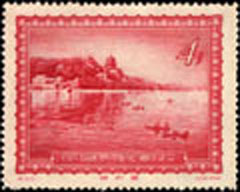
The first stamp of the 1956 set S15 “Scenic Spots of the Capital” shows the Summer Palace.
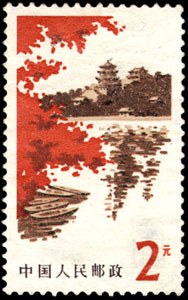
The second stamp of the 1979 definitive set R20 “Scenes of Beijing” shows the Summer Palace.
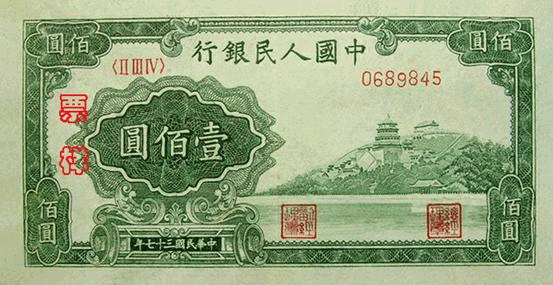
Some varieties of the 20-, 100- and 200-yuan notes of the first series of renminbi (1949) show Longevity Hill.