National Parks of China
Overview
| Designation | UNESCO World Heritage (cultural, 1987) AAAAA tourist attraction |
| Province | Beijing |
| Location | Centre of Beijing |
| Latitude, longitude | 39.9, 116.4 Google Maps |
| Nearby cities | Beijing, Tianjin |
| Highlights | Imperial palace of the Ming and Qing dynasties |
| Top sights | Tian’anmen, the Three Great Halls, the corner towers, the Hall of Mental Cultivation, the Imperial Garden, the Treasure Gallery |
| Area | 720,000 m² |
| Nearby sites | The Temple of Heaven, Beijing, The Summer Palace, Beijing, Badaling & Thirteen Tombs of the Ming Dynasty, Chengde Mountain Resort and its Outlying Temples, Mount Pan, Beijing Central Axis, Stone Flower Cave |
| Themes | Palaces, Historic buildings, Metropolises, Gardens, Museums, Stamps, Banknotes & coins |
The Forbidden City
The Palace Museum in Beijing, commonly called the Forbidden City (Zijincheng), was built in the early 15th century in the Yongle reign of the Ming emperor Zhu Di. Covering 720,000 m² with 150,000 m² of buildings, it was the imperial palace of the Ming and Qing dynasties.
The principal buildings are the Hall of Supreme Harmony (popularly the “Golden Throne Hall”), the Hall of Central Harmony and the Hall of Preserving Harmony. To the south stand, in order, the Gate of Heavenly Peace (Tian’anmen), the Upright Gate and the Meridian Gate; the East Glorious Gate is on the east, the West Glorious Gate on the west and the Gate of Divine Prowess on the north. Other famous buildings include the Palace of Heavenly Purity, the Hall of Union, the Palace of Earthly Tranquillity and the Imperial Garden.
Jingshan
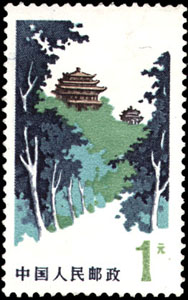
Jingshan (Prospect Hill) is a small hill just north of the palace’s northern gate. It rises 42.6 m (88.35 m above sea level) and is the highest point of the old city; it was built from earth dug out of the palace moats. Jingshan Park covers 23 hectares and adjoins Beihai Park to the west. Five pavilions stand along the ridge; the Wanchun Pavilion at the top is the best place to look down on the Forbidden City.
In 1644, when the rebel Li Zicheng took Beijing, the last Ming emperor, Chongzhen, hanged himself from a locust tree on the hill.
The hill was first laid out in the Jin dynasty. When the Yuan capital Dadu was built it was an imperial garden inside the palace city. The Ming and Qing dynasties rebuilt and enlarged it: in 1420, when Beijing was being built, rubble from demolished Yuan palaces and earth from the new moat were piled on the site of the Yuan Yanchun Pavilion into a hill named Wansui (“Long Life”) Hill, also called Zhen Shan, meaning “the hill that suppresses the Yuan dynasty’s royal aura”. The magnificent Shouhuang Hall complex, with its gate, main hall, side halls and stele pavilions, and the Yongsi and Guande halls were added over time. Cranes and deer were kept in the park, and every Double Ninth festival the emperor climbed the hill with his consorts and courtiers for a banquet.
In 1655 Wansui Hill was renamed Jingshan. In 1749 the Shouhuang Hall was moved to its present site, and in 1751 the five pavilions were built on the summit, from east to west the Zhoushang, Guanmiao, Wanchun, Jifang and Fulan pavilions, each housing a bronze Buddha, the “Buddhas of the Five Directions”. When the Eight-Nation Alliance occupied Beijing in 1900 the buildings were badly damaged and most of the bronze Buddhas were carried off.
Travel information
Admission: 40 yuan in low season, 60 yuan in high season (2007). The palace was under major restoration in 2007.
Stamps and banknotes
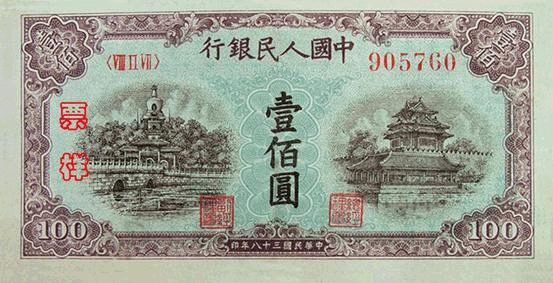
Some varieties of the 100-yuan note of the first series of renminbi (1949) show a corner tower of the Forbidden City and Beihai.
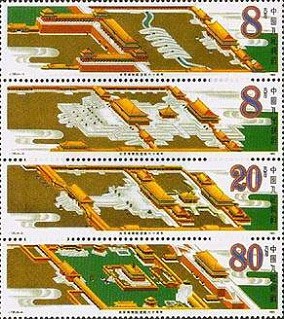
In 1985 China Post issued J.120, “60th Anniversary of the Palace Museum”, four stamps: Red Gate Towers in the Clouds (8 fen), Hall of Supreme Harmony in Morning Light (8 fen), Hall of Union (20 fen) and Imperial Garden in Spring (80 fen).
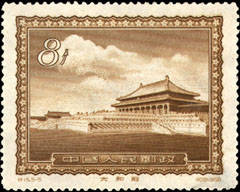
The fifth stamp of the 1956 set S15 “Scenic Spots of the Capital” shows the Hall of Supreme Harmony.
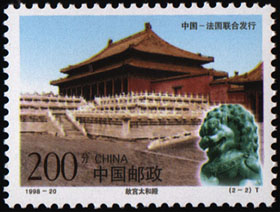
In 1998 China and France jointly issued 1998-20, “The Palace Museum and the Louvre”, two stamps.
The first stamp of the 1979 definitive set R20 “Scenes of Beijing” shows Jingshan Park.