 National Parks of China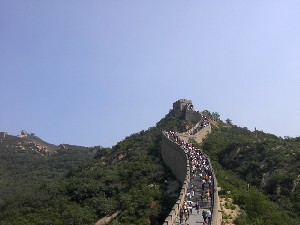
Overview
| Designation | UNESCO World Heritage (cultural, 2003) National Park of China (first batch) AAAAA tourist attraction |
| Province | Beijing |
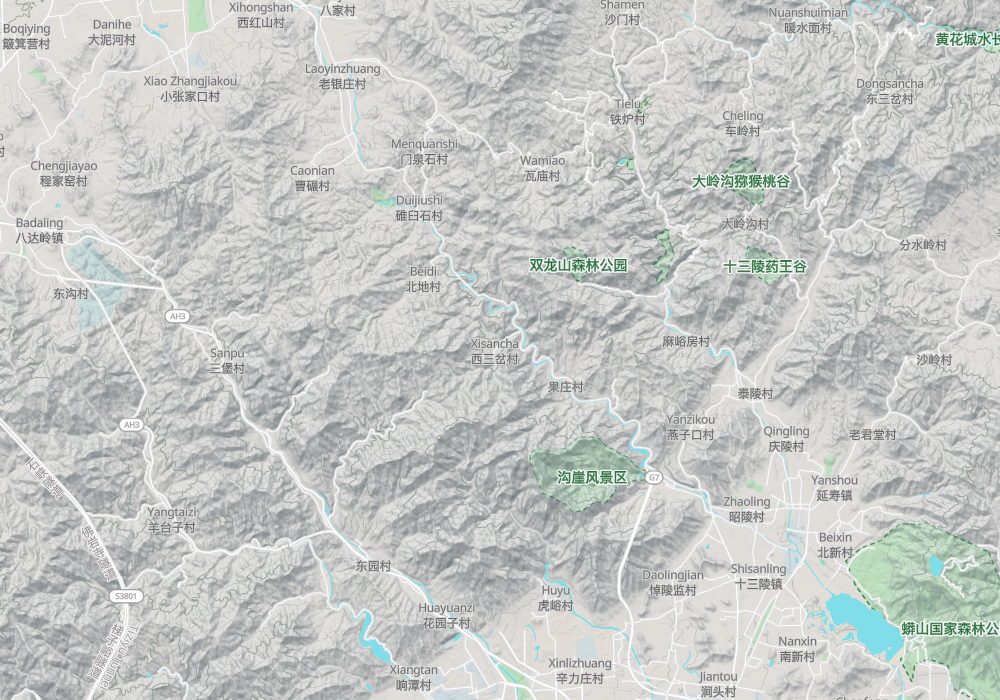
| Location | Yanqing and Changping districts, north of Beijing |
| Latitude, longitude | 40.4, 116.0 Google Maps |
| Highlights | The Great Wall; imperial tombs of the Ming dynasty |
| Top sights | The Great Wall at Badaling, Changling and Dingling tombs, the Sacred Way |
| Highest point | 1,015 m |
| Nearby cities | Beijing, Tianjin, Datong |
| Nearby sites | The Summer Palace, Beijing, The Forbidden City (Palace Museum), Beijing, The Temple of Heaven, Beijing, Chengde Mountain Resort and its Outlying Temples, Mount Pan, Yungang Grottoes, Beijing Central Axis |
| Themes | Historic buildings, City walls, Tombs, Culture & history, Stamps, Banknotes & coins |
Badaling
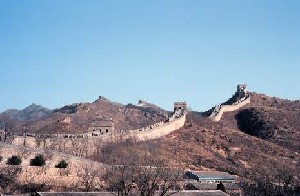
Badaling lies in Yanqing District, about 50 km north-west of central Beijing. It is the best-known section of the Great Wall: the open stretch runs for more than 3,700 m and its highest point is 1,015 m above sea level.
“Layered greenery at Juyong” (Juyong Diecui), one of the Eight Views of old Beijing, refers to the scenery around Badaling and the nearby Juyong Pass. The pass has the Cloud Platform, first built in the Yuan dynasty. At Qinglongqiao railway station near the pass stands a bronze statue of Zhan Tianyou, the father of China’s railways.
It was inscribed on the UNESCO World Heritage List in 2003 as part of “Imperial Tombs of the Ming and Qing Dynasties”, as a cultural site. It is in the first batch of national parks of China (national scenic areas) named by the State Council in 1982.
Main sights
Badaling Pass: the gate on the wall, built in the Hongzhi era of the Ming; the wall runs north and south from it, and the outer face carries a plaque reading Juyong Waizhen.
North section: the wall running north from the pass, with steep steps; the highest point of the site lies on this section, near the stretch known as Hero's Slope.
South section: the wall running south from the pass, shorter and easier than the north section and less crowded.
Great Wall Museum: inside the Badaling site, with exhibits and film on the history, construction and defence system of the wall.
Qinglongqiao Station: a small station on the Beijing–Zhangjiakou railway, with a statue of Zhan Tianyou in front; the line here uses a switchback in the shape of the character for person.
Juyongguan: a pass formed by two fortified gates and linking walls, with the Yuan-dynasty Cloud Platform, whose base carries carved Buddhist figures and texts.
Sacred Way: the entrance avenue to the Ming Tombs, starting at a stone archway and passing the Great Red Gate and a stele pavilion, with stone figures lining both sides.
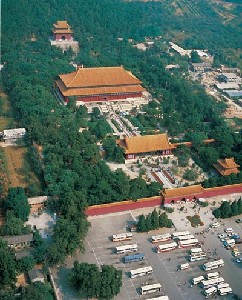
Changling: the joint tomb of the Yongle Emperor and his empress; its Hall of Eminent Favour is one of the largest surviving timber halls, supported by huge nanmu columns.
Dingling: the tomb of the Wanli Emperor and two empresses; the underground palace was excavated in the 1950s and can now be entered.
History and culture
The Badaling Great Wall seen today was built mainly in the Ming. The dynasty treated the wall as its main northern defence and strengthened the passes and walls in the hills north of Beijing; Juyongguan and Badaling were part of the line guarding the capital.
Juyongguan has long been the route linking the North China Plain with the northern grasslands, and passes were kept here in many periods. Badaling takes its name from the sense of roads running in all directions and was an outer defence of Juyongguan.
The Ming Tombs lie below Tianshou Mountain. Construction of Changling began in 1409 under the Yongle Emperor, and thirteen Ming emperors were eventually buried in the valley, down to the Chongzhen Emperor's Siling. The valley, backed by hills and open to the plain, was chosen according to geomancy.
Dingling is the only tomb in the Ming Tombs to have been excavated, between 1956 and 1958; the finds included silks, gold and silver ware and crowns.
After the Chongzhen Emperor took his own life he was buried in a tomb originally made for a consort. It became known as Siling and is one of the smaller tombs in the valley.
Travel tips
Getting there: from Beijing, take the Beijing–Zhangjiakou high-speed line to Badaling Great Wall station; there are also direct buses from the city. The S2 suburban train now starts at Nankou and runs only a few times a day. The Ming Tombs are in Changping, reached by bus or taxi; people combining both in one day usually hire a car or join a day tour.
Booking: Badaling requires advance booking under your real name; holiday slots often sell out quickly.
Badaling Great Wall: from the fortified pass the wall runs north and south. The north side is longer, steeper and busier; the south side is a little easier. There is a cable car on the north side and a funicular on the south side; they may stop in high wind.
Juyongguan: between Badaling and Changping. You can walk a loop of the pass and its walls; it is steep but less crowded than Badaling.
Ming Tombs: the main sites open year-round are Changling, Dingling and Zhaoling, plus the Sacred Way; several other tombs have opened in recent years, mostly by booking. Changling has the intact Hall of Eminent Favour (Ling'en Hall); at Dingling you can go down into the underground palace; the Sacred Way is lined with stone figures.
Time: half a day for Badaling, and half a day for two or three sites at the Ming Tombs. Doing both in one day is tight.
Season: spring and autumn are best, and the October leaf season is busy. Summer is hot; winter is cold and windy but quiet.
Caution: the steps on the wall are uneven and there is little shade; wear good shoes and carry water.
The Thirteen Ming Tombs
The Ming Tombs lie in the north of Changping District, Beijing. They are the mausoleums of thirteen Ming emperors; the main sights are Changling, Dingling and the Sacred Way (Shendao). Changling, at the southern foot of the main peak of Tianshou Mountain, is the tomb of the Yongle Emperor Zhu Di; its palace buildings cover about 120,000 m². Dingling, the tomb of the Wanli Emperor, covers 180,000 m² and is the only one whose underground palace has been excavated.
The Ming Tombs Reservoir is nearby.
Stamps and banknotes
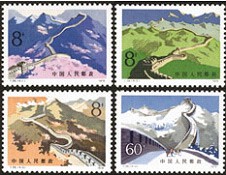
In 1979 China Post issued the set T38 “The Great Wall”, four stamps: the Wall in spring, summer, autumn and winter.
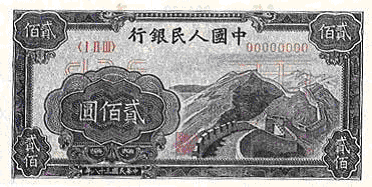
One variety of the 200-yuan note of the first series of renminbi, issued by the People’s Bank of China in 1949, shows the Great Wall.
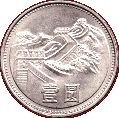
The one-yuan coin of the third series of renminbi shows the Great Wall.
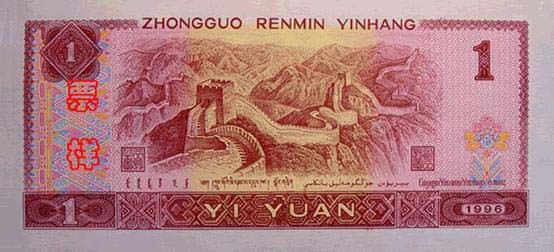
The back of the one-yuan note of the fourth series (1988) shows the Great Wall.
More photos
Map
© OpenStreetMap contributors · terrain © Copernicus · Map credits