National Parks of China
Overview
| Province | Shanxi |
| Location | Shanxi |
| Latitude, longitude | 40.1, 113.3 Google Maps |
| Nearby sites | Mount Wutai, Badaling & Thirteen Tombs of the Ming Dynasty, Yungang Grottoes, Mount Heng (Northern Sacred Mountain) |
| Nearby cities | Hohhot |
| Top sights | Yungang Grottoes, Huayan Temple |
| Themes | Cities, Temples, Buddhism, Statues, Stamps |
About
The best-known sights of Datong, Shanxi, are the Yungang Grottoes in the western suburbs and the Huayan Temple in the city.
City sights
Huayan Temple
Suburban sights
The Datong extinct volcanoes in Datong County east of the city, with the Haotian Temple on one summit
Huayan Temple
Huayan Temple in the city was founded in the Liao and divided into an upper and a lower temple in the Ming.
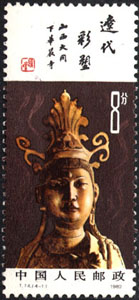
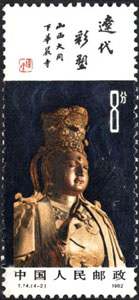
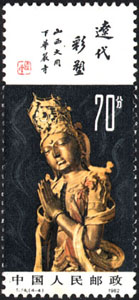
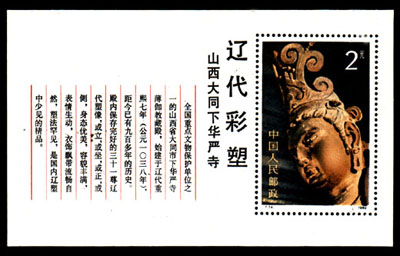
The Bhagavat Sutra Hall of the lower temple dates from 1038; its painted Liao bodhisattvas are rare masterpieces of Liao sculpture, surviving intact through many strong earthquakes over 900 years.
The hall holds 31 Liao statues; a stele of 1162 lists them as “the Buddhas of the three ages, the bodhisattvas of the ten directions, the sravakas, arhats and all the sages”. They are arranged as the vertical three ages, from north to south Dipankara, Sakyamuni and Maitreya, each with six attendant bodhisattvas and disciples, an unusually large number. The faces are full and round and the robes rich, showing late Tang influence with Liao detail: representative works of Liao sculpture. The finest and most moving is a standing bodhisattva with an openwork crown, leaning slightly left with the hips gently turned, hands joined at the chest, round soft face, fine brows, downcast eyes and a smile showing the teeth, hung with jewels and a gauze-like stole that flows over the arms to the feet as if in the wind.
On 19 November 1982 China Post issued T74 “Liao Painted Sculptures”, four stamps and a souvenir sheet: a bodhisattva head, bust, lotus boy, half-figure and head.