National Parks of China
Overview
| Designation | UNESCO World Heritage (cultural, 2009) National Park of China (first batch) AAAAA tourist attraction |
| Province | Shanxi |
| Location | Shanxi |
| Latitude, longitude | 39.0, 113.6 |
| Highlights | One of the four sacred Buddhist mountains |
| Area | 250 km² |
| Highest point | 3,061.1 m |
| Nearby cities | Datong, Taiyuan, Shijiazhuang |
| Nearby sites | Mount Heng (Northern Sacred Mountain), Yungang Grottoes, Xibaipo and Mount Tiangui, Mount Cangyan, Yesanpo, Peking Man Site at Zhoukoudian |
| Themes | Famous mountains, Mountains, Buddhism, Temples, Stamps |
About
Mount Wutai, north-east of Wutai County in Shanxi, is the seat of the bodhisattva Manjushri and one of the four sacred Buddhist mountains. Centred on the town of Taihuai, it consists of five flat-topped peaks: the North Terrace (Yedou Peak), South Terrace (Jinxiu), East Terrace (Wanghai), West Terrace (Guayue) and Central Terrace (Cuiyan). The North Terrace, 3,058 m, is the “roof of north China”.
Wutai is a holy place of both Chinese and Tibetan Buddhism. The five great monasteries around Taihuai are Xiantong, Tayuan, Shuxiang, Luohou and Pusading; the famous temples outside the town are Foguang and Nanchan.
Buddhism flourished here in the Northern Song, when temple building reached its first peak with more than 200 temples; after a thousand years of change some 50 complete temples remain in and around the mountain.
Travel information
Admission: 168 yuan (2007).
Stamps
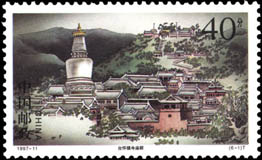
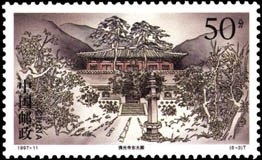
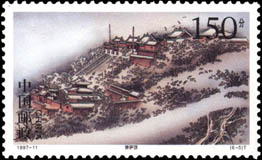
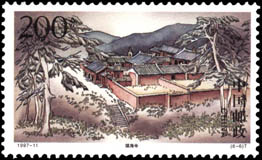
On 26 July 1997 China Post issued 1997-11 “Mount Wutai”, six stamps: the temples of Taihuai, the main hall of Nanchan Temple, the east hall of Foguang Temple, the bronze hall of Xiantong Temple, Pusading and Zhenhai Temple.