 National Parks of China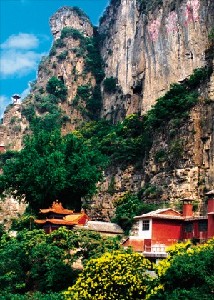
Overview
| Designation | National Park of China (fourth batch) |
| Province | Hebei |
| Location | Eastern foot of the Taihang, Pingshan County, Hebei |
| Latitude, longitude | 38.4, 113.7 Google Maps |
| Highlights | Revolutionary site; karst |
| Highest point | 1,270 m |
| Nearby cities | Shijiazhuang, Taiyuan, Datong |
| Nearby sites | Mount Cangyan, Mount Wutai, Yungang Grottoes, Zhangshiyan, Mount Heng (Northern Sacred Mountain), White Cloud Cave, Mount Kong |
| Themes | Mountains, Karst, Museums, Taoism, Inscriptions, Culture & history |
Xibaipo
Xibaipo, at the eastern foot of the Taihang in Pingshan County, Hebei, about 90 km from Shijiazhuang, was the seat of the Communist Party Central Committee and the People’s Liberation Army headquarters from May 1948 until the founding of the People’s Republic in 1949. The main sight is the Xibaipo memorial museum.
It is in the fourth batch of national parks of China (national scenic areas) named by the State Council in 2002.
Travel tips
Getting there: Xibaipo is in Pingshan County, about 90 km from Shijiazhuang; long-distance buses and tourist shuttles run from the city. Mount Tiangui is also in Pingshan but is a separate trip.
Xibaipo: the site centres on the former headquarters of the Party Central Committee and a memorial hall, with the courtyards where officials worked and lived and several meeting sites, mostly indoor exhibits and preserved buildings.
Visiting: bring an ID card for entry to the memorial hall; holidays are crowded, so go early.
Mount Tiangui: a Daoist mountain with temple buildings; a huge character gui is carved on a cliff near the gate and is clearest seen from below.
Time: Xibaipo takes half a day to a day; adding Mount Tiangui needs two days, or a separate trip.
Season: spring and autumn are best; Mount Tiangui is cool in summer, and cold in winter, when paths may ice over.
Where to stay: most people stay in Shijiazhuang and return the same day; there are also hotels at Xibaipo and in Pingshan town.
Nearby: to the west are Niangziguan waterfall and the Pingshan hot springs; Cangyan Mountain lies west of Shijiazhuang.
Mount Tiangui
Mount Tiangui is a famous Taoist mountain of karst landform, 1,270 m, called the “Guilin of the north”, with the Zhenwu Hall, the Jade Emperor Hall, the Cangyan Palace and the Kuixing Pavilion.
On a cliff near the mountain gate is carved a giant character gui (“return”), 97 m high and 49 m wide, the largest Chinese character in the world, cut in 1997 to celebrate the return of Hong Kong.