 National Parks of China
Overview
| Designation | National Park of China (first batch) AAAAA tourist attraction |
| Province | Guangxi |
| Location | Northern Guangxi |
| Latitude, longitude | 25.0, 110.5 |
| Highlights | Karst landscape, peak forests, caves |
| Top sights | The Li River, Yangshuo, Elephant Trunk Hill |
| Nearby cities | Guangzhou, Shenzhen, Hong Kong |
| Nearby sites | Mount Lang (Langshan), West Mountain of Guiping, Wulingyuan (Zhangjiajie), Nanshan, Mount Wanfo and the Dong Villages, Jiuyi Mountain and Mausoleum of Emperor Shun, Liping Dong Villages |
| Themes | Karst, Mountains, Peaks, Rivers, Caves, Stamps, Banknotes & coins, Scams to avoid |
About
The Guilin and Li River scenic area in northern Guangxi is known for its karst peaks, rivers and caves: “green hills, clear water, strange caves, beautiful rocks”. It is a first-batch national park of China; in 1985 the China Tourism News named the Guilin landscape one of China’s ten great scenic wonders, and in 1982 Guilin was in the first batch of Historic and Cultural Cities.
Guilin city
The city’s highlights are “three hills and two caves”: Elephant Trunk Hill, Fubo Hill, Folded Brocade Hill, Reed Flute Cave and Seven Star Cave in Seven Star Park. The park also has the famous Camel Hill. Cliff carvings and inscriptions are found on Fubo Hill and in the Wind Cave of Folded Brocade Hill.
The city’s waterscape is the “two rivers and four lakes”: the Li and Taohua rivers and Rong, Shan, Gui and Mulong lakes.
The Li River
The Li rises in Ziyuan County and flows south through Guilin and Yangshuo; below Lipu it becomes the Gui River and joins the West River at Wuzhou, 426 km in all. Between Guilin and Yangshuo its banks are crowded with peaks, “water winding round green hills, hills floating on green water”, the heart of the scenic area; the most famous sight is the Nine Horses Fresco Hill.
Yangshuo
“Guilin’s scenery is the finest under heaven, and Yangshuo’s the finest in Guilin.” Yangshuo is even lovelier than Guilin and many foreigners have settled there. Its sights include the Big Banyan, Silver Cave and Moon Hill.
Banknotes and stamps
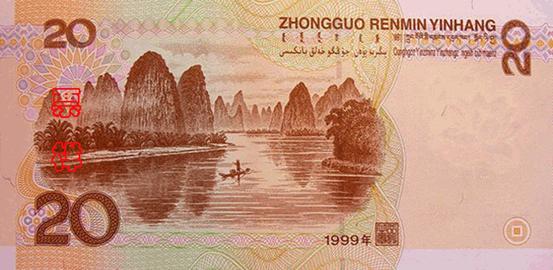
The back of the 20-yuan note of the fifth series of renminbi shows the Li River at Xingping, Yangshuo.
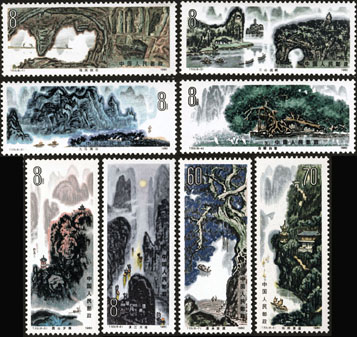
On 30 August 1980 China Post issued T53 “Guilin Landscape”, eight stamps: Pearl Cave and Sword Rock, three hills from afar, Nine Horses Fresco Hill, old banyan and egrets, sunset on the West Hill, moonlit Li River, waterfall and old ferry, and the scenery of Yangshuo.
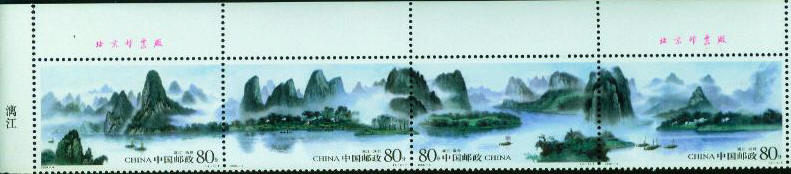
On 25 February 2006 2006-4 “The Li River”, four stamps: Yangdi, Langshi, Huangbu and Xingping.
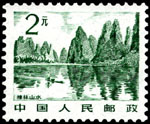
The 16th stamp of the 1981 definitive set R21 “Scenery of the Motherland” shows Guilin.
Tourist scams
Burning incense in the temples on Yu Hill costs a “donation” of 30 to 300 yuan. If you do not intend to donate, do not accept the candles and incense offered to you.
Climate
Guilin has a humid subtropical monsoon climate, mild and rainy, with rain and heat in the same season: “little snow in winter, flowers all year”. The annual mean is about 19 °C; summers are hot, occasionally above 40 °C, winters around freezing with almost no snow. The frost-free period is 309 days and annual rainfall 1,926 mm, as in the saying “foggy Chongqing, rainy Guilin”. In the plum-rain season summer downpours bring muggy weather, swollen rivers and frequent floods.
Food
Guilin rice noodles. The “three treasures of Guilin”: chilli sauce, fermented bean curd and Sanhua liquor.
Suggested itinerary
Day 1: cruise down the Li River to Yangshuo and spend half a day there. Day 2: the three hills and two caves in Guilin. With more time, give a day to the Longsheng rice terraces (day tours from Guilin about 150 yuan) and linger a few days in Yangshuo.