 National Parks of China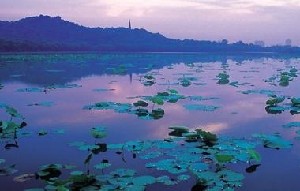
Overview
| Designation | UNESCO World Heritage (cultural, 2011) National Park of China (first batch) AAAAA tourist attraction |
| Province | Zhejiang |
| Location | Hangzhou, Zhejiang |
| Latitude, longitude | 30.2, 120.1 Google Maps |
| Nearby cities | Shanghai, Nanjing, Hangzhou |
| Highlights | Hills, lake, gardens |
| Top sights | Solitary Hill, Spring Dawn on the Su Causeway, Three Pools Mirroring the Moon, Lingyin Temple |
| Elevation | 10 m |
| Highest point | 355 m |
| Nearby sites | Fuchun River, Xin’an River and Thousand Island Lake, Huangshan (Yellow Mountains), Classical Gardens of Suzhou, Mount Putuo, Mount Jiuhua, Archaeological Ruins of Liangzhu City |
| Themes | Culture & history, Lakes, Gardens, Cities, Rivers, Springs, Temples, Hills, Stamps, Banknotes & coins |
About
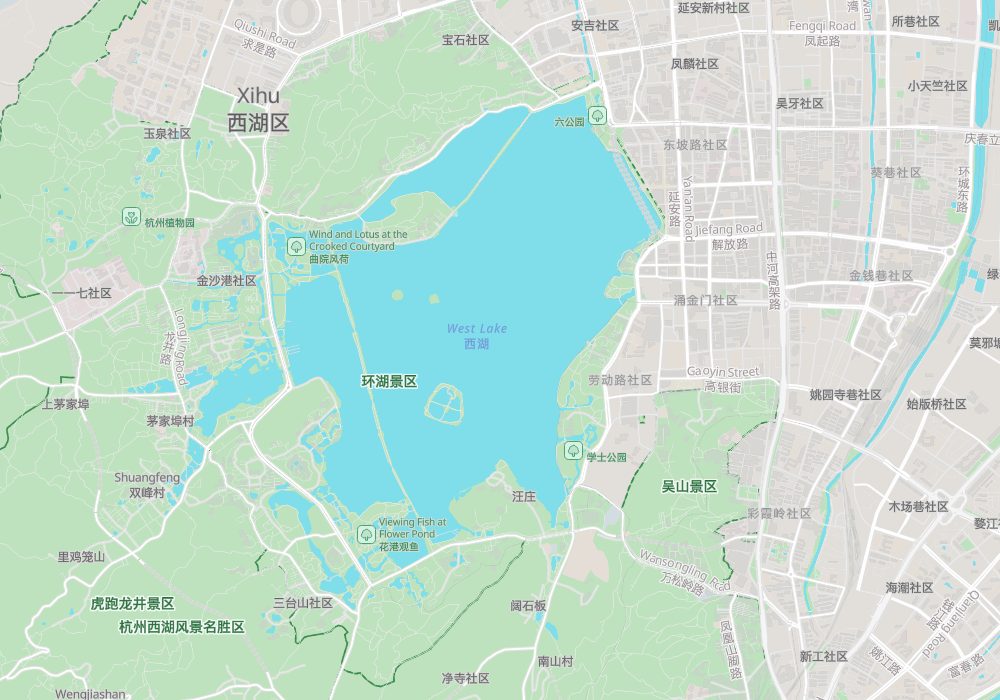
West Lake lies where plain, hills, lake and river meet, west of the city of Hangzhou in Zhejiang, ringed by hills on three sides and by the city on the east. It is 3.3 km north to south and 2.8 km east to west, about 5.7 km² of water with a 15 km shoreline and an average depth of 1.5 m.
Solitary Hill and the Bai and Su causeways divide it into the Outer, Inner and Back lakes, Little South Lake and Yue Lake, the Outer Lake being the largest. Solitary Hill is the largest natural island; the two causeways cross the water, and three man-made islets, Little Yingzhou, Mid-Lake Pavilion and Ruangong Islet, stand in the Outer Lake. The whole is summed up as one hill, two causeways, three islands and ten views.
Besides the historic “Ten Views of Qiantang” and “Eighteen Views of West Lake”, the most famous are the Ten Views named in the Southern Song and the New Ten Views chosen in 1985. The 60 km² scenic area around the lake holds more than 40 major sights and over 30 protected monuments.
It was inscribed on the UNESCO World Heritage List in 2011, as a cultural site. It is in the first batch of national parks of China (national scenic areas) named by the State Council in 1982.
Travel tips
Getting there: the lake is on the west side of central Hangzhou. Longxiangqiao and Fengqi Road stations on Metro Line 1 are close to the east shore, and many bus routes circle the lake. On weekends and holidays cars entering the scenic area are restricted by odd and even number plates, and traffic is heavy; use public transport.
Walking and cycling: the shoreline is about 15 km round. The Bai Causeway and Su Causeway are good for walking or riding the public bikes; walking all the way round takes most of a day.
Boats: boats take you to Xiaoyingzhou island to see Three Pools Mirroring the Moon; board at the Hubin, Yue Fei Temple, Huagang and other piers.
Lingyin Temple: in the hills west of the lake, in the same area as the Feilai Feng carvings; take a bus or taxi from the lake. Entry must be booked in advance under your real name. Mornings are less crowded.
Other sights: on Solitary Hill, the Zhejiang Provincial Museum and the Xiling Seal Engravers' Society; the Yue Fei Temple below Qixia Ridge; Leifeng Pagoda and Jingci Temple on the south shore. Choose by interest.
Time: one day for the main sights around the lake; two or three days with Lingyin Temple and the tea villages and temples in the hills.
Season: in March and April peach trees and willows line the Su Causeway; in summer the lotus at Quyuan Fenghe is in flower, but it is hot and humid; in September and October the osmanthus blooms around Manjuelong; winter is quieter.
Caution: on holidays the Broken Bridge and Bai Causeway are packed; go early in the morning or in the evening.
The Ten Views of West Lake
The Ten Views were named in the Southern Song by the painter Ma Yuan and others.
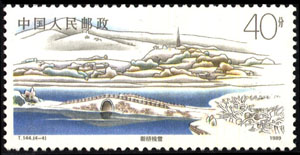
Lingering Snow on the Broken Bridge: the bridge at the east end of the Bai Causeway, built in the Southern Song, with the Yunshui Guangzhong pavilion and a stele pavilion beside it.
Viewing Fish at Flower Harbour: a park on a peninsula between the Inner Lake and Little South Lake west of the Su Causeway; the Kangxi Emperor wrote its name and set up a stele by the fish pond. Today it is a park of over 20 hectares with a red-fish pond, peony garden, flower harbour, lawns and woodland.
Leifeng Pagoda in Evening Glow: the pagoda of the legend of the White Snake stands on Sunset Hill on the south shore, brick within and timber galleries without, with stone slabs carved with the Avatamsaka Sutra set in the walls and sixteen gilded bronze arhats enshrined below.
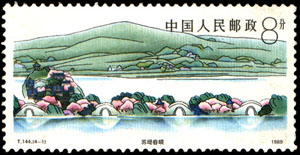
Spring Dawn on the Su Causeway: the causeway runs nearly 3 km from the foot of Nanping Hill to Qixia Ridge, built from dredged silt when Su Dongpo governed Hangzhou in the Northern Song and named in his memory. Its six bridges from south to north are the Yingbo, Suolan, Wangshan, Yadi, Dongpu and Kuahong bridges.
Evening Bell at Nanping Hill: Jingci Temple, founded by the Wuyue kingdom at the foot of Huiri Peak on the south shore, with the Zongjing Hall, Huiri Pavilion, Jizu Hall and the Timber-Hauling Well, and a pond for releasing fish before the gate. The great bell is 3 m high, 2.3 m across and over 10 tonnes. The limestone hills are riddled with caves and their cliffs stand like screens.
Autumn Moon over the Calm Lake: at the west end of the Bai Causeway, with Solitary Hill behind and the Outer Lake in front; a lake-view pavilion was built in the Tang and a Dragon King shrine in the Ming. A couplet reads: “ten thousand acres of lake, calm as a mirror; the moon is fine in every season, finest in autumn”.
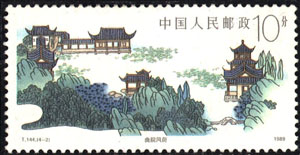
Lotus in the Breeze at Winding Courtyard: in the north-west corner of the lake, famed for lake and lotus views.
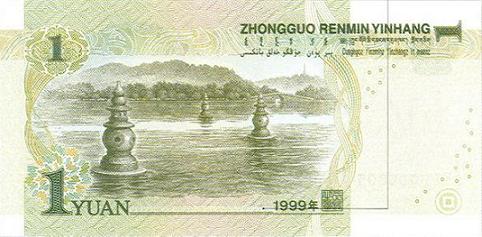
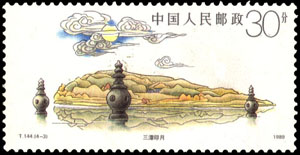
Three Pools Mirroring the Moon: south of the lake’s centre, one of the three islands with Mid-Lake Pavilion and Ruangong Islet, also called Little Yingzhou, an island with lakes inside it, shaped like the character for “field”; three bottle-shaped stone pagodas in the water to its south are the “three pools”.
Twin Peaks Piercing the Clouds: the imperial stele pavilion by Hongchun Bridge; the South and North peaks lie south-west and north-west of the lake, 257 m and 355 m, outliers of the Tianmu Mountains.
Orioles Singing in the Willows: on the south-east shore at Qingbo Gate, the Southern Song imperial garden Jujing Yuan.
Other sights
Solitary Hill, joined to the Bai Causeway on the east and Xiling Bridge on the west, has Zhongshan Park, the Crane-Releasing Pavilion, the Zhejiang Museum, the Xiling Seal Society and the Louwailou restaurant. By Xiling Bridge is the tomb of the revolutionary heroine Qiu Jin. The Xiling Seal Society, China’s famous society for seal carving and epigraphy, was founded in 1904 at the south-west foot of the hill.
The tomb and temple of Yue Fei, the Southern Song general who fought the Jin, lie at the southern foot of Qixia Ridge: the Loyalty Temple, the Qizhong Shrine and the tomb garden, with iron figures of the four traitors Qin Hui, his wife, Moqi Xie and Zhang Jun kneeling before the gate. The couplet reads: “Right and wrong, like ice and coal, have always been apart; praise and blame today tell true from false. The green hill is honoured to hold loyal bones; the white iron is innocent, cast as treacherous ministers.”
Stamps and banknotes
The back of the one-yuan note of the fifth series of renminbi shows Three Pools Mirroring the Moon.
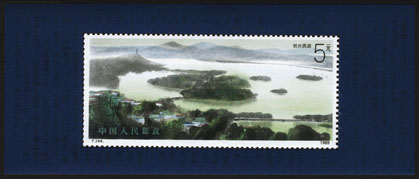
In 1989 China Post issued T144 “West Lake, Hangzhou”, four stamps: Spring Dawn on the Su Causeway, Lotus in the Breeze at Winding Courtyard, Three Pools Mirroring the Moon and Lingering Snow on the Broken Bridge.
In literature
“I would compare West Lake to the beauty Xi Shi: lovely alike in rich make-up or plain.” (Su Shi)
Map
© OpenStreetMap contributors · Map credits