 National Parks of China
Overview
| Designation | UNESCO World Heritage (cultural, 1997) AAAAA tourist attraction |
| Province | Jiangsu |
| Location | Suzhou, Jiangsu |
| Latitude, longitude | 31.3, 120.6 Google Maps |
| Highlights | Classical gardens |
| Top sights | The Humble Administrator’s Garden, the Lingering Garden, the Master of the Nets Garden, the Lion Grove |
| Nearby cities | Shanghai, Nanjing, Hangzhou, Suzhou |
| Nearby sites | Lake Tai, The Three Hills of Zhenjiang, West Lake, Hangzhou, Zhongshan (Purple Mountain), Nanjing, Mount Putuo, Mount Mogan, Archaeological Ruins of Liangzhu City |
| Themes | Gardens, Rock formations, Culture & history, Historic buildings, Cities, Stamps |
About
Suzhou in Jiangsu is known as the “city of gardens”, with more than ten famous ones. In 1997 and 2000 nine of its classical gardens were inscribed on the World Heritage List: the Humble Administrator’s Garden, the Canglang Pavilion, the Lingering Garden, the Garden of Pleasance, the Master of the Nets Garden, the Couple’s Garden, the Lion Grove, the Mountain Villa with Embracing Beauty and the Garden of Cultivation. The Humble Administrator’s Garden and the Lingering Garden are among the four great gardens of China.
The Humble Administrator’s Garden
At 178 Dongbei Street, the garden was laid out in 1509 and covers 5.2 hectares; it is a national protected site and one of the four great gardens of China. It has an east, a central and a west garden and a residence; the central garden is the finest part. The name comes from Pan Yue’s Jin-dynasty “Rhapsody on Living at Leisure”: “to water the garden and sell vegetables for one’s daily food is also a way of governing for the humble man”.
The bonsai garden holds nearly 10,000 Suzhou-style bonsai, and the Yashi Studio is a museum of curious rocks.
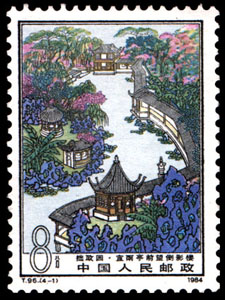
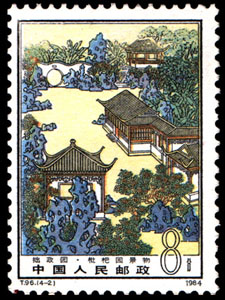
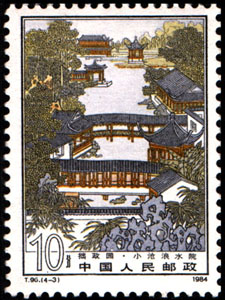
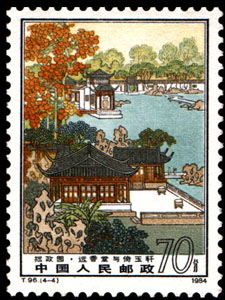
In 1984 T.96 “Suzhou Gardens: the Humble Administrator’s Garden” was issued, four stamps: the Reflection Tower seen from the Pavilion Suitable for Both (8 fen), the Loquat Garden (8 fen), the Little Canglang water court (10 fen) and the Hall of Distant Fragrance with the Jade Pavilion (70 fen).
The Lingering Garden
On Liuyuan Road outside Changmen Gate, the Lingering Garden was begun in 1593 and is famous for its rigorous layout and rich scenery; it is a national protected site and one of the four great gardens.
It has central, east, west and north sections, the central and east being the finest: the central section, the former Hanbi Villa, is built around water and rockery, the east around buildings.
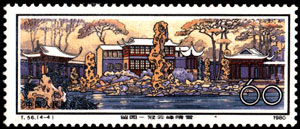
Its three famous rocks are the Cloud-Capped, Auspicious Cloud and Cloud Peak stones; the Auspicious Cloud Peak was a relic of the Song emperor Huizong’s “flower and rock tribute” and is called the most exquisite rock south of the Yangtze.
The winding corridor runs more than 700 m, its walls set with over 300 inscribed tablets, the “Lingering Garden Calligraphy”, the most famous being the Ming engraver Dong Hance’s copies of the calligraphy of Wang Xizhi and his son Wang Xianzhi.
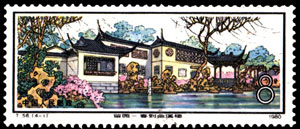
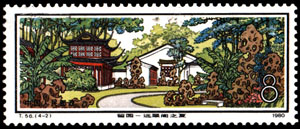
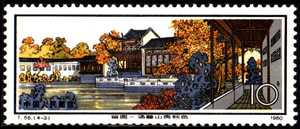
In 1980 T.56 “Suzhou Gardens: the Lingering Garden” was issued, four stamps: spring at the Winding Stream Tower (8 fen), summer at the Distant Green Pavilion (8 fen), autumn at the Hanbi Mountain House (10 fen) and the Cloud-Capped Peak after snow (60 fen).
The Lion Grove
The Lion Grove, 1.1 hectares, was founded in 1342 and is one of the four great gardens of Suzhou.
It is famous for its labyrinth of rockeries, the “kingdom of rockeries”: dry rockeries in the east and water rockeries in the west, the best known being the Nine Lion Peak.
The Master of the Nets Garden
In Kuojiatou Lane inside Fengmen Gate, the Master of the Nets Garden is a national protected site founded in the Southern Song. Only half a hectare, it has a residence in the east, the garden in the centre and a small courtyard in the west. Its speciality is the “night garden”, traditional music performed among the garden scenery after dark.
The Astor Court in the Metropolitan Museum of Art in New York was modelled on the garden’s Late Spring Studio.
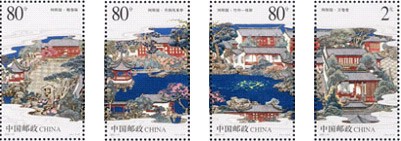
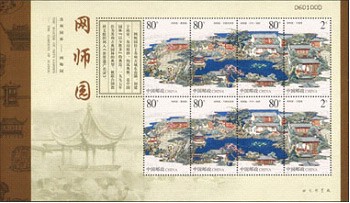
In 2003 2003-11T “Suzhou Gardens: the Master of the Nets Garden” was issued, four stamps: the Late Spring Studio (80 fen), the Moon and Wind Pavilion, the Bamboo Branch Studio (80 fen) and the Hall of Ten Thousand Volumes (2 yuan), with a sheetlet.
News
In February 2007 the Ministry of Construction named the first twenty National Key Parks, including Suzhou’s Lingering Garden, Master of the Nets Garden, Mountain Villa with Embracing Beauty, Lion Grove, Garden of Cultivation, Couple’s Garden, Retreat and Reflection Garden and Canglang Pavilion.