National Parks of China
Overview
| Designation | National Park of China (first batch) AAAAA tourist attraction |
| Province | Anhui |
| Location | Anhui |
| Latitude, longitude | 30.5, 117.8 Google Maps |
| Highlights | Sacred Buddhist mountain |
| Area | 170 km² |
| Highest point | 1,344.4 m |
| Nearby cities | Mount Tianzhu, Nanjing, Hangzhou, Hefei |
| Nearby sites | Huangshan (Yellow Mountains), Mount Qiyun, Mount Lu (Lushan), West Lake, Hangzhou, Mount Sanqing, Zhongshan (Purple Mountain), Nanjing |
| Themes | Famous mountains, Mountains, Buddhism, Stamps |
About
Mount Jiuhua lies in Qingyang County, Chizhou, in southern Anhui, south of the Yangtze and north of Huangshan; its name, “Nine Flowers”, comes from its nine peaks like a lotus. It is the seat of the bodhisattva Kshitigarbha (Dizang) and one of the four sacred Buddhist mountains of China.
Mount Jiuhua was anciently Mount Jiuzi (“nine sons”); Li Bai of the Tang, seeing its nine peaks like a lotus, wrote of “the sacred mountain opening its nine flowers”, and the name stuck. In the Kaiyuan reign of the Tang the Silla prince Kim Gyo-gak crossed the sea to practise here; his body did not decay after death and he was held to be an incarnation of Ksitigarbha (Dizang), and the mountain has been the seat of Dizang ever since. Over 90 temples and several hundred monks and nuns remain, with the preserved bodies of several eminent monks: of the four Buddhist mountains it has the most monks and the most “flesh-body” relics. The main peak, Shiwang, is 1,344 m, among 99 peaks including Tiantai, Lianhua and Tianzhu; the sea of clouds, sunrise, Buddha’s halo and winter rime are its four sights.
Main sights
Jiuhua Street: a basin at about 600 m on the mountainside where the temples and inns cluster; Huacheng Temple, the founding temple, is now the mountain’s museum.
Hall of the Flesh Body (Roushen Baodian): on Shenguang Ridge, holding the stupa of Kim Gyo-gak, the centre of pilgrimage.
Baisui Palace: enshrines the body of the Ming monk Wuxia, who died at 110; the temple stands on the summit of Chaxiao Peak, reached by cable car.
Tiantai Temple: the highest temple, near the top of Tiantai Peak, over a thousand steps up from Jiuhua Street past the old Sutra Terrace and Guanyin Peak, with the sea of clouds and sunrise from the top.
Qiyuan, Ganlu and Dongya temples: famous temples on Jiuhua Street and the lower slopes; Qiyuan is the largest monastery on the mountain.
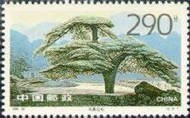
Minyuan: the valley between Jiuhua Street and Tiantai, with the Phoenix Pine, 1,400 years old.
Travel notes
Buses from Chizhou, Hefei or Nanjing to the Kecun visitor centre, then park buses up to Jiuhua Street. Jiuhua Street with Huacheng Temple, the Hall of the Flesh Body and Baisui Palace takes a day, Tiantai another half day. The Dizang festival on the 30th of the seventh lunar month is the busiest time.
Travel information
In March 2008 it was reported that admission was to rise from 140 to 200 yuan.
Stamps
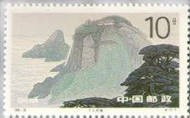
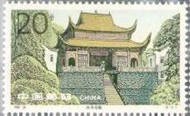
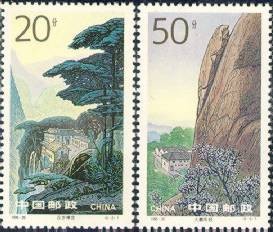
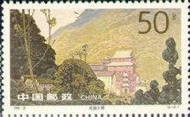
In 1995 China Post issued “Scenery of Mount Jiuhua”, six stamps: dawn at Tiantai, the Centenarian Palace, the Hall of the Incorrupt Body, sunset at the Zhi Garden, the roc listening to the sutras and the Phoenix Pine.