 National Parks of China
Overview
| Designation | National Park of China (first batch) |
| Province | Anhui |
| Location | Qianshan City, Anqing, Anhui, south-east end of the Dabie Mountains |
| Mountains | Dabie Mountains |
| Latitude, longitude | 30.7, 116.5 Google Maps |
| Nearby sites | Mount Lu (Lushan), Huangshan (Yellow Mountains), Mount Jiuhua, Huating Lake |
| Highlights | Granite landforms, deep valleys, strange rocks |
| Nearby cities | Anhui, Wuhan, Nanchang, Hefei |
| Themes | Mountain, Famous Mountain, Stamp, Peak, Stone, Temple, Buddha |
About
Mount Tianzhu (“Heavenly Pillar”), also called Qianshan or Wanshan, lies in Qianshan City, Anqing, Anhui. Emperor Wu of Han named it the Southern Sacred Mountain, so it is also called the Old Southern Sacred Mountain.
On 22 April 2006 China Post issued 2006-9 “Mount Tianzhu”, four stamps: the Blue Dragon Exploring the Sea, mist over the Alchemy Terrace, the Third Patriarch’s Monastery and the Pillar Holding up the Sky.
Mount Tianzhu takes its name from its main peak, a single granite column “propping up the sky” at 1,489 m; weathering has carved the massif into 45 peaks, 17 ridges and 18 cliffs with gorges and strange rocks. In 106 BC Emperor Wu of Han climbed it on his southern tour and named it the Southern Sacred Mountain; after the Sui the title passed to Mount Heng in Hunan, so Tianzhu is the “old Southern Sacred Mountain”. It keeps Buddhist and Taoist remains such as the Third Patriarch’s Temple, seat of Sengcan, third patriarch of Chan, and Qianshan at its foot is a birthplace of the Hui opera from which Peking opera grew.
It is in the first batch of national parks of China (national scenic areas) named by the State Council in 1982.
Main sights
Feilai Peak: a granite peak on the circuit of summits, standing out as an isolated mass; steps and walkways link it with Tianchi and Yingzhen peaks.
Tianchi Peak: another peak on the circuit, from which the main peak and the surrounding peak forest can be seen.
Yingzhen Peak: a peak on the same circuit that, with Feilai and Tianchi, makes up the forest of peaks around the main summit.
Qinglongbei (Green Dragon Ridge): a narrow ridge beneath the main peak with steep drops on both sides; it is where most visitors view the summit.
Dalongwo: one of the scenic areas on the mountain, reached by cable car; visitors change to a park bus at the visitor centre to get there.
History and culture
Tianzhu Mountain was anciently called Wanshan. The abbreviation of Anhui province, Wan, comes from this mountain and the Wan River that flows nearby; the area around Qianshan was the site of the ancient state of Wan.
After Emperor Wu of Han named it the Southern Peak, it became an important sacred mountain for state rituals. Under the Sui the title of Southern Peak passed to Mount Heng, and Tianzhu became known as the Ancient Southern Peak.
Sengcan, the Third Patriarch of Chan Buddhism, taught on this mountain in his later years, and Sanzu Temple commemorates his seat. The line of Chan transmission runs from Bodhidharma through Huike to Sengcan, and this mountain is one of its stops.
In the Northern Song, Wang Anshi served as an assistant prefect at Shuzhou, the area around today's Qianshan, and the mountain and its valley hold poems and cliff inscriptions that continue into the Ming and Qing.
Qianshan is the hometown of Cheng Changgeng, leader of the Hui troupes and a founding figure of Peking opera.
Travel tips
Getting there: first go to Qianshan city (formerly Qianshan County), which has a station on the Hefei–Anqing and Anqing–Jiujiang high-speed lines and buses from Anqing and Hefei; then take a bus or taxi to the visitor centre.
Going up: several cable cars run partway up, and you still walk from the top station; for the Dalongwo cable car, change to the park bus at the visitor centre. You can also climb the stone steps all the way, which is tiring and takes several hours.
Around the main peak: visitors usually view Tianzhu Peak from Qinglong Ridge and the Baiyue Terrace below it. Steps and plank walkways link Feilai, Tianchi and Yingzhen peaks in a loop.
Mystery Valley: the path squeezes between huge boulders, sometimes bent over or sideways, narrow and dim; not suited to large backpacks.
Sanzu Temple: at the foot of the mountain, some way from the peaks; allow a separate half day, together with the inscriptions of the Shangu Liuquan valley.
Time: one day covers the main sights on the mountain; two days with Sanzu Temple.
Season: best in spring for the azaleas and in autumn for the leaves; it is cooler on the mountain, and there may be ice and snow in winter.
Where to stay: in Qianshan city or at the foot of the mountain; to see sunrise and the sea of clouds, stay on the mountain.
Main sights
Tianzhu Peak: the main peak, sheer on all sides and inscribed “standing alone against the sky”; most visitors view it from Qinglongbei and the Baiyue Terrace below.
Mysterious Valley: over 400 m of passages through heaped boulders in three sections, the Dragon Palace, the Maze and the Carefree Palace, now light, now dark.
Liandan Lake: a mountain lake at 1,100 m where the Han alchemist Zuo Ci is said to have refined the elixir.
Third Patriarch’s Temple: a Chan temple at the foot of the mountain founded in the Liang dynasty, with the Tang Juejì pagoda and the patriarch’s cave; the Shangu Liuquan cliff carvings beside it hold over 300 inscriptions since the Tang and Song, including those of Wang Anshi, Huang Tingjian and Su Dongpo.
Feilai Peak, Tianchi Peak, Qinglongbei, Yingzhen Peak and the Great Heavenly Gate: the heart of the peak forest, a loop of stone steps and walkways.
Map
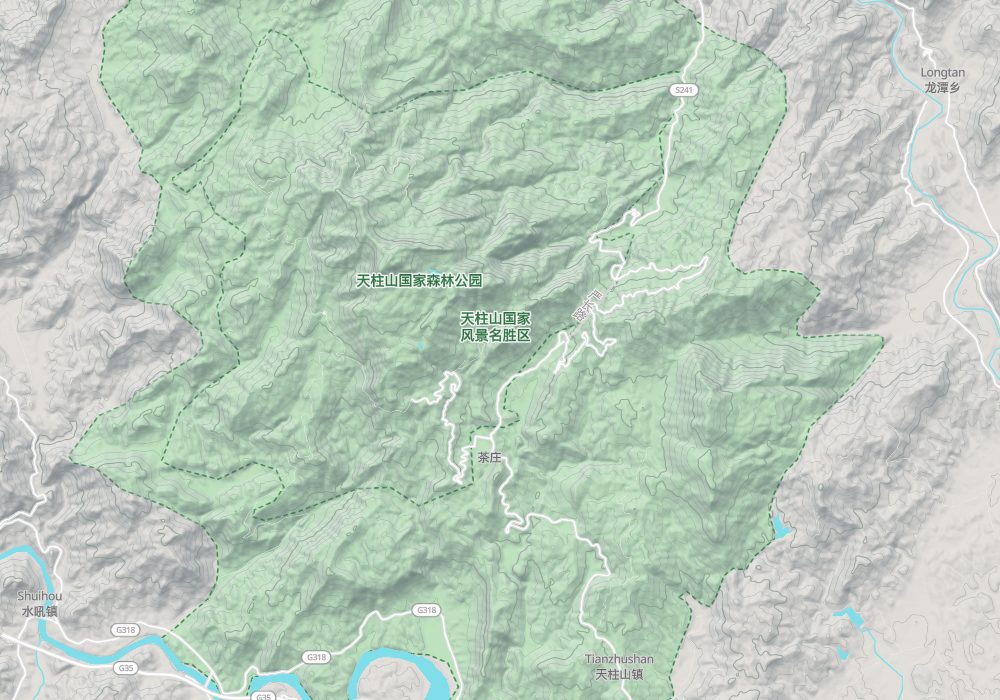
© OpenStreetMap contributors · terrain © Copernicus · Map credits