 National Parks of China
Overview
| Designation | UNESCO World Heritage (cultural, 1996) National Park of China (first batch) AAAAA tourist attraction |
| Province | Jiangxi |
| Location | South of Jiujiang, Jiangxi, where Poyang Lake meets the Yangtze |
| Latitude, longitude | 29.6, 116.0 Google Maps |
| Highlights | Waterfalls, Buddhist sites, summer resort |
| Top sights | Hanpokou, the Five Old Men Peaks, the Three-Tier Spring, the White Deer Grotto Academy |
| Area | 300 km² |
| Highest point | 1,473.4 m |
| Nearby cities | Nanchang, Wuhan |
| Nearby sites | Mount Tianzhu, Mount Yunju and Zhelin Lake, Huangshan (Yellow Mountains), Mount Longhu (Dragon and Tiger Mountain), Mount Jiuhua, Guifeng (Turtle Peak) |
| Themes | Famous mountains, Mountains, Lakes, Waterfalls, Buddhism, Culture & history, Great rivers, Stamps |
About
Mount Lu rises south of Jiujiang in Jiangxi, where Poyang Lake meets the Yangtze. A famous summer resort and one of the three great mountains of China, the scenic area covers 302 km²; the summit, Hanyang Peak, is 1,474 m. The main sights are Hanpokou, Guling town, the Five Old Men Peaks, the Three-Tier Spring, Dragon Head Cliff, Hanyang Peak, the botanical garden, Donglin Temple, the White Deer Grotto Academy, Flower Path and the site of the Lushan conferences. Mount Lu was inscribed on the World Heritage List in 1996.
Travel information
Admission: 180 yuan in high season, 135 yuan in low season (2007).
History
In the fourth century the monk Huiyuan founded Donglin Temple on the mountain and with it the Pure Land school of Buddhism.
In the 1930s Mount Lu became the “summer capital” of the Nationalist government in Nanjing; in 1937 Chiang Kai-shek delivered here the speech that began full-scale resistance to Japan.
In 1959 the Central Committee of the Communist Party met here, the famous Lushan Conference: Mao Zedong urged the Party to complete the year’s Great Leap Forward targets, and the defence minister Peng Dehuai wrote to Mao pointing out the Leap’s problems.
The White Deer Grotto Academy
The academy, at the southern foot of the Five Old Men Peaks, was founded in the Tang dynasty and is one of the four great academies of China. The Song philosopher Zhu Xi rebuilt it and taught here himself.
Zhu Xi’s rules for the academy: between father and son there is affection; between ruler and minister, duty; between husband and wife, distinction; between elder and younger, order; between friends, trust. These are the five teachings that Yao and Shun charged Xie to spread, and they are all a student need learn. The order of study is five: learn broadly, inquire carefully, think prudently, discriminate clearly, practise earnestly. For conduct: be loyal and truthful in word, earnest and respectful in deed; curb anger and desire; move towards good and correct faults. In affairs: do what is right without scheming for profit; make the Way clear without reckoning the reward. With others: do not do to others what you would not want done to you; when you fail, look for the cause in yourself.
Stamps
In 1981 China Post issued “Mount Lu”, seven stamps: the Five Old Men Peaks, Hanpokou, Yellow Dragon Pool, Sunlit Peak, the Three-Tier Spring, stone pines and Dragon Head Cliff.
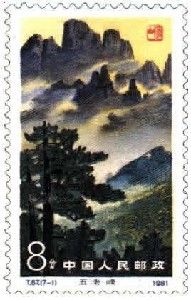
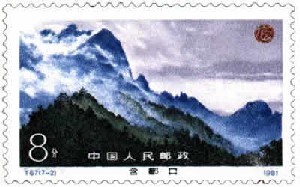
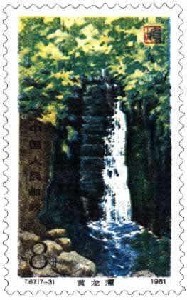
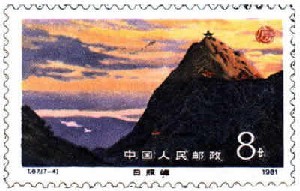
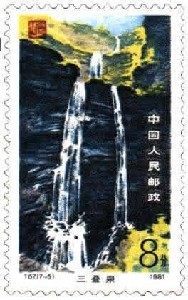
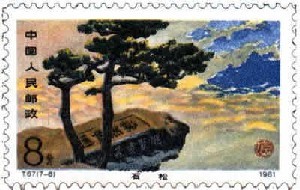
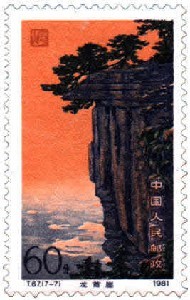
In 1999 China and North Korea jointly issued stamps of Mount Lu and Mount Kumgang.
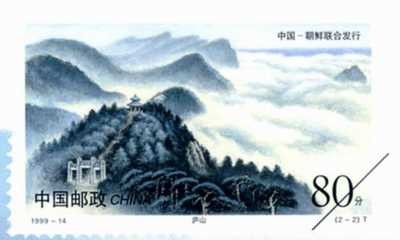
In literature
Li Bai: “Sunlight on Incense Burner Peak kindles a violet haze; far off I see the waterfall hung before the river. It plunges three thousand feet straight down, as if the Milky Way were falling from the ninth heaven.”
Su Shi: “Seen from the side a range, from the end a peak; near, far, high, low, no two views the same. I cannot tell the true face of Mount Lu, because I am inside the mountain.”
Mao Zedong: “In the dusk I watch the sturdy pines; tumbling clouds race past and still they stand at ease. Nature made the Immortal’s Cave; the boundless view is from the perilous peak.”
Poyang Lake
Poyang Lake, second in size only to Qinghai Lake, is China’s largest freshwater lake. At normal water level it covers nearly 4,000 km², though it has been shrinking in recent years.