 National Parks of China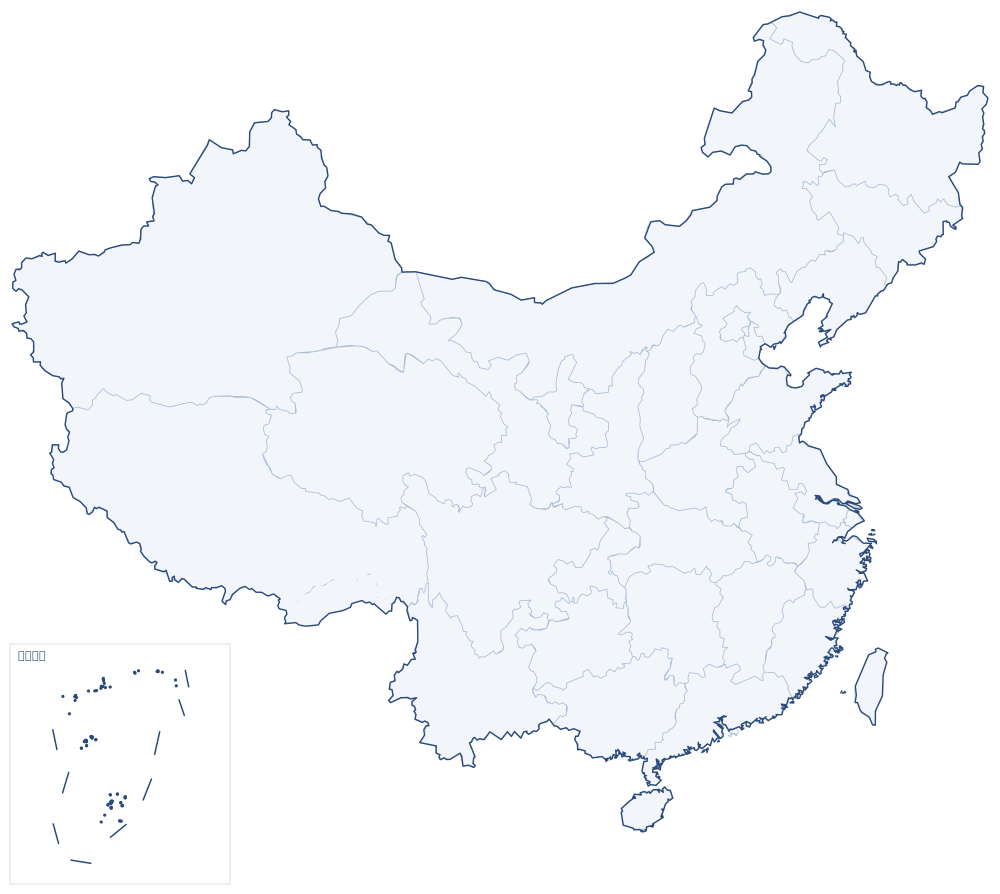
The Five Sacred Mountains
The Five Sacred Mountains (Wuyue) are Taishan in Shandong, Mount Hua in Shaanxi, Mount Heng in Hunan, Mount Heng in Shanxi and Mount Song in Henan. Mount Tianzhu was once named the Southern Sacred Mountain by Emperor Wu of Han and is called the old Southern Sacred Mountain.
- East: Taishan, “like a seated figure”
- West: Mount Hua, “like a standing figure”
- South: Mount Heng, “like a flying bird”
- North: Mount Heng, “like a walking figure”
- Centre: Mount Song, “like a reclining figure”
In Taoist lore each mountain has a divine ruler: the Eastern Sacred Mountain governs life and death and rank among men; the Southern the stars and the creatures of the water; the Western metals, birds and beasts; the Northern the rivers and four-footed animals; the Central the mountains, land and livestock.
Legend says that when Pangu, who separated heaven and earth, died, his breath became wind and cloud, his voice thunder, his eyes the sun and moon, his hair the stars, his blood the rivers, his flesh the fields, his skin the plants, his teeth and bones metal and stone, his marrow pearls and jade, his sweat rain and dew, the vermin on his body the common people, and his head and four limbs the Five Sacred Mountains, the head being the Eastern one.
The Three Mountains
The three mountains were originally the three legendary island mountains of the immortals, Penglai, Yingzhou and Fangzhang. Later the name was applied to the three most famous mountains of China:
- Huangshan, Anhui
- Lushan, Jiangxi
- Mount Emei, Sichuan
Other versions replace Mount Emei with Mount Wuyi or Mount Yandang.
The Five Zhen
Besides the Five Sacred Mountains there are the Five Zhen (guardian mountains); together they are the ten famous mountains. The Five Zhen are:
- East: Mount Yi, Linqu, Shandong
- West: Mount Wu (also Mount Yue), Longxian, Shaanxi
- South: Mount Kuaiji, Shaoxing, Zhejiang
- North: Mount Yiwulü, Beizhen, Liaoning
- Centre: Mount Huo, Huoxian, Shanxi