National Parks of China
Overview
| Designation | UNESCO World Heritage (mixed, 1996) National Park of China (first batch) AAAAA tourist attraction |
| Province | Sichuan |
| Location | Sichuan |
| Latitude, longitude | 29.5, 103.3 Google Maps |
| Highlights | One of the four sacred Buddhist mountains; “Buddha’s halo” |
| Top sights | Golden Summit, Wannian Temple, Elephant Bathing Pool |
| Wildlife | Tibetan macaques |
| Area | 154 km² |
| Highest point | 3,079.3 m |
| Nearby cities | Chongqing, Guiyang, Kunming |
| Nearby sites | Mount Qingcheng and the Dujiangyan Irrigation System, Mount Gongga (Minya Konka), Mount Siguniang and the Sichuan Giant Panda Sanctuaries, Dazu Rock Carvings, Mount Tiantai, Qionglai, Xiling Snow Mountain, Shunan Bamboo Sea |
| Themes | Famous mountains, Mountains, Snow mountains, Buddhism, Temples, Animals, Statues, Rivers, Stamps, Cable cars |
Mount Emei
Mount Emei in Sichuan is the seat of the bodhisattva Samantabhadra and one of the four sacred mountains of Chinese Buddhism. Famed for its elegance (“Emei is the most beautiful under heaven”), it is counted among the three great mountains of China and the four great sights of Sichuan, and in 2005 Chinese National Geography named it one of China’s ten most beautiful mountains.
The summit is the Golden Summit, also called Wanfo Peak, over 3,000 m high. On clear days the snow peaks of Gongga and Siguniang can be seen from it, and sometimes the “Buddha’s halo”, a glory in the clouds. Other sights are Baoguo Temple, Hongchunping, Qingyin Pavilion, Wannian Temple and the Elephant Bathing Pool.
Troops of wild Tibetan macaques beg food from visitors along the mountain paths.
The Leshan Giant Buddha
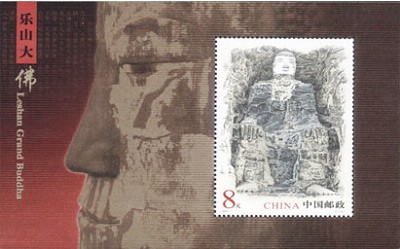
The Leshan Giant Buddha was carved in the Tang dynasty into Lingyun Hill on the outskirts of Leshan, where the Min, Dadu and Qingyi rivers meet. At 58 m it is said that “the mountain is a Buddha and the Buddha is a mountain”.
Reports in 2007 described serious weathering and erosion of the statue.
In 2003 the press reported that a company was building the Oriental Buddha Capital theme park with a full-size, 37 m copy of the Bamiyan Buddha of Afghanistan among more than 3,000 reproduced statues, all inside the protected zone of the Leshan Giant Buddha and Mahao cliff tombs World Heritage area. Experts said the copy cheapens the historical significance of the Giant Buddha and harms its cultural value and setting.
Stamps
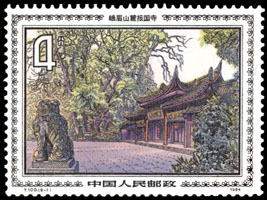
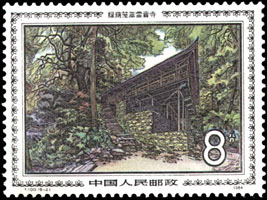
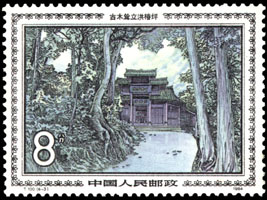
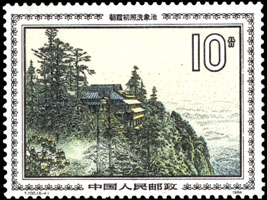
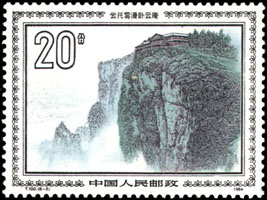
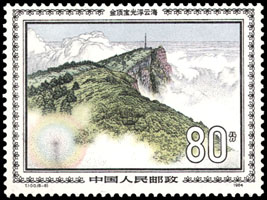
On 16 November 1984 China Post issued T.100 “Scenery of Mount Emei”, six stamps: Baoguo Temple at the foot of the mountain (4 fen), Leiyin Temple in green shade (8 fen), ancient trees at Hongchunping (8 fen), dawn glow at the Elephant Bathing Pool (10 fen), clouds and mist at Woyun Hermitage (20 fen) and the Buddha’s halo over a sea of clouds at the Golden Summit (80 fen).
On 28 April 2003 an 8-yuan souvenir sheet 2003-7T “The Leshan Giant Buddha” was issued.