 National Parks of China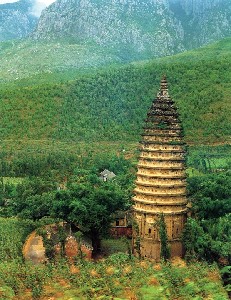
Overview
| Designation | UNESCO World Heritage (cultural, 2010) National Park of China (first batch) AAAAA tourist attraction |
| Province | Henan |
| Location | North-west of Dengfeng, Henan |
| Latitude, longitude | 34.5, 112.9 Google Maps |
| Highlights | The Central Sacred Mountain of the Five Sacred Mountains |
| Top sights | Shaolin Temple |
| Highest point | 1,491.7 m |
| Nearby cities | Henan, Zhengzhou, Luoyang, Wuhan, Xi’an, Taiyuan |
| Nearby sites | Longmen Grottoes, Luoyang, Mount Wangwu and Mount Yuntai, Zhengzhou Yellow River, Mount Shennong, Qingtian River, Mount Shiren (Stone Men) |
| Themes | Famous mountains, Mountains, Buddhism, Temples, Pagodas & towers, Culture & history, Stamps |
About
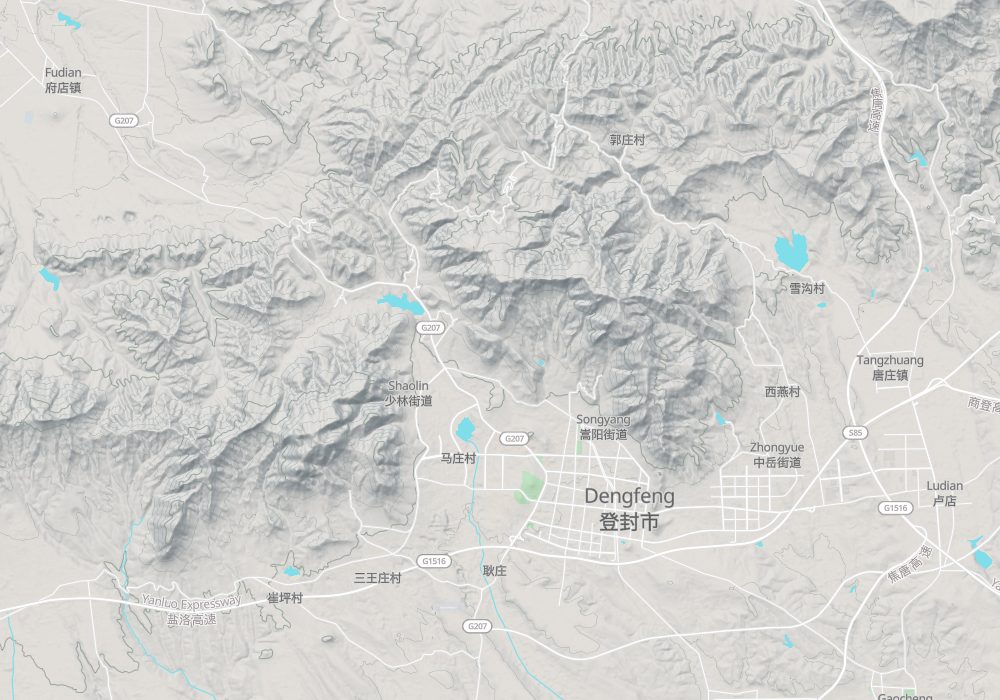
Mount Song, the Central Sacred Mountain, lies north of Dengfeng in Henan and consists of Taishi Mountain (1,491.7 m) and Shaoshi Mountain (1,512 m). Its famous sights are Shaolin Temple, home of Shaolin kung fu, the Songyang Academy, one of China’s four great academies, and the Zhongyue Temple.
It was inscribed on the UNESCO World Heritage List in 2010, as a cultural site. It is in the first batch of national parks of China (national scenic areas) named by the State Council in 1982.
Travel tips
Getting there: Dengfeng has no railway; long-distance buses run from Zhengzhou and Luoyang, about an hour and a half from Zhengzhou. City buses go from Dengfeng to Shaolin Temple and Zhongyue Temple.
Shaolin Temple: some 10–15 km west of Dengfeng. The site includes the main monastery, the Pagoda Forest and the Chuzu Hermitage, and there are martial-arts shows. Allow most of a day.
Mount Shaoshi: a cable car goes up from the Shaolin area to the plank paths around Sanhuangzhai. The climbing paths are steep.
Mount Taishi area: Zhongyue Temple, Songyang Academy and the Songyue Temple Pagoda are all near Dengfeng and fit into one day. From near Songyang Academy a path climbs Junji Peak, most of a day there and back.
Observatory: the Yuan-dynasty observatory at Gaocheng, southeast of Dengfeng, can be seen on the way.
Time: one day for Shaolin, one day for the Taishi area.
Season: spring and autumn are best; summer is hot and winter dry and cold.
Caution: around Shaolin people often offer guiding, fortune-telling or incense; you can ignore them.
Mount Song
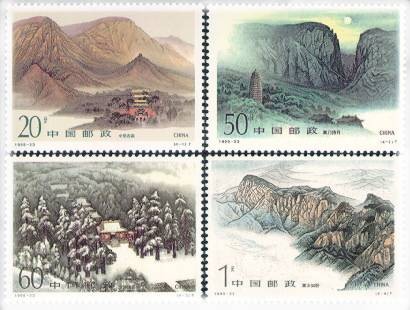
In 1995 China Post issued “Mount Song”, four stamps: the old temple of the Central Sacred Mountain, Shaolin in clear snow, the Song Gate awaiting the moon, and Mount Song reclining.
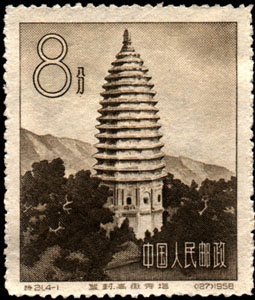
The first stamp of the 1958 set S21 “Ancient Pagodas of China” shows the Songyue Temple pagoda at Dengfeng.
Shaolin Temple
Shaolin Temple lies on the shaded north side of Shaoshi Mountain at the western foot of Mount Song, with the Pagoda Forest, the First Patriarch’s Hermitage, Bodhidharma’s Cave, the Second Patriarch’s Hermitage, Yongtai Temple and the Shaoshi Que. Ringed by hills, it was among the first AAAA attractions named by the national tourism authority.
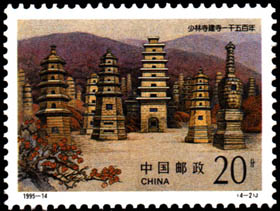
Founded in 495 and named for the dense forest (lin) below Shaoshi Mountain, it is the cradle of Chan (Zen) Buddhism in China and the birthplace of Shaolin martial arts. The Pagoda Forest to its west covers about 20,000 m² with 231 brick and stone memorial pagodas of the Tang, Song, Jin, Yuan, Ming and Qing dynasties and modern times, the largest in China.
The temple covers more than 30,000 m² with seven courtyards on its axis, grand in scale and fine in sculpture and painting. More than 300 stelae survive, among them the poem of Empress Wu of Tang, the Qianlong stele, the stele of the Three Teachings, works of the four great Song calligraphers and the stele of Master Dao written by the Ming calligrapher Dong Qichang, all of high calligraphic and sculptural quality.
The Thousand Buddha Hall holds 320 m² of murals out of more than 500 m² in the temple: five hundred arhats, lifelike and varied, painted in the Wanli reign of the Ming more than 400 years ago, their colours and lines still clear, the temple’s greatest treasure. Around the temple, besides the Pagoda Forest, stand pagodas of the Tang and Five Dynasties, including those of the masters Tongguang, Faru and Fahua.
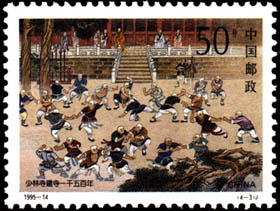
Today Shaolin is famous not only for its ancient Buddhist tradition but for its martial arts: “Chinese kung fu leads the world, and all kung fu comes from Shaolin”.
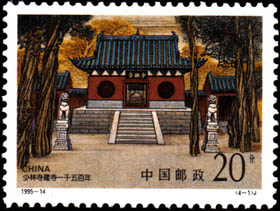
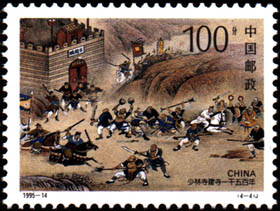
On 30 August 1995 China Post issued 1995-14 “Shaolin Temple”, four stamps: the gate, the Pagoda Forest, monks practising, and the thirteen monks rescuing the Prince of Qin.
Map
© OpenStreetMap contributors · terrain © Copernicus · Map credits