National Parks of China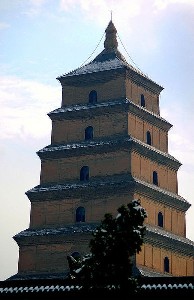
Overview
| Province | Shaanxi |
| Location | Shaanxi |
| Latitude, longitude | 34.3, 108.9 Google Maps |
| Highlights | Ancient capital |
| Top sights | Terracotta Army, Big Wild Goose Pagoda |
| Nearby cities | Chongqing, Taiyuan, Zhengzhou |
| Nearby sites | Terracotta Army and Mount Li, Lintong, Mount Hua, Mount Taibai, Mausoleum of the Yellow Emperor, Wulao Peak, Mount Tiantai, Baoji, Qiachuan, Heyang |
| Themes | Metropolises, Culture & history, Museums, Historic buildings, Tombs, City walls, Pagodas & towers, Buddhism, Prehistory, Hot springs & geothermal, Springs, Mountains, Theme parks, Stamps |
About
Xi’an, capital of Shaanxi, is one of China’s ancient capitals. From the 11th century BC to about the 10th century AD thirteen dynasties or regimes ruled from here over some 1,100 years; the Western Zhou, Qin, Western Han and Tang were its golden ages.
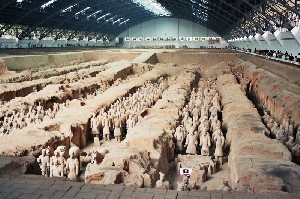
Its most famous sight is the Terracotta Army museum, the “eighth wonder of the world”. Mount Hua, the Western Sacred Mountain, is an hour or two east by road. In the city are the old walls, the Forest of Steles, and the Big and Small Wild Goose Pagodas.
City sights
Big Wild Goose Pagoda: in the Daci’en Temple, a seven-storey brick pagoda over 64 m high on a 25 m square base.
Small Wild Goose Pagoda: Jianfu Temple
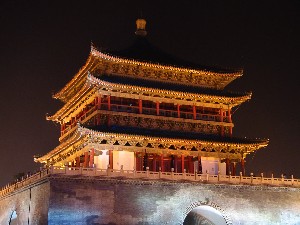
Bell Tower and Drum Tower
Great Mosque
City wall: China’s World Heritage tentative list
Shaanxi History Museum
Forest of Steles: over 2,300 steles from the Han to the Qing;
Banpo Neolithic site
Xingqing Palace Park
Tang Paradise: a Tang-style theme park
Suburban sights
Cuihua Mountain
Yangling: tomb of Emperor Jing of Han
Maoling: tomb of Emperor Wu of Han
Zhaoling: tomb of Emperor Taizong of Tang
Qianling: joint tomb of Emperor Gaozong and Wu Zetian
Further afield
Famen Temple
Suggested itinerary
One day for the Terracotta Army and nearby Qin Shihuang’s mausoleum, Mount Li and Huaqing Pool.
One to three days for the city: the Big Wild Goose Pagoda, Forest of Steles, Shaanxi History Museum, city wall, Bell and Drum Towers, Great Mosque, Banpo and the Small Wild Goose Pagoda.
One or two days for Mount Hua.
With more time, Qianling, Yangling and Cuihua Mountain.
Big Wild Goose Pagoda
The Big Wild Goose Pagoda in the Daci’en Temple in the south of the city is the landmark of Xi’an: a seven-storey brick pagoda of square tapering form, over 64 m high on a base 25 m square, built of fine-jointed bricks with pilasters marking the bays in traditional Chinese style.
It was begun in 652; by tradition the monk Xuanzang, first abbot of the temple, designed and supervised it after his return from India to house Sanskrit scriptures, images and relics. Emperors Taizong and Gaozong wrote the two stele inscriptions on the Tripitaka.
Because of the urban environment the pagoda has leaned more than a metre in recent years.
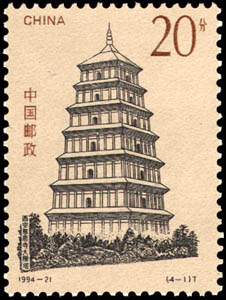
The first stamp of the 15 December 1994 set 1994-21 “Ancient Pagodas of China” shows the pagoda.
Forest of Steles
Seven large galleries, eight corridors and eight pavilions hold over 2,300 steles from the Han to the Qing, over 1,000 on show, mostly Tang. Here you can see seal, clerical, cursive and running scripts and the work of Ouyang Xun, Yan Zhenqing, Liu Gongquan, Wang Xizhi and Su Shi.
Transport: buses 14, 402 and 239 to the museum stop.
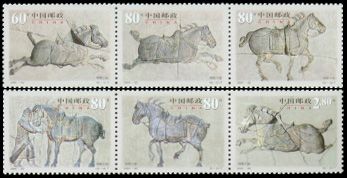
The Six Steeds of Zhaoling
Zhaoling, the mausoleum of Emperor Taizong of Tang, is built into a mountain at Liquan, Shaanxi. Before it stood the reliefs of six chargers, the famous Six Steeds of Zhaoling, the war horses of Taizong’s campaigns to found the Tang: superbly carved, lifelike and harmonious, treasures of Chinese stone sculpture. Two were stolen and taken to the United States; the other four are in the Shaanxi museum.
On 28 October 2001 China Post issued 2001-22 “The Six Steeds of Zhaoling”, six stamps: Shifachi, Qingzhui, Telebiao, Saluzi, Quanmaogua and Baitiwu.
City wall
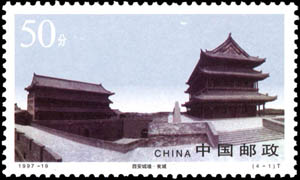
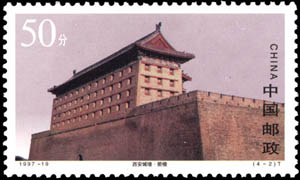
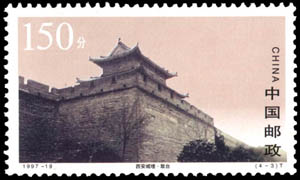
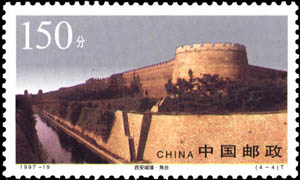
The Xi’an city wall is the most complete ancient city wall in China and the largest and best-preserved ancient military fortification in the world. Built in the Hongwu reign of the Ming on the base of the sixth-century Sui–Tang imperial city, it is 13,912 m round, 12 m high, 18 m wide at the base and 15 m at the top, thicker than it is high. The moat was the first line of defence, crossed by drawbridges lowered by day and raised at night; the watchtowers outside the gates for the night watch and alarms were the second; the arrow towers over 30 m high with sheer outer walls pierced by arrow slits the third; the barbican of 9,348 m² between arrow tower and gate tower, a trap for attackers, the fourth; and the main gate the fifth. Since 1983 the restored wall has been encircled by the country’s only ring park.
On 24 October 1997 China Post issued 1997-19 “Xi’an City Wall”, four stamps: the barbican, the arrow tower, the bastion and the corner tower.
Transport
Xianyang airport lies north-west of the city.
The railway station is just outside the north wall.
Food
Eating in Xi’an is cheaper than in other big cities. Famous dishes:
Yangrou paomo (mutton soup with bread), best at Lao Sun Jia
Dumpling banquet, at the Jiefang Road dumpling restaurant
Other snacks: bangbang noodles, persimmon cakes, liangpi, chao fenyu, guokui and thousand-layer pastry
Besides the night markets at Nanshaomen and Dongxin Street, try the snack street behind the Drum Tower.
Restaurants: Xi’an Fanzhuang; Lao Sun Jia, Dongguan Zhengjie; Chunfasheng, 20 Nanyuanmen; Tongshengxiang, Bell and Drum Tower square; Fan Ji cured pork, 45 Zhubashi; Defachang, 3 West Street; Jiefang Road dumpling restaurant, Longhai Hotel ground floor; Jia San soup dumplings, 121 Xiyangshi; Sanyuan Lao Huang Jia, 16 Jianshe West Street, Wenyi Road.
Shopping
Large malls, department stores and supermarkets are concentrated on West, South and East Streets and Jiefang Road.
For antiques and crafts try the Shuyuanmen antique street beside the Forest of Steles, the Xi’an antiques market on Zhuque Road and Wenbaozhai at 5 Yanta Road: terracotta warrior replicas, Tang tricolour pottery, paper cuts and cloth crafts.
More photos