 National Parks of China
Overview
| Designation | UNESCO World Heritage (cultural, 1987) National Park of China (first batch) AAAAA tourist attraction |
| Province | Shaanxi |
| Location | Lintong, Xi’an, Shaanxi |
| Latitude, longitude | 34.4, 109.2 |
| Highlights | Imperial mausoleum, hot springs |
| Top sights | The Terracotta Army |
| Nearby cities | Xi’an, Chongqing, Taiyuan, Zhengzhou |
| Nearby sites | Mount Hua, Mausoleum of the Yellow Emperor, Wulao Peak, Qiachuan, Heyang, Mount Tiantai, Baoji |
| Themes | Tombs, Museums, Statues, Mountains, Famous mountains, Hot springs & geothermal, Springs, Historic buildings, Culture & history, Stamps |
About
Mount Li at Lintong, Xi’an, Shaanxi, is a first-batch national park of China. The Mausoleum of the First Qin Emperor and its Terracotta Army at the northern foot of the mountain were inscribed on the World Heritage List in 1987.
Mount Li and the Huaqing Pool
Mount Li (Lishan), also called Xiuling, rises south of Lintong at the northern foot of the Qinling range; its highest point, Jiulongding, is 1,302 m. It is named for its resemblance to a black horse (li) seen from afar. King You of Zhou is said to have built a palace here; the First Qin Emperor made it the Lishan Baths, and the Tang emperor Xuanzong enlarged it into the Huaqing Palace, also called the Huaqing Pool for its hot springs. About 30 km east of central Xi’an, it is famous for the story of Xuanzong and his consort Yang Guifei.
The east section bears a gilded plaque “Huaqing Pool” in the hand of Guo Moruo and contains the Lotus and Flying Rosy Cloud pavilions and the Five-Room Hall; the Ode to the Hot Spring stele on the spring wall is a gem of Chinese stone inscription. The middle section is the museum of the Tang imperial baths: the Lotus, Crabapple, Crown Prince, Shangshi and Star baths, with an exhibition hall. The west section has the Nine-Dragon Lake and the Feixia Hall, and a large mural in 90 pieces of white marble, 9.15 m by 3.6 m, showing Xuanzong receiving Yang Yuhuan at the hot-spring palace for the first time in 740.
When the Xi’an Incident broke out in 1936 Chiang Kai-shek was staying in the Five-Room Hall. Halfway up the mountain, by the Striped Tiger Rock, stands the Remonstrance Pavilion, once called the “Catch Chiang Pavilion”.
On the western ridge is the famous Taoist Laojun Hall. On the summit is a beacon tower: legend places here the story of King You lighting the war beacons to make his favourite Baosi smile, “one smile that lost the kingdom”.
The Mausoleum of the First Qin Emperor
The mausoleum lies at the northern foot of Mount Li and was built between 246 and 208 BC, a labour of 39 years. The surviving mound is 76 m high; the inner wall is 2.5 km round, the outer 6.3 km. It is the largest imperial tomb in China. Qin Shihuang began building it when he came to the throne at 13, and after unifying the six states conscripted 700,000 men from all over the country; it was still unfinished when he died. Decades of survey and trial excavation have found more than 500 accompanying tombs and pits in the 56.25 km² protected zone and over 50,000 important objects. The discovery of the Terracotta Army has been called “the most important archaeological find of the twentieth century” and “the eighth wonder of the world”.
The Terracotta Army
The Museum of the Terracotta Warriors and Horses stands 1.5 km east of the mausoleum on its burial pits. On 29 March 1974 local farmers digging a well chanced on Pit 1; Pits 2 and 3 followed, and a large site museum was built over them. The warriors stand 1.75 to 1.85 m tall and, by dress, bearing and hairstyle, include generals, infantry and charioteers; bronze swords, spears, halberds and curved knives were found with them.
Pit 1, the main sight, is 210 m by 62 m; more than 1,000 life-size figures, 8 chariots, 32 horses and nearly 10,000 bronze objects have been excavated. It is thought to hold over 6,000 figures in all; for want of conservation techniques more than 4,000 have been reburied and only about 1,000 are on show.
Pit 2, the finest of the three, is L-shaped, 96 m at its longest and 84 m at its widest, about 5 m deep and 6,000 m² in area, with kneeling and standing crossbowmen, a square of four-horse chariots, a mixed formation of chariots, infantry and cavalry, and a formation of cavalry.
Pit 3, the smallest, is believed to be the command post; bronze chariots were found there.
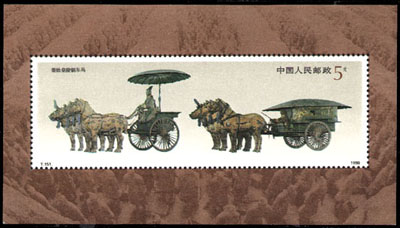
In December 1980 two bronze chariots with horses were unearthed, hailed as “the crown of bronzes” and “national treasures”. They represent the emperor’s processional carriages: a standing carriage and a covered carriage, each two-wheeled with a single shaft, drawn by four bronze horses and driven by a senior charioteer. Cast mainly in bronze with gold and silver fittings, the parts were cast separately and joined by inlay casting, welding, gluing, riveting, mortise joints, ring fastenings and pins. They are painted all over, the horses white, in mineral pigments bound with glue, the glue’s thickness used to raise lines in relief. Chariots, horses and figures are about half life size, faithfully reproducing the emperor’s equipage. They were found 20 m west of the mound in a wooden chamber, one behind the other, badly broken, and have been restored.
Travel information
Terracotta Army: 90 yuan, 60 yuan in low season (2007). Huaqing Pool: 40 yuan.
Bus 306 (tourist line 7) from outside the railway station calls at the Huaqing Pool, the mausoleum and the Terracotta Army; 5 yuan, 8 am to 6 pm. If you can afford it, hire a taxi for the day.
Avoid package tours, which force visits to worthless man-made attractions and souvenir shops.
Stamps
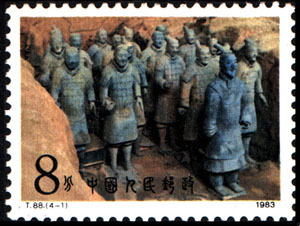
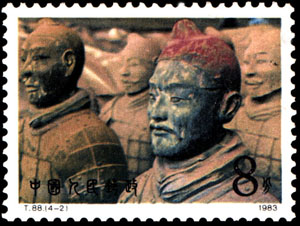
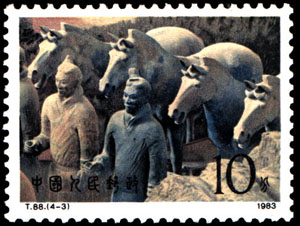
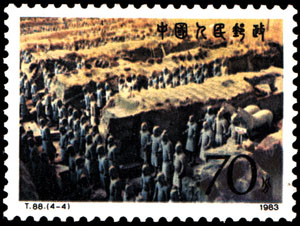
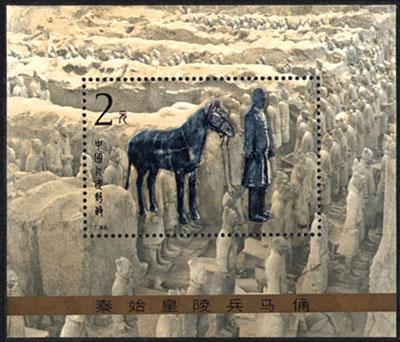
In 1983 China Post issued T.88 “Terracotta Figures of the Qin Mausoleum”, four stamps: a group of figures (8 fen), a figure (8 fen), warriors and horses (10 fen) and a pit (70 fen), with a 2-yuan souvenir sheet of a groom.
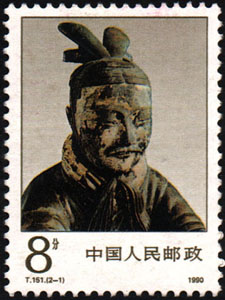
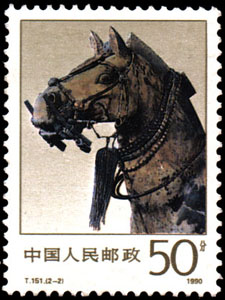
In 1990 T.151 “Bronze Chariots of the Qin Mausoleum”, two stamps: the head of a charioteer (8 fen) and a bronze horse’s head (50 fen), with a souvenir sheet.
News
In March 2008 Lintong announced a 160-million-yuan programme to afforest Mount Li.