National Parks of China
Overview
| Designation | National Park of China (first batch) |
| Province | Shaanxi |
| Location | Shaanxi, northern foot of the Qinling Mountains |
| Latitude, longitude | 34.5, 110.1 Google Maps |
| Highlights | The Western Sacred Mountain of the Five Sacred Mountains |
| Top sights | East Peak, Blue Dragon Ridge, the Plank Walk in the Sky |
| Highest point | 2,154.9 m |
| Nearby cities | Xi’an, Luoyang |
| Nearby sites | Terracotta Army and Mount Li, Lintong, Terracotta Army and Mount Li, Lintong, Longmen Grottoes, Luoyang, Mausoleum of the Yellow Emperor, Mount Wudang, Wulao Peak |
| Themes | Mountains, Famous mountains, Cliffs, Peaks, Taoism, Stamps, Cable cars |
About
Mount Hua, the Western Sacred Mountain, rises to 2,154 m in Huayin County, Shaanxi, about 100 km east of Xi’an at the northern foot of the Qinling range. A Taoist mountain famed for its precipitous grandeur, “since ancient times there has been only one path up Mount Hua”. It has five peaks, East, South, West, North and Central, the East, West and South being the highest. The East Peak is the place to watch the sunrise; the West Peak, shaped like a lotus, is the most beautiful; the South Peak, Luoyan, is the summit.
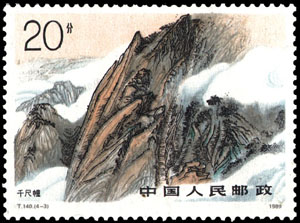
Famous sights: Yuquan Temple, Qingkeping, the Thousand-Foot Precipice, the Hundred-Foot Gorge, Blue Dragon Ridge, the East Peak, the Sparrowhawk’s Somersault and the Plank Walk in the Sky.
Getting there
Mount Hua is on the Longhai railway; get off at Huashan station. Tourist buses from Xi’an are also convenient. A cable car runs to the North Peak.
Stamps
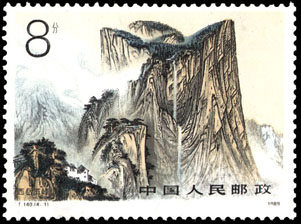
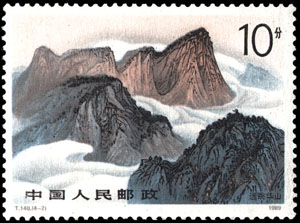
In 1989 China Post issued T140 “Mount Hua”, four stamps: the Western Sacred Mountain, Mount Hua from afar, the Thousand-Foot Precipice and Blue Dragon Ridge.
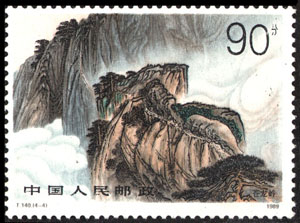
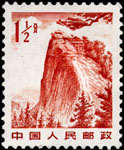
The second stamp of the 1981 definitive set R21 “Scenery of the Motherland” shows Mount Hua.