National Parks of China
Overview
| Designation | UNESCO World Heritage (cultural, 2000) National Park of China (first batch) AAAAA tourist attraction |
| Province | Henan |
| Location | On the Yi River south of Luoyang, Henan |
| Latitude, longitude | 34.6, 112.5 |
| Highlights | Buddhist sculpture, calligraphy inscriptions |
| Top sights | The great Vairocana Buddha |
| Nearby cities | Luoyang, Zhengzhou |
| Nearby sites | Mount Song, Mount Wangwu and Mount Yuntai, Mount Shennong, Mount Shiren (Stone Men), Qingtian River, Zhengzhou Yellow River |
| Themes | Grottoes, Statues, Buddhism, Culture & history, Inscriptions, Stamps |
About
The Longmen Grottoes, one of China’s three great grotto complexes, are cut into Longmen Mountain on the banks of the Yi River 12 km south of Luoyang, Henan. A spur of the Xiong’er range, the mountain splits into two facing hills with the river between, a natural gateway called the “Yi Gate”. The west bank is steep; over more than 400 years of carving from the Northern Wei to the Northern Song, a stretch 1 km long came to hold more than 2,100 caves and niches, over 100,000 figures, more than 3,600 inscriptions and over 40 pagodas, the largest number at any Chinese grotto site.
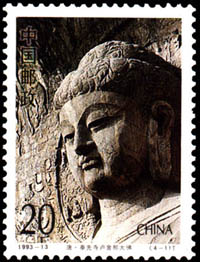
Fengxian Temple is the largest cave, over 30 m on each side; its statue of the Vairocana Buddha, 17.14 m high, is a masterpiece. Other caves include the middle Binyang Cave, the Guyang Cave and the Prescription Cave. The “Twenty Longmen Inscriptions” are the finest of Northern Wei calligraphy, and the Yique Buddhist Niche Stele in the hand of the Tang calligrapher Chu Suiliang is a model of early Tang regular script.
The east hill is called Xiangshan (Fragrant Hill); its temple is said to be where the Tang poet Bai Juyi lived in retirement, and his tomb, the Bai Garden, lies at the northern foot.
Stamps
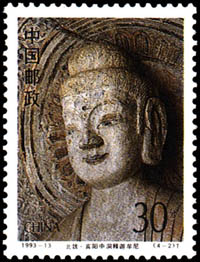
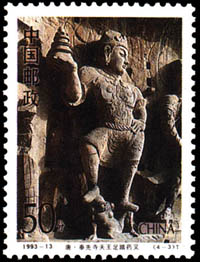
On 5 September 1993 China Post issued 1993-13 “Longmen Grottoes”, four stamps and a souvenir sheet: the Vairocana Buddha of Fengxian Temple (Tang), the Shakyamuni of the middle Binyang Cave (Northern Wei), a heavenly king treading a yaksha at Fengxian Temple (Tang), the left attendant bodhisattva of the Guyang Cave (Northern Wei), and Fengxian Temple.
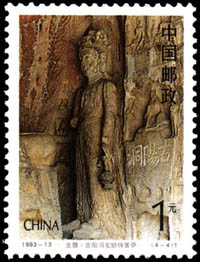
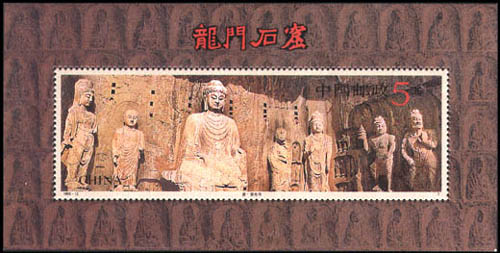
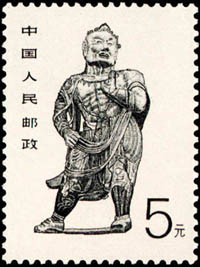
The second stamp of the 1988 definitive set R24 “Chinese Grotto Art” shows a Tang guardian from Longmen.