 National Parks of China
Overview
| Designation | UNESCO World Heritage (mixed, 1987) National Park of China (first batch) AAAAA tourist attraction |
| Province | Shandong |
| Location | Shandong |
| Latitude, longitude | 36.3, 117.1 Google Maps |
| Highlights | First of the Five Sacred Mountains; stone inscriptions, sea of clouds, sunrise |
| Top sights | The Eighteen Bends, South Heavenly Gate, Jade Emperor Peak, Dai Temple |
| Highest point | 1,532.7 m |
| Nearby cities | Jinan, Beijing, Tianjin, Nanjing |
| Nearby sites | Temple, Mansion and Cemetery of Confucius, Qufu, Thousand Buddha Mountain, Boshan, Qingzhou |
| Themes | Famous mountains, Mountains, Inscriptions, Temples, Taoism, Forests, Cascades, Stamps, Banknotes & coins, Cable cars |
About
Mount Tai, the Eastern Sacred Mountain, also called Daizong, is the first of the Five Sacred Mountains. It rises on the northern edge of Tai’an in Shandong, about 70 km south of Jinan. Emperors of many dynasties held the Fengshan sacrifices here. The summit, Jade Emperor Peak, is 1,533 m above sea level, the highest point in Shandong.
Inscriptions and stelae left by famous figures of every age are found all over the mountain, together with more than 20 groups of ancient buildings. The main sights are the Dai Temple, Puzhao Temple, Black Dragon Pool, the Sutra Stone Valley, the Doumu Palace, the Middle and South Heavenly Gates, the Bixia Temple and Jade Emperor Peak. The four wonders of the summit are sunrise over the east, the glow of sunset, the “golden belt” of the Yellow River and the “jade plate” sea of clouds.
A road climbs as far as the Middle Heavenly Gate, and a cable car runs from there to the top; the cable car has been much criticised by experts.
The Dai Temple in the city of Tai’an, also called the Temple of the Eastern Sacred Mountain, is where emperors sacrificed to the mountain and held their grand ceremonies.
Travel information
Admission (raised in 2007): 125 yuan in high season (1 February – 30 November), 100 yuan in low season (1 December – 31 January).
Stamps and banknotes
In 1988 China Post issued “Mount Tai”, four stamps: the Dai Temple in clear snow, the winding path to heaven, the grand peaks and sunrise over a sea of clouds.
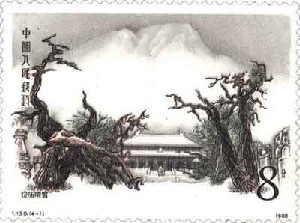
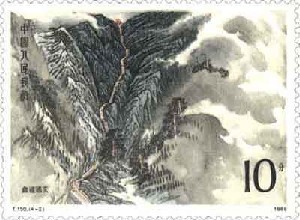
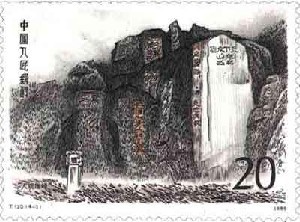
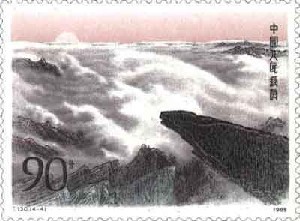
The third stamp of the 1981 definitive set R21 “Scenery of the Motherland” shows Mount Tai.
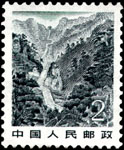
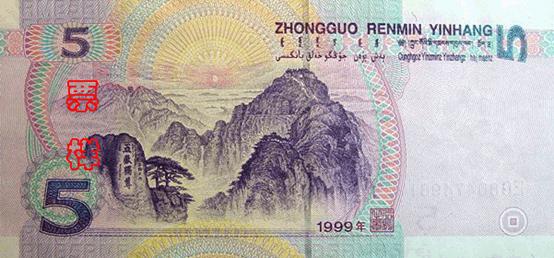
The back of the five-yuan note of the fifth series of renminbi shows Mount Tai.
In literature
“Gazing at the Sacred Mountain” by Du Fu (712–770): “What of Daizong? Over Qi and Lu the green never ends. Creation gathered here its divine beauty; north and south divide dusk and dawn. Layered clouds swell the breast; straining eyes follow the homing birds. One day I shall stand on the summit and see all the other mountains small.”
Lingyan Temple
Lingyan Temple lies north of Mount Tai in Changqing District of Jinan and is counted among the four great temples of China; as the saying goes, a visit to Mount Tai is not complete without Lingyan. The temple is famous for its painted clay arhats, called “the finest sculptures in the land”, and also has an ancient pagoda and a forest of memorial pagodas.