National Parks of China
Overview
| Designation | UNESCO World Heritage (cultural, 1994) |
| Province | Tibet |
| Location | Central Lhasa, Tibet |
| Latitude, longitude | 29.6, 91.1 Google Maps |
| Highlights | Holy place of Tibetan Buddhism; palace; works of art |
| Top sights | The stupas of the Dalai Lamas, the golden roofs |
| Elevation | 3,650 m |
| Nearby cities | Lhasa, Gyantse |
| Nearby sites | Namtso and the Nyainqêntanglha Mountains, Yamdrok Lake, Yarlung River, Tanggula Mountains and the Source of the Nu River |
| Themes | Palaces, Buddhism, Historic buildings, Museums, Temples, Statues, Plateaus, Snow mountains, Cities, Stamps, Banknotes & coins |
The Potala Palace
The Potala stands on Marpo Ri (Red Hill) in the centre of Lhasa, Tibet, and is the highest Buddhist palace in the world. Begun in the seventh century under the Tibetan king Songtsen Gampo, it rises 113 m in 13 storeys, 360 m east to west and 270 m north to south, with about 120,000 m² of floor space in a thousand rooms: living quarters, chapels, stupa halls and monks’ cells. It holds a vast number of statues, murals and other treasures.
The palace is in two parts: the Red Palace in the centre and the White Palace across the two wings. The Red Palace contains the stupa tombs of the Dalai Lamas and many chapels and assembly halls; the White Palace was where the Dalai Lama governed and lived. “Potala” is Sanskrit, also rendered Putuoluo or Putuo, the name of the island home of the bodhisattva Avalokiteshvara, so the palace is also called the second Mount Putuo. In the 1,300 years from Songtsen Gampo to the fourteenth Dalai Lama, nine Tibetan kings and ten Dalai Lamas ruled and taught here.
The Jokhang Temple
The Jokhang, in the heart of old Lhasa, was founded in 647 by Songtsen Gampo to welcome Princess Wencheng of the Tang court. The holiest temple of Tibetan Buddhism, it belongs to no single school. Since the rise of the Gelug school the Great Prayer Festival has been held here every year, and the ordination ceremonies of the Dalai Lamas and Panchen Lamas take place here. It enshrines the statue of Shakyamuni at the age of twelve brought by Princess Wencheng, and statues of Songtsen Gampo, Princess Wencheng and the Nepalese Princess Bhrikuti, as well as rare Tang relics; its corridors and halls are covered in murals of historical and legendary scenes. The golden roof is one of the best places from which to view the Potala.
Norbulingka
Norbulingka, in the west of the city, was the summer palace of the Dalai Lamas.
Travel information
Admission to the Potala is limited daily: 100 yuan (2005), 300 yuan (2007). The Jokhang: 70 yuan.
The second phase of restoration of the Potala, costing 179.3 million yuan, was due to finish by the end of 2007.
Stamps and banknotes
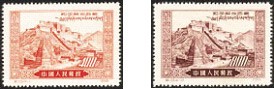
On 15 March 1952 China Post issued C13 “Peaceful Liberation of Tibet”, four stamps, two of which (400 and 800 yuan, old currency) show a panorama of the Potala.
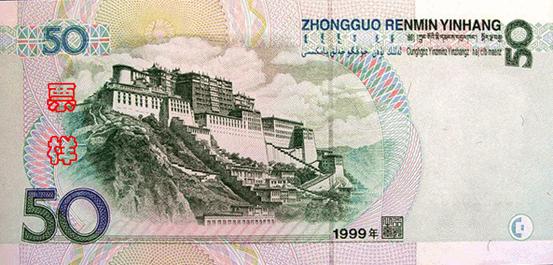
The back of the 50-yuan note of the fifth series of renminbi shows the Potala.