 National Parks of China
Overview
| Designation | National Park of China (second batch) |
| Province | Hunan |
| Location | Yueyang, Hunan |
| Latitude, longitude | 29.4, 113.1 Google Maps |
| Nearby cities | Wuhan, Changsha |
| Highlights | Lake; one of the famous towers of the south |
| Wildlife | Birds |
| Area | over 1,300 km² |
| Nearby sites | Lushui and the Red Cliff, Yuelu Mountain, Mount Heng (Southern Sacred Mountain), Shaoshan, Mount Jiugong, Weishan, Peach Blossom Land (Taohuayuan), East Lake, Wuhan |
| Themes | Lakes, Great rivers, Historic buildings, Culture & history, Cities, Stamps |
About
The Yueyang Tower–Dongting Lake scenic area in Yueyang, Hunan, has nine parts including the old town and tower, Junshan, South Lake, Bajiao Lake, the Miluo River, the Tieshan reservoir, Fushou Mountain and Huanggai Lake, over 1,300 km² in all.
Dongting Lake
Dongting Lake in northern Hunan, 4,000 km², is China’s second largest freshwater lake. It joins the Yangtze to the north and receives Hunan’s four great rivers, the Xiang, Zi, Yuan and Li, from the south.
Birds of Dongting
In 2008 experts from China, Britain, Denmark and Australia jointly surveyed 21 important wintering sites in the lake’s four wetland reserves, more than 40 experts and monitors in ten teams using line and point counts with uniform methods and forms, the largest simultaneous waterbird count ever made at Dongting.
The survey showed how much wintering waterbirds depend on the lake: 49 species and about 110,000 birds, eight species above the 1% international threshold: great cormorant, Bewick’s swan, falcated duck, greater and lesser white-fronted geese, bean goose, common crane and avocet. The lesser white-fronted geese were about 60% of the world’s wintering population, falcated ducks over 40%, avocets over 27% and bean geese over 20%.
The survey and monitoring during the winter freeze showed that with much of the lake iced over, open water for ducks shrank to the channels where the current kept flowing, and diving ducks such as the tufted duck, which need deep water, fell by more than 90%.
“More worrying, some birds could not be found at all,” said Jiang Yong, deputy director of the East Dongting national nature reserve. Black-headed gulls, once seen everywhere in winter at 3,000 to 10,000, were not found at all; more than five once widespread species of plovers and sandpipers were missing; and the endangered black stork, whose Dongting wintering flock was once about 30% of its eastern population, was not seen.
Lakes such as Jiaxing and the Qingshan polder and many outlying lakes that once held concentrations of birds had few wintering waterbirds this time, because of drought, conversion to reed farms and poplar plantations, and draining of enclosed waters to catch wintering fish, all of which have sharply reduced their value for birds.
Yueyang Tower
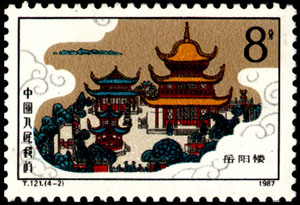
Yueyang Tower stands on the west gate of the city wall, the city behind, Dongting Lake below and Junshan Island opposite, one of the three great towers of the south: “Dongting is the water of the world, Yueyang the tower of the world”. Fan Zhongyan’s essay “On Yueyang Tower” made it famous.
The main tower has three storeys, 15 m, its weight carried on four great nanmu columns, with twelve round columns supporting the second floor and twelve catalpa eave columns raising the flying eaves; the roof is shaped like a general’s helmet. Beside it stand the Xianmei, Sanzui and Huaifu pavilions.
It was first built around AD 220, over 1,700 years ago, as the reviewing tower of Lu Su of the Three Kingdoms; it was the Baling city tower in the Northern and Southern dynasties and the South Tower in the early Tang, and took the name Yueyang Tower after Li Bai wrote of it in the mid-Tang. In the spring of 1045 Teng Zijing rebuilt it and asked his friend Fan Zhongyan for the essay that made it known everywhere. It was destroyed and rebuilt many times; the last major restoration was in 1983. Its structure is exquisite and dignified: “all timber, four columns, three storeys, flying eaves”.
The Xianmei (Immortal Plum) Pavilion to the south: when the foundations were dug for a rebuilding in the Chongzhen reign of the Ming, a slab white as jade was found with a withered plum branch of twenty-four faint blossoms, strong as if painted by an immortal; a pavilion was built to house it. The Sanzui (Thrice Drunk) Pavilion to the north recalls Lü Dongbin of the Eight Immortals, who three times wandered to Yueyang, fell in love with the scenery and got roaring drunk; a pavilion was added at the spot in 1755 and renamed in 1987.
The park gate bears the couplet “Dongting, the water of the world; Yueyang, the tower of the world”.
Inside hang couplets by famous writers of every age. Each of the first two floors has a carved screen of “On Yueyang Tower”: the first a 19th-century copy, the second written by the 18th-century master Zhang Zhao, square and vigorous, a national treasure. The third-floor screen is Du Fu’s “Climbing Yueyang Tower” in the hand of Mao Zedong, gleaming gold.
The hundred-metre stele gallery holds 134 steles of poems and calligraphy on the tower from every age and 24 recording its repairs since the Ming and Qing; the versions of the essay by the Ming painter Dong Qichang and by Zhu Yunming, one of the four talents of Wu, are treasures of the Palace Museum.
The second stamp of the 1987 set T121 “Famous Towers of China” shows Yueyang Tower.
“On Yueyang Tower” by Fan Zhongyan
In the spring of the fourth year of Qingli, Teng Zijing was demoted to govern Baling. By the next year government ran smoothly, the people were at peace and all that had fallen into neglect was restored; so he rebuilt Yueyang Tower, enlarging its old plan and carving on it the poems of Tang worthies and men of today, and asked me to write an account.
I observe that the splendour of Baling lies wholly in Dongting Lake: it holds distant mountains in its mouth and swallows the Yangtze, vast and surging, boundless, bright at dawn and dim at dusk, in ten thousand aspects. This is the great view from Yueyang Tower, and those before me have described it fully. Yet since it opens north to the Wu Gorge and reaches south to the Xiao and Xiang, exiled officials and poets gather here, and can their feelings at the sight be the same?
When the rains fall unceasing for months on end, the chill wind howls, muddy waves heave to the sky, sun and stars hide their light and the mountains vanish; when merchants cannot travel, masts topple and oars break; when dusk falls dark and tigers roar and gibbons cry: then to climb this tower is to feel the loss of one’s country and longing for home, fear of slander and dread of ridicule, desolation on every side and grief beyond bearing.
But when spring is mild and the light is clear, the waves lie still, sky and water share one blue to the horizon, gulls gather and fish swim, the orchids on the shore are lush and green; or when the long mist clears and the bright moon shines a thousand li, the floating light gleams like gold and the still reflection sinks like jade, and fishermen answer one another’s songs, what joy is greater? Then to climb this tower is to feel the heart open and the spirit lift, honour and disgrace forgotten, cup in hand in the breeze, glad beyond measure.
Ah! I have sought the hearts of the benevolent men of old, and they differed from both of these. Why? They did not rejoice in things nor grieve for themselves. High in the court, they worried for the people; far among rivers and lakes, they worried for their ruler. Advancing they worried, retiring they worried; when then were they happy? They would say: be the first in the world to worry, and the last in the world to rejoice. Alas, without such men, with whom shall I go?
Other poems
Li Bai: “Lightly swept, the bright lake opens like a jade mirror; what is painted there is Junshan.” Liu Yuxi: “Lake light and autumn moon in harmony; the surface windless, a mirror unpolished. Gazing far at the colours of Dongting, a green snail on a silver plate.”
News
In the summer of 2007 a plague of two billion Yangtze voles struck the Dongting region, some migrating inland as the water rose.
In March 2008 a suspected wild South China tiger was reported at Shiniuzhai in Pingjiang County, filmed for 20 seconds by a local TV reporter; on 23 March the provincial forestry department declared it a hoax staged with a circus.