 National Parks of China
← World Heritage map · ← Europe
Cultural 44Natural 4Mixed 2
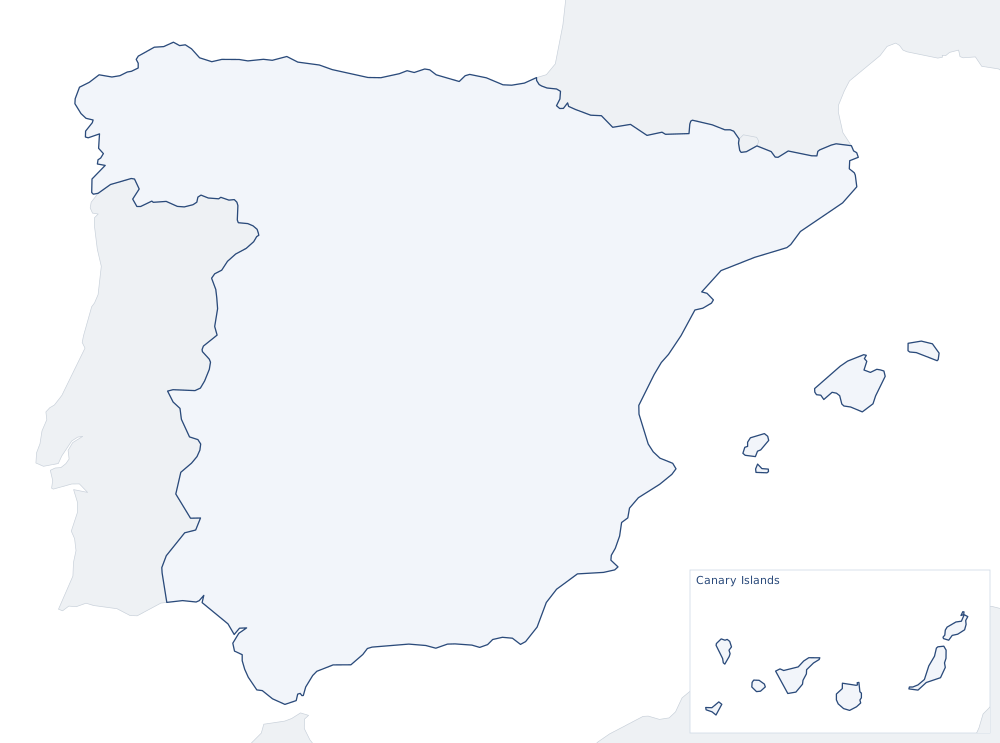
Spain has 50 World Heritage Sites (44 cultural, 4 natural, 2 mixed), the 5th most in the world. Hover over or tap a dot to see its name; click a name in the list to show it on the map. Listed by year of inscription.
- Historic Centre of Cordoba Córdoba in Andalusia, southern Spain, flourished from the 8th century under Islamic rule, when it gained hundreds of mosques and many palaces. After the city passed to Ferdinand III in the 13th century its Great Mosque became a cathedral, and the combination of Islamic and Christian architecture defines the historic centre.
- Alhambra, Generalife and Albayzín, Granada The Alhambra and the Albaycín occupy two adjacent hills in Granada, southern Spain, and form the medieval part of the city. The Alhambra is the fortress and palace of the Nasrid emirs of the 13th and 14th centuries, with the Generalife, their rural retreat and gardens, to its east. Together they are outstanding examples of Islamic architecture and garden design.
- Burgos Cathedral Burgos Cathedral in Castile, northern Spain, was begun in the 13th century, at the same time as the great cathedrals of the Île-de-France, and completed in the 15th and 16th centuries. Its architecture and its paintings, choir stalls, sculpture and tombs sum up the whole history of Gothic art.
- Monastery and Site of the Escurial, Madrid The Escorial Monastery stands in Castile, north-west of Madrid. It was built at the end of the 16th century on a grid-shaped plan recalling the martyrdom of St Lawrence, and served as monastery, royal palace, mausoleum and library. Its austere architecture influenced Spanish building for more than half a century.
- Works of Antoni Gaudí The property consists of seven works by the architect Antoni Gaudí (1852-1926) in and near Barcelona, including parts of the Sagrada Família, Casa Batlló and Park Güell. They show his highly personal style and his exceptional contribution to architecture and building technology in the late 19th and early 20th centuries.
- Cave of Altamira and Paleolithic Cave Art of Northern Spain Spread across the northern Spanish regions of Cantabria, Asturias and the Basque Country, this group of Palaeolithic caves includes the cave of Altamira. Its paintings and engravings represent the high point of Palaeolithic cave art in Europe, made mostly between about 35,000 and 11,000 years ago.
- Old Town of Segovia and its Aqueduct Segovia stands in Castile in central Spain. Its Roman aqueduct, built around the 1st century AD with two tiers of arches, is remarkably well preserved. The old town also contains the Alcázar, begun around the 11th century, and a 16th-century Gothic cathedral.
- Monuments of Oviedo and the Kingdom of the Asturias Oviedo in northern Spain was the capital of the Kingdom of the Asturias in the 9th century. The kingdom developed an innovative pre-Romanesque architectural style that influenced later religious architecture on the Iberian peninsula, and the property comprises several churches and buildings in and around the city.
- Santiago de Compostela (Old Town) Santiago de Compostela in Galicia, north-west Spain, is one of the major Christian pilgrimage destinations. The town was destroyed in the late 10th century and rebuilt in the 11th, and its Romanesque, Gothic and Baroque buildings are centred on the cathedral where the pilgrim routes end.
- Old Town of Ávila with its Extra-Muros Churches Ávila in Castile, central Spain, was founded in the 11th century as a defensive city and is known as the 'City of Saints and Stones'. Its complete medieval walls, Gothic cathedral and Romanesque churches outside the walls survive, and it is the birthplace of St Teresa.
- Mudejar Architecture of Aragon Mudejar architecture of Aragon, in north-eastern Spain, arose in the 12th century after the Reconquista, combining Islamic tradition with Gothic and other European styles, and continued into the early 17th century. The property includes towers and churches whose decorative brickwork is a defining feature.
- Historic City of Toledo Toledo in central Spain was a Roman town, the capital of the Visigothic Kingdom, a Muslim-ruled fortress and, in the 16th century, a seat of power of Charles V. Its old town preserves Christian, Islamic and Jewish monuments and holds more than 2,000 years of history.
- Garajonay National Park Garajonay National Park lies in the centre of La Gomera in Spain's Canary Islands, and about 70% of it is covered by laurel forest. Forests of this type were widespread in southern Europe in the Tertiary but have largely disappeared, and survive here thanks to abundant springs and streams.
- Old Town of Cáceres Cáceres in Extremadura, western Spain, has an old town blending Roman, Islamic, Northern Gothic and Italian Renaissance styles, reflecting its history of conflict between Moors and Christians. About 30 towers from the Muslim period remain, the best known being the Torre del Bujaco.
- Cathedral, Alcázar and Archivo de Indias in Seville The cathedral, the Alcázar and the Archivo de Indias stand together in the centre of Seville, Andalusia. The cathedral and Alcázar date from after the reconquest of 1248 to the 16th century and show Moorish influence, while the archive holds documents on Spain's colonisation of the Americas.
- Old City of Salamanca Salamanca in north-western Spain was held in turn by Carthaginians, Romans and Moors. Its university is among the oldest in Europe, and the historic centre, with Romanesque, Gothic, Renaissance and Baroque buildings, reflects the city's golden age in the 15th to 18th centuries.
- Poblet Monastery Poblet Monastery in Catalonia is one of the largest Cistercian abbeys in Spain, centred on a 12th-century church. It includes a fortified royal residence and the pantheon of the kings of Catalonia and Aragon.
- Archaeological Ensemble of Mérida Mérida in Extremadura, western Spain, was founded in 25 BC as Augusta Emerita and was the capital of the Roman province of Lusitania. Its well-preserved remains include a large bridge over the Guadiana, an amphitheatre, a theatre and a circus.
- Royal Monastery of Santa María de Guadalupe The Royal Monastery of Santa María de Guadalupe in Extremadura, western Spain, preserves four centuries of Spanish religious architecture. It is associated with two events of 1492, the completion of the Reconquista and Columbus's arrival in the Americas, and its statue of the Virgin became an important focus of pilgrimage in the Spanish-speaking world.
- Routes of Santiago de Compostela: Camino Francés and Routes of Northern Spain This extension of the Routes of Santiago de Compostela covers pilgrim routes across northern Spain, namely the Camino Francés and the coastal, Basque Country-La Rioja, Liébana and primitive routes, a network of almost 1,500 km. The routes link churches, hospitals and bridges that reflect the medieval pilgrimage tradition to Santiago de Compostela.
- Doñana National Park Doñana National Park lies on the right bank of the Guadalquivir estuary in Andalusia, southern Spain. Its lagoons, marshes, dunes and scrub woodland form one of Europe's most important wetlands, a wintering and breeding area for migratory birds and home to several threatened bird species.
- Historic Walled Town of Cuenca Cuenca in central Spain was built by the Moors on a defensive site and conquered by the Castilians in the 12th century. The walled medieval town is unusually well preserved, with Spain's first Gothic cathedral and the casas colgadas, the houses that hang over the gorge.
- La Lonja de la Seda de Valencia The Silk Exchange of Valencia, in eastern Spain, was built between 1482 and 1533 for the silk trade and is a masterpiece of late Gothic architecture. Its grand Contract Hall reflects the wealth of the city as a Mediterranean commercial centre.
- Pyrénées - Mont Perdu This mountain landscape spans the border between France and Spain around Mont Perdu, a limestone massif rising to 3,352 m, and covers about 30,639 ha. Its cirques, canyons and high pastures preserve a traditional Pyrenean pastoral way of life.
- Las Médulas Las Médulas in north-western Spain was the site of a large Roman gold mine, worked from the 1st century AD for about two centuries using hydraulic techniques. The mining left a dramatic landscape of reddish crags, ravines and channels that was not altered by later industry.
- Palau de la Música Catalana and Hospital de Sant Pau, Barcelona These two buildings in Barcelona, Spain, are works of the Catalan art nouveau architect Lluís Domènech i Montaner. The Palau de la Música Catalana is a steel-framed concert hall full of light and richly decorated, and the Hospital de Sant Pau is an equally bold hospital complex.
- San Millán Yuso and Suso Monasteries The Yuso and Suso monasteries in La Rioja, northern Spain, grew from the monastic community founded by St Millán in the mid-6th century, which became a place of pilgrimage. At Suso, which has a fine Romanesque church, the earliest written Castilian was produced, the ancestor of modern Spanish.
- Prehistoric Rock Art Sites in the Côa Valley and Siega Verde This property combines two open-air rock-art sites, the Côa Valley in Portugal and Siega Verde in Spain, on the banks of the Côa and Agueda rivers, tributaries of the Douro. The engravings document continuous human occupation from the end of the Upper Palaeolithic.
- Rock Art of the Mediterranean Basin on the Iberian Peninsula This large group of late prehistoric rock-art sites lies along the Mediterranean seaboard of the Iberian peninsula. The paintings vividly depict daily life during a critical phase of human development, and their style and subjects are unique.
- University and Historic Precinct of Alcalá de Henares Alcalá de Henares, near Madrid, was founded in the early 16th century by Cardinal Jiménez de Cisneros and was the world's first planned university city. It served as a model for universities in Europe and for the 'City of God' that Spanish missionaries built in the Americas.
- Ibiza, Biodiversity and Culture Ibiza, in Spain's Balearic Islands in the Mediterranean, is inscribed for both its natural and cultural heritage. Its waters hold dense meadows of Posidonia seagrass, endemic to the Mediterranean, and the island preserves evidence of Phoenician and Punic settlement as well as later fortifications.
- San Cristóbal de La Laguna San Cristóbal de La Laguna, on Tenerife in Spain's Canary Islands, has an unplanned Upper Town and a Lower Town laid out as an ideal city according to philosophical principles. Its wide streets and 16th- to 18th-century churches and houses influenced colonial town planning in the Americas.
- Archaeological Ensemble of Tarraco Tarraco, today's Tarragona in north-eastern Spain, was a major administrative and commercial city of Roman Spain and the centre of the imperial cult for the Iberian provinces. Although most of the excavated remains are fragmentary, together they show the scale and layout of the ancient city.
- Palmeral of Elche The Palmeral of Elche in south-eastern Spain is a landscape of date palm groves laid out with an elaborate irrigation system when the Muslim city was founded, towards the end of the 10th century. It is an oasis and agricultural system for arid areas, rare in Europe.
- Roman Walls of Lugo Lugo in Galicia, north-west Spain, is surrounded by walls built in the later 3rd century to defend the Roman town of Lucus. The whole circuit survives intact and is the finest example of late Roman fortifications in western Europe.
- Catalan Romanesque Churches of the Vall de Boí The Vall de Boí lies in the high Pyrenees of Catalonia, north-eastern Spain, surrounded by steep mountains. Each village has a Romanesque church set among enclosed fields, with seasonal grazing on the higher slopes.
- Archaeological Site of Atapuerca The Sierra de Atapuerca, near Burgos in northern Spain, has caves with a rich fossil record of the earliest humans in Europe, from nearly one million years ago to around the Common Era. The finds are an exceptional source of data on the appearance and way of life of early human communities.
- Aranjuez Cultural Landscape Aranjuez, south of Madrid in Spain, is a royal landscape shaped over three centuries, where watercourses, geometric garden design and palatial architecture combine.
- Renaissance Monumental Ensembles of Úbeda and Baeza Úbeda and Baeza are two small cities in Andalusia, southern Spain, whose layout dates from the Moorish period and the 13th-century Reconquista. Both were remodelled in the 16th century along Renaissance lines, giving early examples of Renaissance urbanism in Spain that later influenced Latin America.
- Vizcaya Bridge Vizcaya Bridge spans the Ibaizabal estuary west of Bilbao, Spain. Designed by Alberto de Palacio and completed in 1893, it is 45 m high with a 160 m span and combines iron-working tradition with steel-rope technology.
- Ancient and Primeval Beech Forests of the Carpathians and Other Regions of Europe This transnational serial property consists of beech forests spread across 18 European countries. Since the end of the last Ice Age, European beech has spread from a few refuges across the continent, and these forests record that ongoing ecological process.
- Teide National Park Teide National Park on Tenerife, Spain, centres on the Teide-Pico Viejo stratovolcano. At 3,718 m, Teide is the highest peak in Spain, rising some 7,500 m from the ocean floor.
- Tower of Hercules The Tower of Hercules, a lighthouse at the entrance of A Coruña harbour in north-western Spain, was built by the Romans in the late 1st century AD. It stands 55 m high on a 57 m rock and is still in use.
- Cultural Landscape of the Serra de Tramuntana The Serra de Tramuntana on the north-west coast of Mallorca, Spain, is a mountain landscape in which millennia of farming produced terraces and an elaborate system of water management.
- Heritage of Mercury. Almadén and Idrija This transnational property consists of the mercury mining sites of Almadén in Spain, where mercury has been extracted since antiquity, and Idrija in Slovenia, where it was found in AD 1490. Together they reflect the centuries-long mercury trade between Europe and the Americas.
- Antequera Dolmens Site The Antequera Dolmens Site in Andalusia, Spain, includes the Menga and Viera dolmens and the El Romeral tholos, with two natural landmarks, La Peña de los Enamorados and El Torcal. The monuments date from the Neolithic and Bronze Age.
- Caliphate City of Medina Azahara Medina Azahara lies just west of Córdoba in southern Spain. It was built in the mid-10th century by the Umayyad dynasty as the seat of the Caliphate of Córdoba, and was ruined in the civil war of 1009-1010. Forgotten for centuries and excavated from the 20th century, it is a key source on the court and urban planning of Islamic Spain.
- Risco Caido and the Sacred Mountains of Gran Canaria Cultural Landscape Risco Caído lies in the mountainous centre of Gran Canaria in Spain's Canary Islands. Its cliffs and ravines hold many cave dwellings, granaries and cisterns left by the pre-Hispanic island culture, together with sacred mountains linked to astronomical observation and ritual.
- Paseo del Prado and Buen Retiro, a landscape of Arts and Sciences Located in the heart of Madrid, Spain, this urban landscape combines the tree-lined Paseo del Prado, laid out from the 16th century, with the Buen Retiro park and surrounding districts. Its fountains, museums, botanical garden and scientific institutions reflect the city's development as a centre of art and science.
- Talayotic Menorca On the island of Menorca in the western Mediterranean, Spain, a group of prehistoric settlements and burial sites lies within an agro-pastoral landscape. Dating from the Bronze Age to the Late Iron Age, the sites show the evolution of a megalithic architecture built of very large stone blocks, including the talayots that give the culture its name.