National Parks of China
Overview
| Designation | National Park of China (first batch) AAAAA tourist attraction |
| Province | Jiangxi |
| Location | South-west Jiangxi, middle of the Luoxiao range |
| Latitude, longitude | 26.5, 114.1 |
| Highlights | Cradle of the Chinese revolution |
| Top sights | Ciping, Wuzhi Peak, the Longtan waterfalls |
| Wildlife | Yew |
| Area | 214 km² |
| Elevation | 1,841 m |
| Highest point | 1,597.6 m |
| Nearby cities | Nanchang, Changsha, Guangzhou, Shenzhen, Hong Kong |
| Nearby sites | Mount Wugong, Mount Heng (Southern Sacred Mountain), Mount Danxia, Mausoleum of the Yan Emperor, Dongjiang Lake, Suxianling and Wanhuayan |
| Themes | Famous mountains, Mountains, Forests, Waterfalls, Culture & history, Banknotes & coins, Stamps |
About
Jinggangshan, the “cradle of the revolution”, lies in south-west Jiangxi on the border with Hunan in the middle of the Luoxiao range, a scenic area of 214 km². The main sights are Ciping, Wuzhi (Five Fingers) Peak and the Longtan waterfalls; the highest point, Jiangxi’ao, is 1,841 m.
Banknotes and stamps
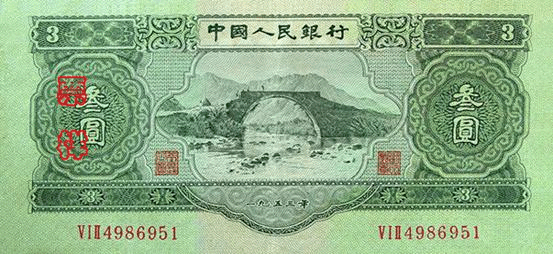
The 3-yuan note of the second series of renminbi (1955) shows Jinggangshan.
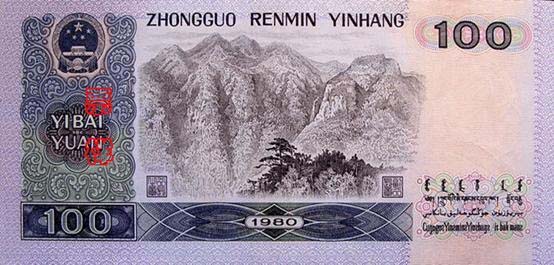
The back of the 100-yuan note of the fourth series (1988) shows Wuzhi Peak.
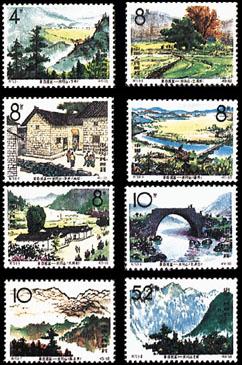
In 1965 China Post issued S70 “Cradle of the Revolution: Jinggangshan”, eight stamps: Ciping, Sanwan village, the Octagonal Building at Maoping, Longshi, Dajing village, Longyuankou, Huangyangjie and the main peak.