 National Parks of China
Overview
| Designation | National Park of China (fifth batch) |
| Province | Jiangxi |
| Location | Outskirts of Nanchang, Jiangxi |
| Latitude, longitude | 28.8, 115.7 |
| Highlights | One of the famous towers of the south |
| Area | 150 km² |
| Nearby cities | Nanchang, Wuhan |
| Nearby sites | Mount Lu (Lushan), Mount Longhu (Dragon and Tiger Mountain), Guifeng (Turtle Peak), Mount Sanqing, Mount Yunju and Zhelin Lake, Mount Jiugong |
| Themes | Mountains, Historic buildings, Cities, Cascades, Caves |
About
The Meiling–Tengwang Pavilion scenic area lies in Nanchang, capital of Jiangxi, 15 km from the city centre, 150 km².
Meiling
Meiling is a detached mountain mass of the Jiuling range, over 100 km round, touching no other range, a “flying peak”. Its sights are Lion Peak with its classic talus landform, the 5 km string of waterfalls and water mills at Tongyuangang, the boulder field of Shixi Valley and the 170 m granite boulder cave of Panxian. It also has rime, hoar and glaze ice in winter.
The Pavilion of Prince Teng
The pavilion stands on Yanjiang North Avenue by the river in Nanchang, facing Meiling across the water, one of the three great towers of the south, “the first tower on the West River”. Wang Bo’s famous preface gave the line “the sunset glow and a lone duck fly together; the autumn water and the long sky share one colour”.
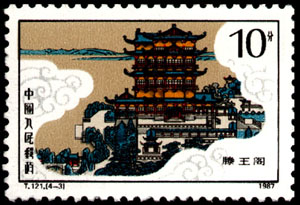
The third stamp of the 1987 set T121 “Famous Towers of China” shows the pavilion.
“Preface to the Pavilion of Prince Teng” by Wang Bo
Old Yuzhang commandery, new Hongdu prefecture: its stars divide Yi and Zhen, its land joins Heng and Lu; it is collared by three rivers and belted by five lakes, holds the barbarian Jing and draws in Ou and Yue. Its things are splendid and heaven’s treasures: the light of the dragon sword shot to the Ox and Dipper; its men are outstanding and its earth numinous: Xu Ru came down to Chen Fan’s couch. The great city ranks like mist, the brilliant talents gallop like stars. Its walls and moats lie between barbarian and Chinese, its guests and hosts are the finest of the south-east. The governor Yan of noble repute comes from afar with his halberds; Yuwen of Xinzhou of fine example halts his carriage for a while. On this tenth-day holiday, fine friends gather like clouds; from a thousand li they are welcomed, noble guests fill the seats. Scholar Meng, master of letters, soaring dragon and rising phoenix; General Wang, armoury of purple lightning and clear frost. My father is a magistrate, and my road passed through this famous place; what does a boy know? I chanced on this splendid feast.
It is the ninth month, the season deep autumn. The rain puddles are gone and the cold pools clear; the mist thickens and the evening hills are purple. We drove our teams along the high road and sought the scenery in the lofty hills; we came to the long isle of the emperor’s son and found the old lodge of the immortal. Layered ridges rise green, soaring past the heavens; the flying pavilion flows vermilion, looking down on no ground. Crane shoals and duck islets wind round the islands; cassia halls and orchid palaces follow the shape of the hills.
Open the embroidered doors, look down from the carved ridges: the hills and plains fill the eyes, the rivers and marshes startle the gaze. Houses crowd the ground, families of bells and tripods; boats and ships throng the crossing, sterns of blue sparrows and yellow dragons. The rainbow fades, the rain clears, the colours shine through the clear air. The sunset glow and a lone duck fly together; the autumn water and the long sky share one colour. Fishing boats sing at evening, their sound reaching the shores of Pengli; a line of geese startles at the cold, their cry breaking off on the banks of Hengyang.
Chanting afar, the spirit is at ease and high feeling flies fast. The clear pipes sound and a cool breeze rises; the fine song lingers and the white clouds stop. Green bamboo of the Sui garden, a spirit surpassing the cups of Pengze; red lotus of the Ye river, a light shining on the brush of Linchuan. The four beauties are present, the two difficulties combined. We gaze to the limit of mid-heaven and spend the leisure day in utmost pleasure. Heaven is high and earth far, and one feels the universe without end; when joy is spent sorrow comes, and one knows that fullness and want have their number. We look for Chang’an beneath the sun and point to Wu and Kuai among the clouds; the land ends and the southern sea is deep, the pillar of heaven is high and the pole star far. Passes and mountains are hard to cross: who pities the man who has lost his way? Duckweed meeting on the water: all are strangers from other lands. I long for the emperor’s gate and do not see it; in what year shall I attend the Xuanshi hall?
Alas! Fortune is uneven and the road of fate full of turns. Feng Tang grew old easily; Li Guang was hard to ennoble. Jia Yi was banished to Changsha, not for want of a sage ruler; Liang Hong fled to the sea’s corner, not for lack of an enlightened age. One relies on the gentleman’s content in poverty and the wise man’s knowledge of fate. Old, one should be the more vigorous, never changing the heart of white hairs; poor, the firmer, never letting fall the ambition of the blue clouds. Drink from the spring of greed and feel refreshed; lie in the dry rut and still rejoice. Though the North Sea is far, it can be reached by the whirlwind; the eastern corner has passed, but the mulberry evening is not late. Meng Chang was pure and lofty, vainly nursing his wish to serve the state; Ruan Ji was wild: shall I copy his weeping at the road’s end?
I, Bo, three feet of lowly fate, a single scholar: no road to ask for the cord, though of the age of Zhong Jun; a wish to throw down the brush, admiring the long wind of Zong Que. I give up hairpin and tablet for a hundred years to serve morning and evening ten thousand li away. Not the precious tree of the Xie family, yet I have joined the fine neighbours of the Mengs. Some day I shall hasten across the court and dare to join Li’s replies; this morning I lift my sleeves and gladly rest on the dragon gate. Not meeting Yang Yi, I stroke the cloud-topping rhapsody and pity myself; having met Zhong Qi, why be ashamed to play Flowing Water?
Ah! Splendid places do not last; grand feasts are hard to repeat. The Orchid Pavilion is gone; Zize is a ruin. At parting I offer these words, fortunate to receive the favour of this great farewell; to climb high and compose is what I hope of all you gentlemen. I dare to exhaust my humble sincerity and respectfully set down this short introduction. One word each to be assigned, four rhymes all complete: pour out the river of Pan and tip the sea of Lu, each of you, I pray.
Poem: The high pavilion of Prince Teng stands over the river isle; jade pendants and singing bells have ceased their song and dance. The painted beams at dawn fly the clouds of the south shore; the pearl curtains at dusk roll up the rain of the western hills. Idle clouds and pool shadows, the days pass slowly; things change and stars move, how many autumns gone. Where now is the emperor’s son in the pavilion? Beyond the rail the long river flows on alone.