National Parks of China
Overview
| Designation | UNESCO World Heritage (cultural, 1987) National Park of China (third batch) |
| Province | Gansu |
| Location | North-west Gansu |
| Latitude, longitude | 40.0, 94.8 Google Maps |
| Highlights | Buddhist cave temples; desert oasis |
| Top sights | The Mogao Caves |
| Highest point | 1,715 m |
| Nearby cities | Gansu |
| Nearby sites | Kumtag Desert, Qinghai Hoh Xil, Qinghai Lake |
| Themes | Grottoes, Buddhism, Statues, Deserts, Sand dunes, Springs, Culture & history, Stamps |
The Mogao Caves
The Mogao Caves, also called the Caves of the Thousand Buddhas, are cut into a cliff at the eastern foot of the Mingsha Dunes 25 km south-east of Dunhuang, at the western end of the Hexi Corridor in Gansu. The cliff face runs 1,680 m north to south and is 50 m high. Work began in AD 366 and the site is the most famous Buddhist cave complex in China: 735 caves survive from the Northern Wei to the Yuan dynasty, 487 in the southern section and 248 in the northern. The main caves, in the southern section, hold a vast number of Buddhist wall paintings and statues: 45,000 m² of murals and more than 2,000 painted sculptures in all.
In 1900 the Library Cave was discovered, holding more than 50,000 manuscripts from the Sixteen Kingdoms to the Northern Song; from it grew Dunhuang studies, the discipline devoted to these documents and to Dunhuang art.
Mingsha Dunes and Crescent Spring
The Mingsha (“Singing Sand”) Dunes lie 5 km south of Dunhuang; the highest point is 1,715 m. They take their name from the sound the sand makes as it shifts. The dunes are built of drifting sand in five colours: red, yellow, green, white and black.
Crescent Spring (Yueyaquan) lies at the foot of the dunes and is named for its shape, like a new moon.
The modern Dunhuang grottoes
The Dunhuang Modern Grotto Art Centre lies in the Danghe gorge 33 km west of the town. Begun in 1996, it fulfils the wish to “continue Dunhuang” of Chang Shuhong, founder of the Dunhuang Academy and “guardian of Dunhuang”, and was cut with their own funds by his widow, the Dunhuang scholar Li Chengxian, and his son, the Japan-based artist Chang Jiahuang.
On 24 July 2007 the centre announced that one of its modern murals, the Medicine Buddha, had been stripped from the wall and stolen.
Travel information
All attractions run by Dunhuang municipality give a 10-yuan discount in low season.
Stamps
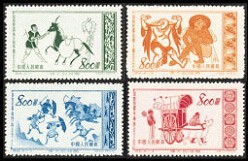
On 1 July 1952 China Post issued S3, “Our Great Motherland (1st series): Dunhuang Murals”, four stamps of 800 yuan (old currency): a hunt (Western Wei), donors (Northern Zhou), flying apsaras (Tang) and a celestial riding a tiger (Tang).
On 1 September 1953 followed S6, “Our Great Motherland (3rd series): Dunhuang Murals”, four stamps: a groom and horse (Western Wei), musicians (Western Wei), a battle (Northern Zhou) and an ox cart (Tang).
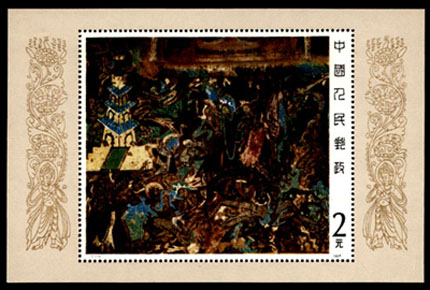
On 20 May 1987 T116 “Dunhuang Murals (1st series)” was issued, four stamps and a souvenir sheet: an offering bodhisattva, the Deer King jataka, heavenly musicians, flying apsaras, and Prince Sattva giving his body to the tigress.
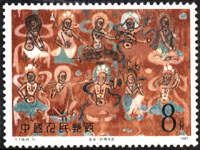
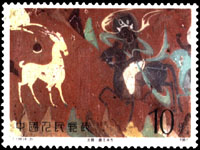
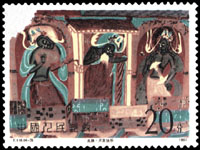
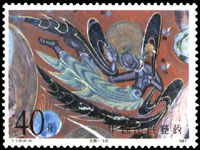
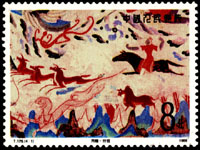
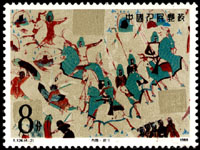
On 25 May 1988 T126 “Dunhuang Murals (2nd series)”, four stamps: a hunt and a battle (Western Wei), ploughing and building a pagoda (Northern Zhou).
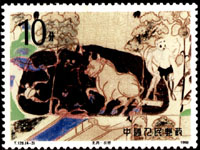
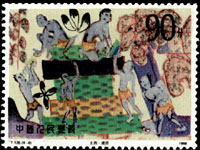
On 10 July 1990 T150 “Dunhuang Murals (3rd series)”, four stamps from the Sui dynasty: flying apsaras, an offering bodhisattva, Guanyin saving the afflicted, and Indra.
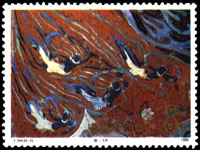
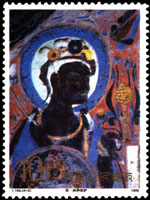
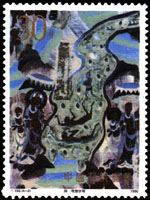
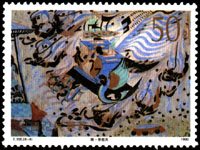
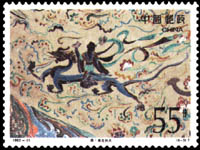
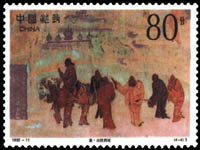
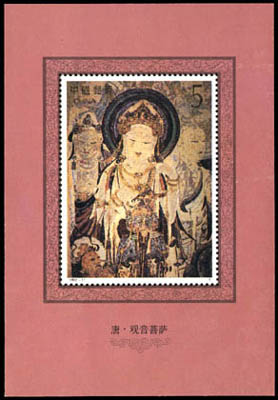
On 15 September 1992 1992-11 “Dunhuang Murals (4th series)”, four stamps and a sheet, all Tang: a bodhisattva, musicians, ascending to heaven on a dragon, an envoy to the Western Regions, and Guanyin.
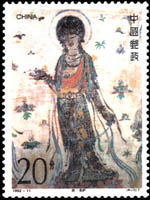
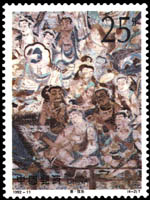
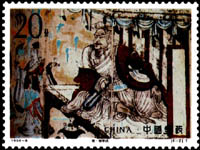
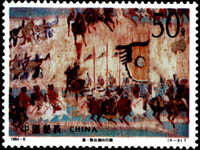
On 16 July 1994 1994-8 “Dunhuang Murals (5th series)”, four Tang subjects: flying apsaras, Vimalakirti, the procession of Zhang Yichao, and the demon’s daughters.
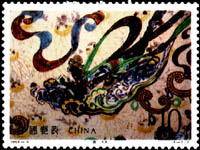

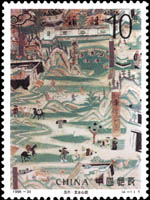
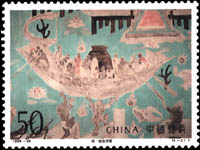
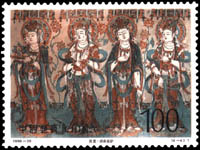
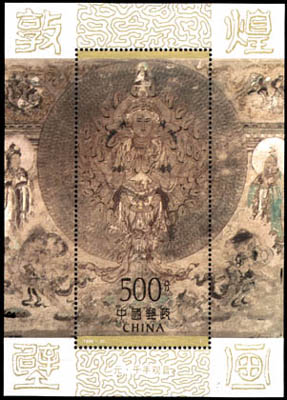
On 15 August 1996 1996-20 “Dunhuang Murals (6th series)”, four stamps and a sheet: the map of Mount Wutai (Five Dynasties), the King of Khotan (Five Dynasties), Guanyin saving the afflicted (Song), an offering bodhisattva (Western Xia) and the thousand-armed Guanyin (Yuan).