 National Parks of China
← World Heritage map · ← Europe
Cultural 22Natural 11
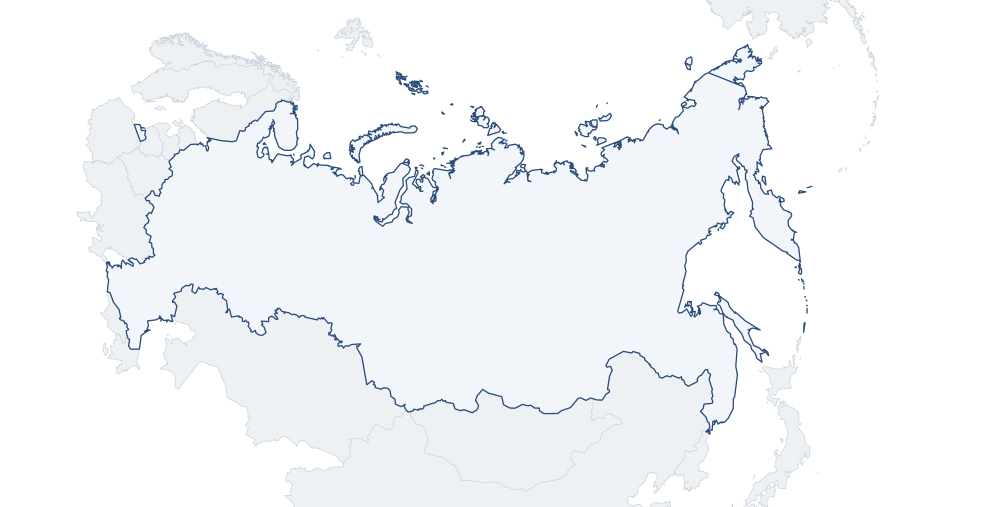
Russia has 33 World Heritage Sites (22 cultural, 11 natural), the 9th most in the world. Hover over or tap a dot to see its name; click a name in the list to show it on the map. Listed by year of inscription.
- Historic Centre of Saint Petersburg and Related Groups of Monuments At the mouth of the Neva in north-western Russia, founded by Peter the Great in 1703 and capital of the Russian Empire. Its centre and surrounding palaces, canals and squares show urban planning and European architectural styles of the 18th and 19th centuries.
- Kizhi Pogost On Kizhi island in Lake Onega, Karelia, Russia, the 18th-century Transfiguration and Intercession churches are built of logs and crowned with many wooden domes. The ensemble represents the wooden architecture of northern Russia.
- Kremlin and Red Square, Moscow In the centre of Moscow, Russia, the Kremlin is a fortress and political and religious centre developed from the 14th to the 17th century, with Red Square on its east side. Its cathedrals, palaces and walls record the history of the Russian state.
- Historic Monuments of Novgorod and Surroundings In north-western Russia, Novgorod was among the earliest political and religious centres of the country and keeps churches, monasteries and a kremlin from the 11th to 17th centuries. St Sophia Cathedral is one of the oldest surviving stone churches in Russia.
- Cultural and Historic Ensemble of the Solovetsky Islands On the Solovetsky Islands in the White Sea, north-western Russia, a monastery founded in the 15th century became a major religious and defensive centre of the Russian North. Its stone monastic complex and the island's water works survive.
- White Monuments of Vladimir and Suzdal East of Moscow, Vladimir and Suzdal keep white-stone churches and monasteries of the 12th and 13th centuries. Their fine carved decoration is an outstanding example of medieval Russian architecture.
- Architectural Ensemble of the Trinity Sergius Lavra in Sergiev Posad In Sergiev Posad, about 70 km north of Moscow, founded in the 14th century by St Sergius and one of the most important monasteries of the Russian Orthodox Church. Churches, a bell tower and walls reflect the architecture of the 15th to 18th centuries.
- Church of the Ascension, Kolomenskoye In southern Moscow, a stone church built in 1532 to mark the birth of the heir of Vasily III. It was one of the first to use the tent-roof form in Russian architecture, which strongly influenced later church design.
- Virgin Komi Forests In the Komi Republic on the western slopes of the Urals, Russia, one of the largest tracts of primary boreal forest in Europe. Its forests, rivers and bogs are largely undisturbed and valuable for studying taiga ecosystems.
- Lake Baikal In southern Siberia, Russia, the deepest and oldest freshwater lake in the world, with a maximum depth of about 1,642 m and an age of some 25 million years. It has a great number of endemic species, such as the Baikal seal.
- Volcanoes of Kamchatka On the Kamchatka Peninsula in the Russian Far East, one of the most concentrated areas of volcanic activity in the world, with active volcanoes and volcanic plateaus. Volcanoes, geysers and hot springs occur together, with rich wildlife such as brown bears and salmon.
- Golden Mountains of Altai In the Altai mountains of southern Siberia, the source of the Ob and Irtysh rivers, three separate areas protect a full sequence of vegetation zones from steppe and forest to alpine tundra. The region is habitat for rare animals such as the snow leopard.
- Western Caucasus At the western end of the Caucasus mountains, about 50 km north-east of the Black Sea, this 275,000 ha area is one of the few large European mountain regions without significant human impact. It preserves ecosystems from lowland broadleaf forest to alpine meadow.
- Historic and Architectural Complex of the Kazan Kremlin In Kazan, capital of Tatarstan, the Kremlin stands on an ancient site from the time of the Golden Horde and the Kazan Khanate. After its capture by Ivan the Terrible in 1552 it became a Christian see of the Volga region, and it is the only surviving Tatar fortress in Russia.
- Ensemble of the Ferapontov Monastery In the Vologda region of northern Russia, this is an exceptionally complete Russian Orthodox monastic complex of the 15th–17th centuries. The Cathedral of the Nativity of the Virgin contains frescoes painted by Dionisy around 1502.
- Curonian Spit The Curonian Spit is a long sand-dune peninsula on the Baltic coast, 98 km long and 0.4 to 4 km wide, shared by Lithuania and Russia. People have lived here since prehistoric times, and the spit survives through continuous human efforts, such as planting and stabilising dunes, to counter erosion by wind and waves.
- Central Sikhote-Alin Located in Primorsky Krai in the Russian Far East, this mountain forest lies in a transition zone between taiga and subtropical vegetation. Tigers and Himalayan bears share it with brown bears and lynx. An extension in 2018 added the Bikin River Valley to the north.
- Citadel, Ancient City and Fortress Buildings of Derbent In Dagestan, Russia, on the western shore of the Caspian Sea, the city controls the passage between the Caucasus and the sea. Its citadel, old town and walls running to the sea date from the Sasanian period and were used as a fortress for many centuries.
- Uvs Nuur Basin The Uvs Nuur Basin, in north-western Mongolia and the Russian Federation, is the northernmost of the enclosed basins of Central Asia, covering 1,068,853 ha. It is named after Uvs Nuur, a large, shallow and saline lake important for migrating birds, and its twelve protected areas represent the major biomes of eastern Eurasia.
- Natural System of Wrangel Island Reserve Wrangel and Herald Islands in the Arctic Ocean off the Russian Far East form an important Arctic reserve. They have the highest density of polar bear dens in the world, along with large Pacific walrus colonies and migratory birds.
- Ensemble of the Novodevichy Convent A convent in Moscow founded in the 16th century and a leading ensemble of Moscow Baroque. It housed women of noble families, and its cemetery holds the graves of many notable Russians.
- Historical Centre of the City of Yaroslavl On the Volga in Russia, founded in the 11th century and long an important trading city on the river. Its 17th-century churches and the district replanned in the 18th and 19th centuries on Neoclassical lines are representative of Russian urban planning.
- Struve Geodetic Arc The Struve Arc is a chain of survey triangulations stretching from Hammerfest in Norway to the Black Sea through 10 countries, over 2,820 km. Measured between 1816 and 1855 to determine the size and shape of the Earth, it is a landmark of scientific cooperation.
- Putorana Plateau A remote basalt plateau in north-central Siberia, south of the Taymyr Peninsula, with deep canyons, waterfalls and thousands of lakes. It holds arctic, subarctic and taiga ecosystems that remain largely undisturbed.
- Lena Pillars Nature Park On the banks of the upper Lena River in the Sakha (Yakutia) Republic, Russia, rock pillars over 100 m high line the river. The site shows distinctive landforms of a cold climate and contains important Cambrian fossils.
- Bolgar Historical and Archaeological Complex On the Volga River south of Kazan, the site holds remains of the medieval city of Bolgar, centre of the Volga Bulgars, who adopted Islam in the early 10th century. It later became an important city of the Golden Horde.
- Landscapes of Dauria The Landscapes of Dauria span eastern Mongolia and south-eastern Siberia in the Russian Federation, and are an outstanding example of the Daurian Steppe eco-region. Cyclical dry and wet climate phases support a wide diversity of species and ecosystems and important bird migration routes.
- Assumption Cathedral and Monastery of the town-island of Sviyazhsk On an island in the Volga west of Kazan, Tatarstan, Russia, founded by Ivan the Terrible in the 16th century. The Assumption Cathedral has well-preserved 16th-century frescoes, and the site records the eastward expansion of Orthodox Christianity.
- Churches of the Pskov School of Architecture In Pskov in north-western Russia, churches of a regional style developed between the 12th and 16th centuries, known for plain facades, asymmetrical composition and bell walls. The school influenced later Russian architecture.
- Petroglyphs of Lake Onega and the White Sea In the Republic of Karelia, Russia, more than 4,000 prehistoric petroglyphs on the eastern shore of Lake Onega and along the White Sea date from roughly the fourth to third millennium BC. They show hunting, fishing and ritual scenes.
- Astronomical Observatories of Kazan Federal University In Kazan, Russia, the Engelhardt Observatory and the university's other observation sites have been used for astronomy since the 19th century. They represent early university-based astronomy in Russia.
- Cultural Landscape of Kenozero Lake In the south-west of Arkhangelsk Oblast, Russia, the Kenozero Lake area keeps wooden churches, chapels and villages from the 16th to 19th centuries. Local traditions still blend Orthodox Christianity with older folk beliefs.
- Rock Paintings of Shulgan-Tash Cave In the Kapova cave in the southern Urals of Bashkortostan, Russia, Upper Palaeolithic paintings in red ochre depict mammoths, horses and rhinoceroses. It is one of the easternmost sites of Palaeolithic cave art in Europe.