 National Parks of China
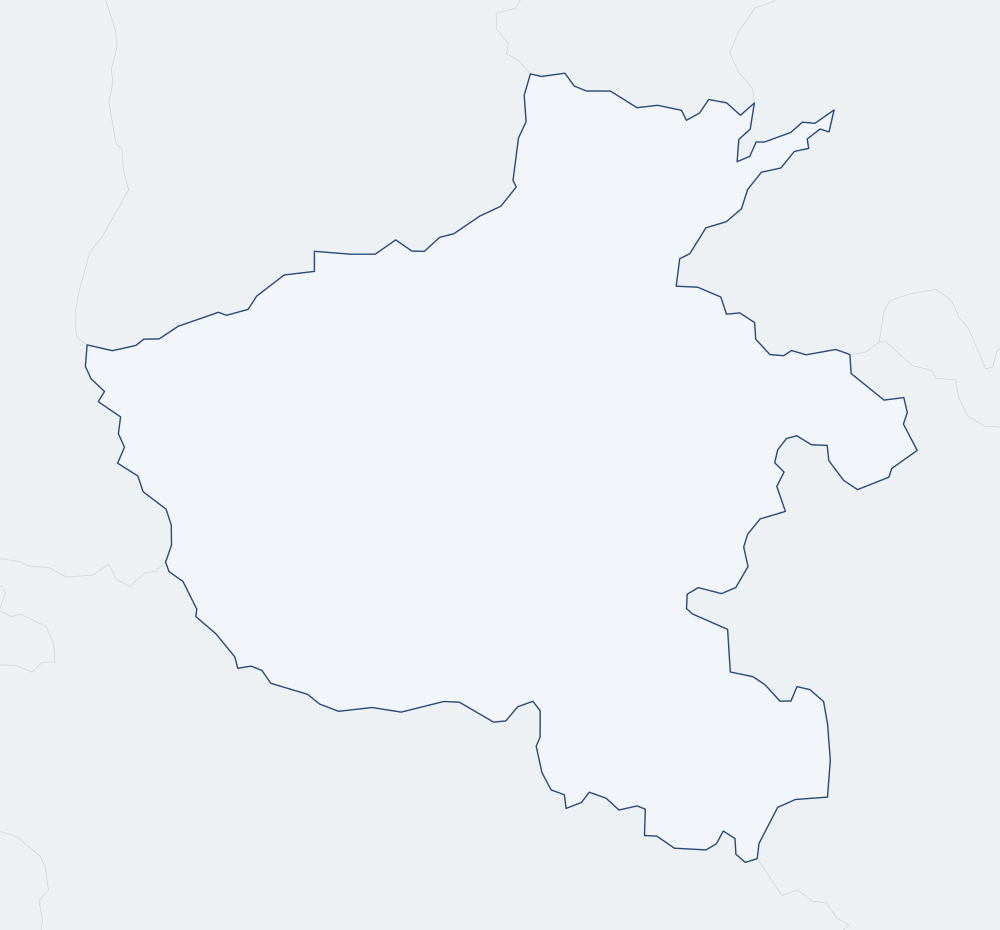
418 Major Historical and Cultural Sites Protected at the National Level in Henan (batches 1–8, named by the State Council 1961–2019). Dots are coloured by category; click one to jump to its entry. See also Henan and all provinces.
Batch:

Zhengzhou (81)
- Taishi Que Gate Tower 太室阙Ancient buildings · first batch (1961)Eastern Han stone que tower standing before the Zhongyue Temple, serving as its symbolic gate; a ritual building.
- Shaoshi Que Gate Tower 少室阙Ancient buildings · first batch (1961)Eastern Han stone que tower, the spirit-way que of the Shaoshi Mountain temple, standing at the foot of Mount Shaoshi.
- Qimu Que Gate Tower 启母阙Ancient buildings · first batch (1961)Eastern Han stone que tower, the spirit-way que before the Qimu Temple, standing below Wansui Peak at the southern foot of Mount Song.
- Songyue Temple Pagoda 嵩岳寺塔Ancient buildings · first batch (1961)Dense-eave brick pagoda built in the Zhengguang years of the Northern Wei; the oldest surviving dense-eave pagoda in China, considered the prototype of later dense-eave pagodas.
- Guanxing Terrace (Observatory) 观星台Ancient buildings · first batch (1961)Observatory rebuilt in 1276 by the Yuan astronomer Guo Shoujing; the oldest surviving ancient observatory in China.
- Zhengzhou Shang City Site 郑州商代遗址Ancient sites · first batch (1961)Shang-dynasty capital site about 3,500 years old with a city wall 6,960 meters in circumference, discovered in 1950.
- Ancient City of Zheng and Han 郑韩故城Ancient sites · first batch (1961)Capital site of the Zheng and Han states in the Spring and Autumn and Warring States periods, near the confluence of the Shuangji and Huangshui rivers.
- Gongxian Grottoes 巩县石窟Cave temples and stone carvings · second batch (1982)Cave complex first cut in the Northern Wei, with construction continuing in the Eastern Wei, Western Wei, Northern Qi, Tang and Song; originally Xixuan Temple, later called Jingtu Temple.
- Song Imperial Tombs 宋陵Ancient tombs · second batch (1982)Northern Song imperial tomb group comprising the tombs of seven emperors, excluding Huizong and Qinzong, plus that of Emperor Taizu's father, together called the "Seven Emperors and Eight Mausolea."
- Pagoda of Chan Master Jingzang 净藏禅师塔Ancient buildings · third batch (1988)Tomb pagoda of the Chan master Jingzang of Huishan Temple, the only octagonal timber-imitating brick pagoda of the Tang surviving in China.
- Dahuting Han Tombs 打虎亭汉墓Ancient tombs · third batch (1988)Eastern Han tombs, an eastern and a western tomb of mixed brick-and-stone construction, with murals and pictorial stones inside.
- Xishan Site 西山遗址Ancient sites · fourth batch (1996)Yangshao-culture ancient city site, one of the earliest ancient city sites found on the Chinese mainland, in the northern suburbs of Zhengzhou.
- Wangchenggang and Yangcheng Sites 王城岗及阳城遗址Ancient sites · fourth batch (1996)Collective name of the Wangchenggang site and the Yangcheng site; Wangchenggang is mainly of the middle and late Longshan culture, with Peiligang culture and Shang and Zhou remains as well.
- Chuzu Convent and Shaolin Pagoda Forest 初祖庵及少林寺塔林Ancient buildings · fourth batch (1996)Convent built in the seventh year of the Xuanhe reign of the Northern Song to commemorate Bodhidharma's wall-gazing meditation, an ancient building of the Mount Song Shaolin Temple area together with the Shaolin Pagoda Forest.
- Peiligang Site 裴李岗遗址Ancient sites · fifth batch (2001)The type site of the Peiligang culture, which dates to about 9,000 to 7,000 years ago and is earlier than the Yangshao culture.
- Dahecun Site 大河村遗址Ancient sites · fifth batch (2001)A Neolithic site in the middle reaches of the Yellow River, in Jinshui District, Zhengzhou.
- Guchengzhai City Site 古城寨城址Ancient sites · fifth batch (2001)A city site of the late Longshan culture of the Neolithic, in Dafanzhuang, Quliang Town.
- Guxing Iron Smelting Site 古荥冶铁遗址Ancient sites · fifth batch (2001)A Han dynasty iron smelting site in Guxing Town, where the ancient city of Xingyang stood, listed in 2001 as a Major Historical and Cultural Site Protected at the National Level (fifth batch).
- Huangye Tricolor Kiln Site 黄冶三彩窑址Ancient sites · fifth batch (2001)A Tang-dynasty tricolor kiln site, one of the confirmed production sites of Tang sancai; it was merged into the Gongyi Kiln Sites in 2006.
- Later Zhou Imperial Tombs 后周皇陵Ancient tombs · fifth batch (2001)The imperial tombs of the Later Zhou of the Five Dynasties; four survive: Songling, Qingling (with accompanying tombs) and Shunling.
- Kang Baiwan Manor 康百万庄园Ancient buildings · fifth batch (2001)A grand manor first built in the late Ming and early Qing, where twelve generations of the Kang family lived for over four hundred years through the Ming, Qing and Republic, a typical manor of the loess hill region.
- Huishan Temple 会善寺Ancient buildings · fifth batch (2001)An ancient temple below Jicui Peak at the southern foot of Mount Song, originally a Northern Wei detached palace later converted into a temple; together with Shaolin Temple, Fawang Temple and Songyue Temple it is called one of the four great temples of Mount Song.
- Pagoda of Yongtai Temple 永泰寺塔Ancient buildings · fifth batch (2001)An 11-story square-plan Tang-dynasty brick pagoda with dense eaves, in Yongtai Temple at the western foot of Mount Song, about 24 m high.
- Fawang Temple Pagoda 法王寺塔Ancient buildings · fifth batch (2001)An ancient temple on the southern foot of Mount Taishi in the Songshan range, one of the earliest temples in China; "Moon-waiting at Songmen" is one of the Eight Scenes of Songshan.
- Zhongyue Temple 中岳庙Ancient buildings · fifth batch (2001)A Taoist temple on the eastern foot of Mount Taishi in the Songshan range, first built in the Qin, where emperors through the ages worshipped the god of the Central Peak and one of the largest surviving temples among the Five Peaks.
- Stele of the Tang Songyang Taoist Temple in Praise of Sacred Virtue and Response 大唐嵩阳观纪圣德感应之颂碑Cave temples and stone carvings · fifth batch (2001)Standing west of the main gate of Songyang Academy, the largest surviving ancient stele in Henan.
- Zhijidong Site 织机洞遗址Ancient sites · sixth batch (2006)A Paleolithic cave site with an entrance 13 to 16 m wide and 22 m deep, found in the 1984 cultural relics survey.
- Xinzhai Site 新砦遗址Ancient sites · sixth batch (2006)A site that falls in time between the Longshan and Erlitou cultures, where large buildings, city walls and inner and outer moats were found, first excavated in 1979.
- Tanghu Site 唐户遗址Ancient sites · sixth batch (2006)A large settlement site with Peiligang, Yangshao, Longshan and Xia-Shang-Zhou remains, covering more than 1.4 million sq m along the Yi River.
- Dashigu City Site 大师姑城址Ancient sites · sixth batch (2006)A city site of the Xia to Shang period, first built at the turn of the second and third phases of the Erlitou culture, on the second terrace of the Suo River.
- Xiaoshuangqiao Site 小双桥遗址Ancient sites · sixth batch (2006)A Shang site regarded as Ao (Xiao), the capital moved to by the Shang king Zhong Ding; the main buildings belong to the second phase of the upper Erligang culture; found in 1989.
- Dazhou Fengsi Altar Site 大周封祀坛遗址Ancient sites · sixth batch (2006)The site of the altar where Wu Zetian performed the shan sacrifice at Shaoshi when she held the feng sacrifice to the Central Peak in 696 (Wansui Dengfeng 1); the altar had three tiers and now survives as a mound about 16 m high.
- Tomb of Ouyang Xiu 欧阳修墓Ancient tombs · sixth batch (2006)The tombs of the Northern Song writer Ouyang Xiu and his kin, in Ouyangsi Village, Xindian Town.
- Tomb of Li Jie 李诫墓Ancient tombs · sixth batch (2006)The tomb of the Northern Song architect Li Jie, author of the Yingzao Fashi, buried in his hometown after his death in the 4th year of Daguan.
- Xinzheng Xuanyuan Temple 新郑轩辕庙Ancient buildings · sixth batch (2006)A temple honoring the Yellow Emperor, including the Yellow Emperor's hometown and the Fenghou Ridge remains group on Mount Juci; an ancestral worship ceremony is held here every year on the third day of the third lunar month.
- Statues of Chongtang Temple 崇唐观造像Cave temples and stone carvings · sixth batch (2006)A statue of the Celestial Worthy of Primordial Beginning with two attendant immortals, carved in 693 (Wu Zhou Changshou 2), about 2.8 m high overall; Chongtang Temple was originally called Longtang Temple and was renamed to avoid a taboo name.
- Stele of Liubei Temple 刘碑寺碑Cave temples and stone carvings · sixth batch (2006)A stele of the Northern and Southern Dynasties, from Liubei Temple.
- Zhengzhou February 7th Strike Memorial Tower and Hall 郑州二七罢工纪念塔和纪念堂Modern historic sites · sixth batch (2006)Built in memory of the great strike of February 7, 1923; the tower was completed in 1971 and is a landmark of Zhengzhou, on Erqi Square.
- Lijiagou Site 李家沟遗址Ancient sites · seventh batch (2013)Site from the transition between the Paleolithic and Neolithic, with prehistoric deposits dating to about 10,500 to 8,600 years ago; named one of the Top Ten New Archaeological Discoveries in China in 2009.
- Shanggangyang Site 尚岗杨遗址Ancient sites · seventh batch (2013)A Neolithic site in Guancheng Hui District.
- Houzhuangwang Site 后庄王遗址Ancient sites · seventh batch (2013)A Neolithic site in Zhongyuan District.
- Qingtai Site 青台遗址Ancient sites · seventh batch (2013)Neolithic site of the middle-late Yangshao culture, on a terrace on the north bank of the Ku River.
- Qinwangzhai Site 秦王寨遗址Ancient sites · seventh batch (2013)Neolithic site in Xingyang.
- Renhezhai Site 人和寨遗址Ancient sites · seventh batch (2013)Neolithic site in Xinzheng.
- Huadizui Site 花地嘴遗址Ancient sites · seventh batch (2013)Site from the Neolithic to the Xia dynasty, in Gongyi.
- Quliang Site 曲梁遗址Ancient sites · seventh batch (2013)Long-lived site from the Neolithic to the Han dynasty, in Xinmi.
- Niangniangzhai Site 娘娘寨遗址Ancient sites · seventh batch (2013)Site from the Neolithic to the Zhou dynasty, in Xingyang.
- Shaochai Site 稍柴遗址Ancient sites · seventh batch (2013)Site from the Neolithic to the Xia dynasty, in Gongyi.
- Nanwa Site 南洼遗址Ancient sites · seventh batch (2013)Long-lived site from the Xia and Shang periods to the Tang and Song dynasties, in Dengfeng.
- Wangjinglou Site 望京楼遗址Ancient sites · seventh batch (2013)Site of the Xia and Shang periods, in Xinzheng.
- Jibocheng Site 祭伯城遗址Ancient sites · seventh batch (2013)Site of the Zhou-dynasty city of Jibo, in Jinshui District.
- Huayang Ancient City 华阳故城Ancient sites · seventh batch (2013)Eastern Zhou city site in Huayangzhai Village, Guodian Town; listed as a national key cultural relics protection unit in 2013.
- Jingcheng Ancient City Site 京城古城址Ancient sites · seventh batch (2013)Spring and Autumn period city site, rectangular in plan, about 1,810 m north-south and 1,499 m east-west, with eight sections of wall still standing.
- Yuanling Ancient City 苑陵故城Ancient sites · seventh batch (2013)Ancient city site of Yuanling County from the Eastern Zhou to the Han dynasty; listed as a national key cultural relics protection unit in 2013.
- Han-Ba Twin Cities 汉霸二王城Ancient sites · seventh batch (2013)Military city site of the Chu-Han War at the end of the Qin dynasty, consisting of the City of the King of Han and the City of the Hegemon-King.
- Tieshenggou Iron Smelting Site 铁生沟冶铁遗址Ancient sites · seventh batch (2013)Han-dynasty iron smelting site in Gongyi.
- Mixian Porcelain Kiln Site 密县瓷窑遗址Ancient sites · seventh batch (2013)Also called the "Xiguan Kiln", a porcelain kiln site from the mid-Tang to the mid-Northern Song, thought to be the origin of the pearl-ground incised decoration technique.
- Changcun Han Tombs 苌村汉墓Ancient tombs · seventh batch (2013)Han-dynasty tombs in Xingyang.
- Houshiguo Mural Tomb 后士郭壁画墓Ancient tombs · seventh batch (2013)Eastern Han mural tomb in Xinmi.
- Shaolin Temple 少林寺Ancient buildings · seventh batch (2013)A Buddhist temple first built in 495 (Northern Wei Taihe 19) below the Five-Breast Peak of Shaoshi Mountain on Mount Song, the ancestral temple of Chan Buddhism in Han Chinese areas.
- Qianchi Pagoda 千尺塔Ancient buildings · seventh batch (2013)Also called Empress Cao's Pagoda, built in the Renzong reign of the Northern Song on the summit of Dazhou Mountain.
- Shousheng Temple Twin Pagodas 寿圣寺双塔Ancient buildings · seventh batch (2013)Two ancient pagodas standing side by side; the date of construction is unrecorded but, judging by style, they should be late Northern Song.
- Fengtai Temple Pagoda 凤台寺塔Ancient buildings · seventh batch (2013)A dense-eaved brick pagoda built before the 4th year of the Yuanfeng reign of the Northern Song; Fengtai Temple is gone and only the pagoda remains.
- Qingliang Temple 清凉寺Ancient buildings · seventh batch (2013)At the foot of Qingliang Peak on the south slope of Mount Shaoshi, rebuilt in the Zhenyou reign of the Jin; its founding date is unknown.
- Nanyue Temple 南岳庙Ancient buildings · seventh batch (2013)Said to have been begun in the Jin dynasty; most existing buildings date from the Ming and Qing, in Dajindian Town.
- Zhengzhou City God Temple (including the Dacheng Hall of the Confucian Temple) 郑州城隍庙(含文庙大成殿)Ancient buildings · seventh batch (2013)A Daoist temple, one of the larger and well-preserved Ming and Qing building complexes in Henan, including the Dacheng Hall of the Confucian Temple.
- Dengfeng City God Temple 登封城隍庙Ancient buildings · seventh batch (2013)Begun in the early Ming, facing south on a north-sitting axis and covering 4,600 square meters.
- Zhengzhou Mosque 郑州清真寺Ancient buildings · seventh batch (2013)A mosque begun in the Ming; the existing gate, Wangyue Tower and Great Prayer Hall were built after the mid-Qing, and it is the earliest and largest place of worship established in Zhengzhou.
- Mi County Yamen 密县县衙Ancient buildings · seventh batch (2013)First built in 616 (Sui Daye 12); the existing buildings were built in the Qing Kangxi reign, with three axes, five rows of courtyards and over 350 rooms.
- Ciyun Temple Stone Carvings 慈云寺石刻Cave temples and stone carvings · seventh batch (2013)Steles of the Yuan to Qing in Ciyun Temple, which stands on Qinglong Mountain, was begun in the 7th year of the Yongping reign of the Eastern Han and is considered one of the earliest temples after Buddhism entered China.
- Zhang Hu Manor 张祜庄园Modern historic sites · seventh batch (2013)A manor of the Qing to Republican periods, in Gongyi.
- Liu Zhenhua Manor 刘镇华庄园Modern historic sites · seventh batch (2013)The private manor of Liu Zhenhua, commander of the Zhensong Army, in Shenbei Village, Heluo Town.
- Laonainai Temple Site 老奶奶庙遗址Ancient sites · eighth batch (2019)A Paleolithic site in Erqi District.
- Xishicun Site 西史村遗址Ancient sites · eighth batch (2019)A site of the Xia and Shang periods, in Xingyang.
- Guanzhuang Site 官庄遗址Ancient sites · eighth batch (2019)A Zhou-dynasty site in Xingyang.
- Yaogou Site 窑沟遗址Ancient sites · eighth batch (2019)A kiln site of the Song and Jin periods, in Xinmi.
- Sanzu Hermitage Pagoda 三祖庵塔Ancient buildings · eighth batch (2019)An ancient Jin-dynasty pagoda, at Sanzu Hermitage in Dengfeng.
- Dengfeng Yuxi Palace 登封玉溪宫Ancient buildings · eighth batch (2019)In Tuguan Village, Tangzhuang Town; listed in the Eighth Batch of Major Historical and Cultural Sites Protected at the National Level in 2019.
- Dengfeng Chongfu Palace 登封崇福宫Ancient buildings · eighth batch (2019)At the foot of Wansui Peak on its south side; in the Northern Song it was a Taoist temple managed by the court.
- Usnisa Vijaya Dharani Pillar 佛顶尊胜陀罗尼经幢Cave temples and stone carvings · eighth batch (2019)A Jin-dynasty Buddhist dharani pillar, in Xingyang.
- Former Zhengzhou No. 2 Grinding Wheel Factory 郑州第二砂轮厂旧址Modern historic sites · eighth batch (2019)Former site of the No. 2 Grinding Wheel Factory, begun in 1956; listed in the Eighth Batch of Major Historical and Cultural Sites Protected at the National Level in 2019.
Luoyang (50)
- Longmen Grottoes (including the Tomb of Bai Juyi) 龙门石窟(包括白居易墓)Cave temples and stone carvings · first batch (1961)Large cave complex on the cliffs on both sides of the Yi River, cut mainly from the Northern Wei to the Northern Song, with over 2,100 caves and niches and more than 100,000 statues; the "Twenty Longmen Inscriptions" are a masterpiece of Wei stele calligraphy. Inscribed as a World Cultural Heritage site in 2000.
- White Horse Temple 白马寺Ancient buildings · first batch (1961)Founded in the 11th year of the Yongping reign of the Eastern Han; said to be the first temple built after Buddhism entered China, and called the "ancestral court" and "source of Buddhism" of Chinese Buddhism.
- Han-Wei Luoyang City Site 汉魏洛阳故城Ancient sites · first batch (1961)Capital site of the Eastern Han, Cao Wei, Western Jin and Northern Wei; called the Han-Wei Luoyang ancient city after Emperor Yang of Sui built a new city elsewhere, and inscribed as a World Cultural Heritage site in 2014.
- Erlitou Site 二里头遗址Ancient sites · third batch (1988)Early Bronze Age site that gave its name to the Erlitou culture, covering about 3 square kilometers, with palaces and a ritual area found.
- Shixianggou Shang City Site 尸乡沟商城遗址Ancient sites · third batch (1988)Also called the Yanshi Shang City, considered the site of Xibo, an early Shang capital; discovered in 1983 and made up of three walled enclosures: a great city, an inner city and a palace city.
- Sui-Tang Luoyang City Site 隋唐洛阳城遗址Ancient sites · third batch (1988)Site of the Eastern Capital first built under Emperor Yang of Sui, used for over 500 years through the Sui, Tang, Five Dynasties and Northern Song; one of the first national archaeological site parks in 2010.
- Qiantang Zhi Zhai Stone Carvings 千唐志斋石刻Cave temples and stone carvings · fourth batch (1996)The largest collection of epitaph stone carvings in China, holding epitaphs from the Western Jin to the Republic, now the Qiantangzhizhai Museum.
- Mangshan Tombs 邙山陵墓群Ancient tombs · fifth batch (2001)The collective name for five imperial burial areas of successive dynasties on Mangshan north of Luoyang, dating from the Han to the Northern Wei; listed in 2001 as a Major Historical and Cultural Site Protected at the National Level (fifth batch).
- Gongling 恭陵Ancient tombs · fifth batch (2001)The tomb of Li Hong, fifth son of Emperor Gaozong of Tang and eldest son of Wu Zetian; the cemetery is square, 440 m on each side, with a gate on each of the four sides.
- Luze Guild Hall 潞泽会馆Ancient buildings · fifth batch (2001)A Qing dynasty building complex, both a guild hall for merchants of Lu'an and Zezhou Prefectures of Shanxi and a Guan Di temple.
- Wangwan Site 王湾遗址Ancient sites · sixth batch (2006)A Neolithic site with a cultural layer about 3 m thick, containing Yangshao culture and Henan Longshan culture remains.
- Ancient City of the Hua State 滑国故城Ancient sites · sixth batch (2006)The ancient city site of the Hua state in the Spring and Autumn period, regarded as the site of Fei, the capital of Hua, about 2.25 km long north to south.
- Tomb of Fan Zhongyan 范仲淹墓Ancient tombs · sixth batch (2006)The cemetery of the Northern Song statesman and writer Fan Zhongyan and some of his descendants, divided into front and rear areas, covering about 85 mu in all.
- Hometown of the Two Chengs 两程故里Ancient buildings · sixth batch (2006)The hometown of the Neo-Confucian brothers Cheng Hao and Cheng Yi; Cheng Yi moved here in his later years to escape the ban on his school. East of the village is a Ming-dynasty stone archway inscribed 'Hometown of the Two Chengs'.
- Luoyang Duke of Zhou Temple 洛阳周公庙Ancient buildings · sixth batch (2006)A Ming-Qing Temple of the Duke of Zhou, now the Luoyang Duke of Zhou Temple Museum (Luoyang Capital City Museum), covering over 50 mu.
- Guanlin 关林Ancient buildings · sixth batch (2006)Said to be the burial place of Guan Yu's head, rebuilt in the 20th year of the Ming Wanli reign; a Ming and Qing complex combining tomb, temple and grove.
- Henan Prefecture Confucian Temple 河南府文庙Ancient buildings · sixth batch (2006)A Ming-dynasty temple to Confucius that was also the Henan Prefecture school, in the southeast of the old city.
- Zushi Temple 祖师庙Ancient buildings · sixth batch (2006)A Ming-dynasty ancient building, now the site of the Luoyang Laozi Memorial Hall, which opened in 2012.
- Luoyang Shaanxi-Shanxi Guildhall 洛阳山陕会馆Ancient buildings · sixth batch (2006)A Qing-dynasty guildhall of Shaanxi and Shanxi merchants, now open as the Luoyang Ten-Thousand-Mile Tea Road Museum.
- Shengxian Prince Stele 升仙太子碑Cave temples and stone carvings · sixth batch (2006)Erected in the 2nd year of Shengli of the Wu Zhou; both the title and the text were written by Wu Zetian, and the back is inscribed with the poem "You Xian Pian" and names.
- Site of the Eighth Route Army Luoyang Office 八路军洛阳办事处旧址Modern historic sites · sixth batch (2006)The wartime office of the Eighth Route Army in Luoyang, now a memorial hall, abbreviated "Luobaneng."
- Qiliping Site 七里坪遗址Ancient sites · seventh batch (2013)A Paleolithic site in Luanchuan County.
- Beiyao Site 北窑遗址Ancient sites · seventh batch (2013)A Paleolithic site found in 1998 on the west bank of the Chan River, with continuously stacked strata; the stone artifacts are tentatively dated to about 100,000-30,000 years ago.
- Tumen Site 土门遗址Ancient sites · seventh batch (2013)Neolithic site first excavated in 1965; listed as a national key cultural relics protection unit in 2013.
- Qiaobeicun Site 桥北村遗址Ancient sites · seventh batch (2013)A Yangshao Culture site found in the winter of 1956, which yielded fine red pottery, coarse red pottery, white-slipped painted pottery, and stone tools such as perforated stone knives and sickles.
- Xiwangcun Site 西王村遗址Ancient sites · seventh batch (2013)A Neolithic site in Luoning County.
- Luoyang Eastern Zhou Royal City 洛阳东周王城Ancient sites · seventh batch (2013)Site of the royal city built when King Ping of Zhou moved east to Luoyi in 770 BC; twenty-five kings ruled here over more than 500 years.
- Liu State Ancient City 刘国故城Ancient sites · seventh batch (2013)Site of the ancient city of the Liu state in the Spring and Autumn and Han periods, in Yanshi.
- Ancient Han Capital at Yiyang 宜阳韩都故城Ancient sites · seventh batch (2013)The site of an early capital of the Han state in the Warring States period; Han Wuzi is recorded as moving the capital to Yiyang in 424 BC, and it was later moved to Yangzhai. Rammed-earth city walls survive.
- Xin'an Hangu Pass 新安函谷关Ancient sites · seventh batch (2013)Site of the Western Han Hangu Pass, in Xin'an County.
- Song Tombs Quarry 宋陵采石场Ancient sites · seventh batch (2013)A quarry site where stone was cut for building the Northern Song imperial tombs.
- Luonan Eastern Han Imperial Tombs 洛南东汉帝陵Ancient tombs · seventh batch (2013)Part of the Eastern Han imperial tombs, including six tombs such as Xianjieling of Han, in southern Luoyang.
- Gaopingling of Emperor Ming of Wei 魏明帝高平陵Ancient tombs · seventh batch (2013)Mausoleum of Cao Rui, Emperor Ming of Wei in the Three Kingdoms period; the tomb mound is truncated pyramidal, 16 m high and 200 m in circumference.
- Later Jin Xianling 后晋显陵Ancient tombs · seventh batch (2013)Tomb of Shi Jingtang, founder of the Later Jin; its earth mound is 20 m high, and in front stands a stele erected in the second year of the Yongzheng reign of the Qing reading "Tomb of Emperor Gaozu of Jin".
- Tombs of Cheng Yi and Cheng Hao 程颐、程颢墓Ancient tombs · seventh batch (2013)The burial ground of the Northern Song Neo-Confucian brothers Cheng Hao and Cheng Yi.
- Wuhua Temple Pagoda 五花寺塔Ancient buildings · seventh batch (2013)A Song dynasty multi-storied hollow brick pagoda on the west bank of the Lianchang River; Wuhua Temple is gone and only the pagoda remains.
- Lingshan Temple 灵山寺Ancient buildings · seventh batch (2013)A temple of the Jin to Qing period, in Yiyang County.
- Shuiquan Grottoes 水泉石窟Cave temples and stone carvings · seventh batch (2013)Grottoes of the Northern and Southern Dynasties in Yanshi.
- Wanfo Mountain Grottoes 万佛山石窟Cave temples and stone carvings · seventh batch (2013)Grottoes of the Northern and Southern Dynasties on Wanfo Mountain in Jili District.
- Stele of the Newly Built Huisheng Palace of the Great Song 大宋新修会圣宫铭碑Cave temples and stone carvings · seventh batch (2013)The Northern Song stele "Inscription of the Newly Built Huisheng Palace of the Great Song", in Yanshi.
- Luoyang Xigong Barracks 洛阳西工兵营Modern historic sites · seventh batch (2013)Modern-style barracks begun in 1914; the headquarters courtyard, senior residences, Xiyin Study, Laowu Bridge and reviewing stand survive.
- Soviet-Style Building Complex in Jianxi, Luoyang 洛阳涧西苏式建筑群Modern historic sites · seventh batch (2013)Factory buildings and residential areas built in Luoyang during the First Five-Year Plan for key Soviet-aided projects, including the factories of the First Tractor Plant and Luoyang Copper Processing Plant and several blocks of Jianxi District.
- Sunjiadong Site 孙家洞遗址Ancient sites · eighth batch (2019)A Paleolithic site in Luanchuan County.
- Suyang Site 苏羊遗址Ancient sites · eighth batch (2019)A Neolithic site in Yiyang County.
- Xuyang Cemetery 徐阳墓地Ancient tombs · eighth batch (2019)An Eastern Zhou cemetery, in Yichuan County.
- Xizhu Village Cao Wei Tombs 西朱村曹魏墓Ancient tombs · eighth batch (2019)A group of large tombs of the Cao Wei period, once selected among the "Six Major New Archaeological Discoveries" of 2016.
- Jiulong Temple in Yanshi 偃师九龙庙Ancient buildings · eighth batch (2019)A Qing-dynasty temple to the dragon gods, in Yanshi City.
- Dongzhen Temple in Xin'an 新安洞真观Ancient buildings · eighth batch (2019)A Qing-dynasty Daoist temple in Xin'an County.
- Yiyang Fuchang Pavilion 宜阳福昌阁Ancient buildings · eighth batch (2019)A Qing-dynasty pavilion building, in Yiyang County.
- Yanshi Xingfu Temple Main Hall 偃师兴福寺大殿Ancient buildings · eighth batch (2019)The main hall of a Qing-dynasty temple, at Xingfu Temple in Yanshi.
Pingdingshan (31)
- Fengxue Temple and Pagoda Forest 风穴寺及塔林Ancient buildings · third batch (1988)Ancient temple at the southern foot of Mount Shaoshi with a Tang pagoda and buildings of various periods, and the third largest pagoda forest in China; listed as a national key cultural relics protection unit in 1988.
- Qingliangsi Ruguan Kiln Site 清凉寺汝官窑遗址Ancient sites · fifth batch (2001)One of the Song dynasty Ru kiln sites, where an exhibition hall for the Qingliangsi Ruguan Kiln Site has been built.
- Puchengdian Site 蒲城店遗址Ancient sites · sixth batch (2006)A large site in continuous use from the Longshan Culture to the Han dynasty, where a Longshan-period wall and moat, early Erlitou-culture house foundations and a pottery kiln with two fireboxes were found.
- Ancient City of Yeyi 叶邑故城Ancient sites · sixth batch (2006)The fief of Lord Ye, Shen Zhuliang, in the Spring and Autumn period, and also a place to which the Xu state moved its capital; the site has remains of a rammed-earth city wall.
- Wangchenggang Iron Smelting Site 望城岗冶铁遗址Ancient sites · sixth batch (2006)A Han dynasty iron smelting site, used for over 300 years from the Western to the Eastern Han, south of Lushan County town.
- Duandian Kiln Site 段店窑址Ancient sites · sixth batch (2006)Also called the Lushan Kiln, famous in the Tang dynasty for flower-glazed ceramics; fragments of a flower-glazed jie drum were found at the site.
- Zhanggongxiang Kiln Site 张公巷窑址Ancient sites · sixth batch (2006)A celadon kiln site in Ruzhou; recent excavation dates it to the Song and Jin periods, and it is closely tied to research on the Northern Song official kiln.
- Cemetery of the Ying State 应国墓地Ancient tombs · sixth batch (2006)Tombs of Western Zhou Ying nobles, Spring and Autumn Chu nobles and Han commoners, with large tombs buried in order along the central line, covering about 20 hectares.
- Faxing Temple Pagoda 法行寺塔Ancient buildings · sixth batch (2006)An ancient pagoda of the Tang to Song, formerly at the old site of Faxing Temple, listed as a Henan provincial cultural heritage site in 1963.
- Three Su Shrine and Tombs 三苏祠和墓Ancient buildings · sixth batch (2006)The tombs of the Northern Song father and sons Su Xun, Su Shi and Su Zhe, at the foot of Xiao'e Mountain, commonly called the Three Su Tombs.
- Jiaxian Confucian Temple 郏县文庙Ancient buildings · sixth batch (2006)An official Confucian temple built in the 6th year of Taihe of the Jin, with the school on the left and the temple on the right; it served as both school and Confucius shrine, and 22 buildings with 71 bays survive.
- Ye County Yamen 叶县县衙Ancient buildings · sixth batch (2006)Begun in the 29th year of the Ming Hongwu reign, the only surviving Ming government office in China; the other surviving buildings are mostly Qing.
- Ruzhou Confucian Temple 汝州文庙Ancient buildings · sixth batch (2006)A temple to Confucius that was also the Ruzhou prefectural school, also called the Ruzhou Academy Palace.
- Stele of Yuan Cishan 元次山碑Cave temples and stone carvings · sixth batch (2006)A Tang-dynasty stele set up for Yuan Jie (courtesy name Cishan).
- Lilou Site 李楼遗址Ancient sites · seventh batch (2013)Site from the Neolithic to the Xia dynasty, in Ruzhou.
- Meishan Site 煤山遗址Ancient sites · seventh batch (2013)Site from the Neolithic to the Xia dynasty, in Ruzhou.
- Xiaolizhuang Site 小李庄遗址Ancient sites · seventh batch (2013)Long-lived site from the Neolithic to the Northern and Southern Dynasties, in Baofeng County.
- Wenji Site 文集遗址Ancient sites · seventh batch (2013)Long-lived site from the Neolithic to the Jin and Yuan periods, in Ye County.
- Fucheng Site 父城遗址Ancient sites · seventh batch (2013)Site of Fucheng of the Eastern Zhou and Han periods, in Baofeng County.
- Wugang Iron Smelting Sites 舞钢冶铁遗址群Ancient sites · seventh batch (2013)Group of iron smelting sites from the Warring States period to the Han dynasty, in Wugang.
- Yanhedian Kiln Site 严和店窑址Ancient sites · seventh batch (2013)Song-dynasty kiln site in Ruzhou.
- Xiangshan Temple Dabei Guanyin Pagoda and Inscriptions 香山寺大悲观音大士塔及碑刻Ancient buildings · seventh batch (2013)An octagonal nine-story dense-eaved brick pagoda rebuilt in the Northern Song in Xiangshan Temple on Huozhu Mountain, repaired many times from the Ming and Qing to the present.
- Linfeng Stockade 临沣寨Ancient buildings · seventh batch (2013)A Ming-Qing ancient stockade known for its red-stone walls, about 1,100 m long, with several Ming-dynasty dwellings and Qing-dynasty courtyards preserved inside.
- Shanxi-Shaanxi Guild Hall in Jia County 郏县山陕会馆Ancient buildings · seventh batch (2013)A guild hall built by Shanxi and Shaanxi merchants in the Qing dynasty, in Jia County.
- Site of the Henan-Shaanxi-Hubei Front and Rear Work Committee 豫陕鄂前后方工作委员会旧址Modern historic sites · seventh batch (2013)The site of the Henan-Shaanxi-Hubei Front and Rear Work Committee of 1947, in Lushan County.
- Yancun Site 阎村遗址Ancient sites · eighth batch (2019)A Neolithic site in Ruzhou.
- Bao'an Ancient City Site 保安古城遗址Ancient sites · eighth batch (2019)An ancient city site of the Warring States period, in Ye County.
- Donggou Kiln Site 东沟窑遗址Ancient sites · eighth batch (2019)A kiln site of the Jin and Yuan periods, in Ruzhou.
- Longquan Lihe Stone Bridge 龙泉澧河石桥Ancient buildings · eighth batch (2019)Also called the Cuihua Bridge; a stone-beam bridge first built in the Ming, spanning the Lihe River, now 64.75 meters long with 33 spans.
- Houwan Taishan Temple 侯湾泰山庙Ancient buildings · eighth batch (2019)A temple of the Ming and Qing periods that worships the god of Mount Tai, in Ruzhou City.
- Former Henan-Shaanxi-Hubei Military and Political University 豫陕鄂军政大学旧址Modern historic sites · eighth batch (2019)Former site of the Henan-Shaanxi-Hubei Military and Political University of 1948, in Lushan County.
Jiaozuo (28)
- Fucheng Site 府城遗址Ancient sites · fifth batch (2001)An early Shang city site, built in the lower Erligang culture period; found in 1957 and confirmed through repeated excavations.
- Tomb of Zhu Zaiyu 朱载堉墓Ancient tombs · fifth batch (2001)The tomb of Zhu Zaiyu, a Ming-dynasty heir of the Prince of Zheng and a music theorist, who died in 1611 and was buried below Jiufeng Mountain; a gallery of stele walls with inscriptions by famous people stands before the tomb.
- Sansheng Pagoda of Tianning Temple 天宁寺三圣塔Ancient buildings · fifth batch (2001)A Jin dynasty thirteen-story dense-eaved brick pagoda, originally part of Tianning Temple; the temple has been destroyed and only the pagoda remains.
- Miaole Temple Pagoda 妙乐寺塔Ancient buildings · fifth batch (2001)A thirteen-story, square, dense-eaved brick pagoda with corbelled eaves, rebuilt in the Later Zhou of the Five Dynasties; Miaole Temple is gone and only the pagoda remains.
- Jiaying Temple 嘉应观Ancient buildings · fifth batch (2001)The "Dragon King temple for the Huai, Yellow and other rivers" built by imperial order in the 1st year of Yongzheng of the Qing; fifty buildings survive on 140 mu.
- Cisheng Temple 慈胜寺Ancient buildings · fifth batch (2001)A Buddhist temple first built in the Zhenguan reign of the Tang, destroyed by war in the late Northern Song and rebuilt in the Yuan; most surviving buildings are Yuan remains.
- Ancient City of Shanyang 山阳故城Ancient sites · sixth batch (2006)The city site of Shanyang County in the Han dynasty, an irregular rectangle about 5 km in perimeter, surrounded by more than a thousand ancient tombs.
- Dangyangyu Kiln Site 当阳峪窑址Ancient sites · sixth batch (2006)A famous Song dynasty folk kiln in the north, also called the Xiuwu kiln, Huaiqing kiln or Henei kiln, with a wide variety of products and decorative techniques.
- Tomb of Han Yu 韩愈墓Ancient tombs · sixth batch (2006)The tomb of the Tang writer Han Yu, first built in the 1st year of Baoli of Emperor Jingzong of Tang, which houses the China International Han Yu Research Institute.
- Pagoda of Shengguo Temple 胜果寺塔Ancient buildings · sixth batch (2006)An octagonal nine-story tower-style brick pagoda about 27 m high; the temple is recorded as first built in the Tang dynasty and repaired in the Northern Song Shaosheng reign.
- Pagoda of Baijiayan Temple 百家岩寺塔Ancient buildings · sixth batch (2006)A Jin-dynasty pagoda around Baijiayan on Yuntai Mountain, originally belonging to Baijiayan Temple.
- Qinyang North Great Mosque 沁阳北大寺Ancient buildings · sixth batch (2006)A mosque rebuilt in the 8th year of the Ming Wanli reign and enlarged in the Qing, consisting of the men's mosque and the North Mosque; a large and well-preserved Islamic complex in Henan.
- Qianfo Pavilion 千佛阁Ancient buildings · sixth batch (2006)First built in 1557 (Ming Jiajing 36), named for the many Buddha images in it and the thousand-armed, thousand-eyed Buddha enshrined upstairs.
- Qingtianhe Cliff Carvings 青天河摩崖Cave temples and stone carvings · sixth batch (2006)Cliff statues and inscriptions from the Northern Wei to the Tang, spread across the Qingtian River gorge, with more than 50 surviving niches and more than 80 statues.
- Xubao Ancient City Site 徐堡古城址Ancient sites · seventh batch (2013)Neolithic ancient city site in Wen County.
- Xijincheng Site 西金城遗址Ancient sites · seventh batch (2013)Neolithic site in Boai County.
- Shangcun Site 商村遗址Ancient sites · seventh batch (2013)Site from the Neolithic to the Shang and Zhou periods, in Wuzhi County.
- Yu State Ancient City 邘国故城Ancient sites · seventh batch (2013)Site of the ancient city of the Yu state in the Shang, Zhou and Han periods, in Qinyang.
- Chanling of Emperor Xian of Han 汉献帝禅陵Ancient tombs · seventh batch (2013)Tomb of Liu Xie, Emperor Xian of Han, last emperor of the Eastern Han, south of Guhan Village, Fangzhuang Town, Xiuwu County.
- Tomb of Xu Heng 许衡墓Ancient tombs · seventh batch (2013)The tomb of Xu Heng (1209-1281), a Yuan-dynasty Neo-Confucian scholar; the tomb mound is about 9 m high, and before it stand stone guardian figures and a stele for the Qianlong emperor's sacrifice.
- Main Hall of Yaowang Temple 药王庙大殿Ancient buildings · seventh batch (2013)The main hall of a Yuan dynasty Yaowang (King of Medicine) Temple, in Shanyang District.
- Xianshengwang Temple 显圣王庙Ancient buildings · seventh batch (2013)A temple of the Yuan and Qing periods that honors Xianshengwang, in Mengzhou City.
- Zhaibuchang Village Historic Building Complex 寨卜昌村古建筑群Ancient buildings · seventh batch (2013)A village building complex of the Ming and Qing periods, in Bo'ai County.
- Qinglong Palace 青龙宫Ancient buildings · seventh batch (2013)A Qing-dynasty Daoist temple in Wuzhi County.
- Xiguan Mosque 西关清真寺Ancient buildings · seventh batch (2013)A Qing dynasty mosque in Xiguan, Bo'ai County.
- Zhaijiangu Taiping Temple Grottoes 窄涧谷太平寺石窟Cave temples and stone carvings · seventh batch (2013)Grottoes of the Northern and Southern Dynasties to the Qing at Taiping Temple in Zhaijiangu, Qinyang.
- Arabic Stele of Shuinanguan Mosque 水南关清真寺阿文碑Cave temples and stone carvings · seventh batch (2013)An Arabic-language stele in a Yuan dynasty mosque at Shuinanguan, Qinyang.
- Yuxian Temple in Wen County 温县遇仙观Ancient buildings · eighth batch (2019)A Daoist temple of the Ming and Qing periods, in Wen County.
Xuchang (26)
- Juntai Jun Kiln Site 钧台钧窑遗址Ancient sites · third batch (1988)Song-dynasty Jun kiln site, where the Yuzhou Jun Official Kiln Museum on the theme of Jun ware now stands.
- Wadian Site 瓦店遗址Ancient sites · sixth batch (2006)A large settlement site of the late Longshan culture, on a terrace around Wadian Village, Huolong Town, Yuzhou.
- Shigu Site 石固遗址Ancient sites · sixth batch (2006)A Peiligang culture site, another important discovery after the Peiligang site in Xinzheng, also containing remains of later cultures.
- Bacun Kiln Site 扒村窑址Ancient sites · sixth batch (2006)A kiln site of the Song to the Yuan, known as the site of Song black porcelain, in Bacun, Qianjing Town.
- Qianming Temple Pagoda 乾明寺塔Ancient buildings · sixth batch (2006)A Song-dynasty pavilion-style brick pagoda, 38 meters high with a hexagonal plan, on Longxing Ridge in the northwest corner of Yanling County town.
- Xuchang Wenfeng Pagoda 许昌文峰塔Ancient buildings · sixth batch (2006)Also called the Wenming Pagoda or Wenming Temple Pagoda, a Ming brick pagoda listed in 2006 in the sixth batch of national key cultural heritage sites.
- Lingjing 'Xuchang Man' Site 灵井“许昌人”遗址Ancient sites · seventh batch (2013)A Paleolithic site found in 1965 that yielded skull fossils of 'Xuchang Man' about 80,000-100,000 years old, along with stone and bone tools; in Lingjing Town, Jian'an District.
- Xuyouzhai Site 许由寨遗址Ancient sites · seventh batch (2013)Longshan culture site of about 100,000 square meters, with cultural layers 3 to 5 m thick and remains of a stockade wall.
- Liuzhuang Site 刘庄遗址Ancient sites · seventh batch (2013)Neolithic site in Yanling County.
- Yan State Ancient City 鄢国故城Ancient sites · seventh batch (2013)Site of the ancient city of the Yan state in the Eastern Zhou, in Yanling County.
- Shi'er Liancheng 十二连城Ancient sites · seventh batch (2013)Eastern Zhou ancient site, shown by research to be a stretch of defensive "Great Wall" built by the Wei state, in Laocheng Town, Changge.
- Xu Capital Ancient City of the Han and Wei 汉魏许都故城Ancient sites · seventh batch (2013)Also called the Zhangpan Ancient City, the ancient city of Xu, capital of the Han and Wei periods, beside Gucheng Village in Jian'an District, Xuchang.
- Later Han Imperial Tombs 后汉皇陵Ancient tombs · seventh batch (2013)Imperial tombs of the Later Han of the Five Dynasties, in Yuzhou; listed as a national key cultural relics protection unit in 2013.
- Tomb of Zhu Su, Prince Ding of Zhou 明周王墓Ancient tombs · seventh batch (2013)Tomb of Zhu Su, Prince Ding of Zhou of the Ming, in Yuzhou; listed as a national key cultural relics protection unit in 2013.
- Pagoda of Xingguo Temple 兴国寺塔Ancient buildings · seventh batch (2013)A Song-dynasty pagoda that originally belonged to Xingguo Temple, in Yanling County.
- Pojie Guan Wang Temple Main Hall 坡街关王庙大殿Ancient buildings · seventh batch (2013)The main hall of a Yuan dynasty Guan Wang Temple at Pojie in Yuzhou.
- Xiangcheng Confucian Temple 襄城文庙Ancient buildings · seventh batch (2013)Also called the Kong Temple or Huangxue, a county-level Confucian temple combining temple and school, begun in the 2nd year of the Zhenguan reign of the Tang and covering over 22,000 square meters.
- Xiangcheng City Wall 襄城城墙Ancient buildings · seventh batch (2013)The surviving wall is 2,297 meters long, 6.5 meters high and 5 meters wide, the best-preserved county town wall in Henan.
- Qianming Temple in Xiangcheng 襄城乾明寺Ancient buildings · seventh batch (2013)Also called Beiying Temple, on the north side of Shou Mountain; accounts of its founding date differ, and it was rebuilt in the Ming Chenghua reign.
- Tianbao Palace 天宝宫Ancient buildings · seventh batch (2013)A Daoist temple north of Aizhuang Village, Aizhuang Hui Ethnic Township, Jian'an District.
- Xuchang Guandi Temple 许昌关帝庙Ancient buildings · seventh batch (2013)One of the eight major Guan temples in China, located in Baling Park.
- Chanjing Temple Statue Stele 禅静寺造像碑Cave temples and stone carvings · seventh batch (2013)A statue stele carved in the 2nd year of the Xinghe reign of the Eastern Wei, originally standing before the pagoda of Chanjing Temple and later buried underground.
- Yuzhou Tianning Wanshou Temple 禹州天宁万寿寺Ancient buildings · eighth batch (2019)A temple of the Yuan to Qing periods, in Yuzhou.
- Xuchang Confucian Temple 许昌文庙Ancient buildings · eighth batch (2019)First built in the Tang dynasty, adjoining the Chunqiu Tower; listed in the Eighth Batch of Major Historical and Cultural Sites Protected at the National Level in 2019.
- Huaibang Guildhall 怀邦会馆Ancient buildings · eighth batch (2019)Originally the Tanhuai Guildhall, built in the 11th year of Tongzhi of the Qing by medicine merchants of Huaiqing Prefecture; named for the two characters "Huaibang" stamped on its bricks.
- Yin Zhou Stele 尹宙碑Cave temples and stone carvings · eighth batch (2019)An Eastern Han stele, in Yanling County.
Anyang (25)
- Yin Ruins 殷墟Ancient sites · first batch (1961)Site of the royal capital of the late Shang dynasty, to which Pan Geng moved the capital; centered on Xiaotun Village and spanning both banks of the Huan River, it comprises palace and temple sites and royal tombs.
- Xiudingsi Pagoda 修定寺塔Ancient buildings · second batch (1982)Tang-dynasty brick pagoda in Xiuding Temple, first built in the 18th year of the Taihe reign of the Northern Wei; listed as a national key cultural relics protection unit in 1982.
- Youli City Site 羑里城遗址Ancient sites · fourth batch (1996)Humans were active here from the Neolithic; in the Shang it was a prison, where King Wen of Zhou is said to have been held by King Zhou of Shang and to have elaborated the Book of Changes.
- Lingquan Temple Grottoes 灵泉寺石窟Cave temples and stone carvings · fourth batch (1996)Caves of Lingquan Temple, first built in the fourth year of the Wuding reign of the Eastern Wei, between Bao Mountain and Lanfeng Mountain; listed in the fourth batch of national key cultural relics protection units in 1996.
- Tangyin Yue Fei Temple 汤阴岳飞庙Ancient buildings · fifth batch (2001)A shrine commemorating Yue Fei, rebuilt in the 1st year of Jingtai of the Ming, mainly comprising the Jingzhong Archway, mountain gate, main hall and the shrine of Yue's mother tattooing his back.
- Anyang Tianning Temple Pagoda 安阳天宁寺塔Ancient buildings · fifth batch (2001)Also called Wenfeng Pagoda, built in the 2nd year of Guangshun of the Later Zhou, 38.65 m high and octagonal; Tianning Temple was originally built in the Renshou reign of the Sui.
- Mingfu Temple Pagoda 明福寺塔Ancient buildings · fifth batch (2001)A seven-story octagonal multi-story brick pagoda 43 m high, judged by its style to have been built in the early Song; Mingfu Temple is gone.
- Xiaonanhai Grottoes 小南海石窟Cave temples and stone carvings · fifth batch (2001)Northern Qi grottoes named for the Xiaonanhai to their south, also called the Lingshan Temple Grottoes, separated from the Lingquan Temple Grottoes by a single hill.
- Sanyangzhuang Site 三杨庄遗址Ancient sites · sixth batch (2006)A rural settlement site buried by Yellow River flood silt at the end of the Western Han, with several Han courtyards, roads, ponds and farmland remains found, fairly well preserved.
- Red Flag Canal 红旗渠Modern historic sites · sixth batch (2006)Originally called the Yinzhang Ru Lin project, it crosses the Taihang Mountains with a main canal 70.6 km long and about 1,500 km of canals of all levels, praised as an "artificial Milky Way."
- Baiying Site 白营遗址Ancient sites · seventh batch (2013)Neolithic site in Baiying Village, 6 km east of Tangyin County seat; listed as a national key cultural relics protection unit in 2013.
- Guan Cemetery 固岸墓地Ancient tombs · seventh batch (2013)Cemetery of the Warring States period to the Song dynasty, in Anyang County.
- Gaoling Tomb at Anyang 安阳高陵Ancient tombs · seventh batch (2013)Also called Cao Cao's Gaoling or Xigaoxue Tomb No. 2; in December 2009 the Henan cultural relics bureau announced that archaeology had confirmed it as Cao Cao's tomb, though scholars still differ.
- Yangtai Temple Twin Stone Pagodas 阳台寺双石塔Ancient buildings · seventh batch (2013)Twin Tang dynasty stone pagodas at Yangtai Temple in Linzhou.
- Daxing Temple Pagoda 大兴寺塔Ancient buildings · seventh batch (2013)A Song dynasty pagoda that originally belonged to Daxing Temple, in Neihuang County.
- Xingyang Chan Temple Pagoda 兴阳禅寺塔Ancient buildings · seventh batch (2013)A Song dynasty pagoda that originally belonged to Xingyang Chan Temple, in Anyang County.
- Han Wang Temple and Zhoujin Hall 韩王庙与昼锦堂Ancient buildings · seventh batch (2013)Yuan to Qing temple buildings including Han Wang Temple and Zhoujin Hall, in Wenfeng District.
- Gaoge Temple 高阁寺Ancient buildings · seventh batch (2013)A historic building of the Ming and Qing periods, in Wenfeng District.
- Zhangde Prefecture City God Temple 彰德府城隍庙Ancient buildings · seventh batch (2013)Said to have been begun in the early Jin dynasty and repaired in the 2nd year of the Hongwu reign and the 5th year of the Jingtai reign of the Ming; later converted into the Anyang Folk Art Museum.
- Linzhou Huiming Temple 林州惠明寺Ancient buildings · seventh batch (2013)A temple of the Ming and Qing periods, in Linzhou.
- Xijiang Village Ma Family Manor 西蒋村马氏庄园Ancient buildings · seventh batch (2013)A manor of the Qing to Republican periods in Xijiang Village, Anyang County.
- Honggu Temple Pagoda and Thousand Buddha Cave Grottoes 洪谷寺塔与千佛洞石窟Cave temples and stone carvings · seventh batch (2013)A pagoda and grottoes of the Northern and Southern Dynasties to the Ming, at Honggu Temple in Linzhou.
- Yuan Lin 袁林Modern historic sites · seventh batch (2013)Also called the Tomb of Yuan Shikai or Yuangonglin, the burial place of Yuan Shikai, President of the Republic of China, and his wife Lady Yu; its architectural layout is largely intact.
- Anyang Yonghe Bridge 安阳永和桥Ancient buildings · eighth batch (2019)A Northern Song ancient bridge, in Anyang County.
- Early Buildings of the Huaxian County Party Committee and Government 滑县县委县政府早期建筑Modern historic sites · eighth batch (2019)Early buildings of the county Party committee and government of 1959, in Hua County.
Nanyang (24)
- Shanxi-Shaanxi Guildhall in Sheqi 社旗山陕会馆Ancient buildings · third batch (1988)Native-place guildhall funded by Shanxi and Shaanxi merchants from the Qianlong to the Guangxu years of the Qing, taking 136 years to complete and facing south.
- Tomb of Zhang Heng 张衡墓Ancient tombs · third batch (1988)Tomb of the Eastern Han scientist and writer Zhang Heng, at Shiqiao Town, Wolong District, Nanyang, a national science education base.
- Tomb and Shrine of Zhang Zhongjing 张仲景墓及祠Ancient tombs · third batch (1988)A tomb and shrine commemorating the Eastern Han physician Zhang Zhongjing, also known as the Nanyang Medical Sage Shrine, with statues and steles of famous physicians through the ages; the present shrine was rebuilt after the Cultural Revolution.
- Nanyang Wuhou Shrine 南阳武侯祠Ancient buildings · fourth batch (1996)Large shrine complex built to commemorate Zhuge Liang's farming at Nanyang, also called Zhuge Liang's Hermitage, one of nine surviving Wuhou shrines.
- Neixiang County Office 内乡县衙Ancient buildings · fourth batch (1996)Also called "Jutan Gu Zhi," the best-preserved Qing county-level yamen in China; the surviving building group was built in the Guangxu years of the Qing.
- Baligang Site 八里岗遗址Ancient sites · fifth batch (2001)A Neolithic tribal settlement site about 6,800 years old, covering nearly 90,000 square meters.
- Nanyang Prefect's Yamen 南阳知府衙门Ancient buildings · fifth batch (2001)The office of the prefects of Nanyang in the Yuan, Ming and Qing; over 150 rooms survive, on 36,000 square meters.
- Jingziguan Ancient Building Complex 荆紫关古建筑群Ancient buildings · fifth batch (2001)A Ming and Qing group of ancient buildings with over 2,200 rooms and over 700 shops surviving, including the Shanxi-Shaanxi Guild Hall, the Yu Wang Palace and the Pinglang Palace.
- Wafangzhuang Iron Smelting Site 瓦房庄冶铁遗址Ancient sites · sixth batch (2006)A Han dynasty iron smelting site covering 180,000 square meters, at Wafangzhuang in Wancheng District.
- Sizhou Temple Pagoda 泗洲寺塔Ancient buildings · sixth batch (2006)Also called the "Sishui Pagoda," begun in the 2nd year of Shaosheng of the Northern Song; one of the tallest and largest surviving ancient pagodas in Henan.
- Echeng Temple 鄂城寺Ancient buildings · sixth batch (2006)Its pagoda, called the "Sui Pagoda," gives the temple its name because the temple site was in the Western Han Xi'e County.
- Cangfang Xiangyan Temple 仓房香严寺Ancient buildings · sixth batch (2006)Also called Changshou Temple, among the Baiya mountains in a lotus-shaped terrain, founded in the reign of Emperor Daizong of the Tang.
- Fusheng Temple Pagoda 福胜寺塔Ancient buildings · sixth batch (2006)Also called the Fan Pagoda, begun in the 10th year of Tiansheng of the Northern Song; an octagonal close-eaved brick pagoda imitating pavilion style, originally 13 stories, reduced to seven after destruction in the late Yuan and repaired in the early Hongwu era.
- Xinghuashan and Xiaokongshan Sites 杏花山与小空山遗址Ancient sites · seventh batch (2013)Made up of two sites: Xinghuashan, an early human site about 500,000-600,000 years old, and Xiaokongshan, a late Paleolithic site; the two are about 3 km apart.
- Huangshan Site 黄山遗址Ancient sites · seventh batch (2013)Neolithic site in Wolong District.
- Taizigang Site 太子岗遗址Ancient sites · seventh batch (2013)Neolithic site in Dengzhou.
- Baliqiao Site 八里桥遗址Ancient sites · seventh batch (2013)Xia-dynasty site in Fangcheng County.
- Deng Kiln Site 邓窑遗址Ancient sites · seventh batch (2013)Also known as the Neixiang Kiln; firing began in the Tang, flourished in the Song and continued under the Jin and Yuan; named because Neixiang was under Dengzhou in the Song.
- Zhenping Puti Temple 镇平菩提寺Ancient buildings · seventh batch (2013)According to its inscription, it was founded on Xinghua Mountain in the Yonghui reign of Emperor Gaozong of the Tang by the master Zhu Zhiqin, then with over 200 halls and rooms and more than 170 monks.
- Fogou Cliff Carvings 佛沟摩崖造像Cave temples and stone carvings · seventh batch (2013)Song dynasty cliff carvings at Fogou in Fangcheng County.
- Laofengang Site 老坟岗遗址Ancient sites · eighth batch (2019)A Neolithic site in Xixia County.
- Danxia Temple Pagoda Forest 丹霞寺塔林Ancient buildings · eighth batch (2019)A pagoda forest of the Yuan to Qing periods, at Danxia Temple in Nanzhao County.
- Main Hall of Yang'an Temple 阳安寺大殿Ancient buildings · eighth batch (2019)The main hall of a Ming-dynasty temple, in Zhenping County.
- Huazhou Academy 花洲书院Ancient buildings · eighth batch (2019)First built in the Qingli era of the Song, when Fan Zhongyan, prefect of Dengzhou, established a lecture hall; next to the ancient city wall.
Kaifeng (21)
- Youguo Temple Pagoda 祐国寺塔Ancient buildings · first batch (1961)Commonly called the Iron Pagoda for its dark reddish-brown glazed bricks; the earliest and tallest surviving glazed-brick pagoda in China, originally part of Kaibao Temple.
- Northern Song Dongjing City Site 北宋东京城遗址Ancient sites · third batch (1988)Site of Dongjing Kaifengfu, the Northern Song capital, greatly enlarged on the basis of the Five Dynasties Kaifengfu.
- Kaifeng City Wall 开封城墙Ancient buildings · fourth batch (1996)City wall of the Qing Kaifeng prefectural city, 14.4 kilometers long, second in length only to the Nanjing City Wall.
- Shanxi-Shaanxi-Gansu Guild Hall 山陕甘会馆Ancient buildings · fifth batch (2001)A native-place guild hall built in the Qianlong reign of the Qing, known for its fine wood, stone and brick carving.
- Lutaigang Site 鹿台岗遗址Ancient sites · sixth batch (2006)A site from the Neolithic to the Zhou, where li tripod legs, potsherds and bone needles were unearthed in 1959.
- Weishi Xingguo Temple Pagoda 尉氏兴国寺塔Ancient buildings · sixth batch (2006)An ancient pagoda of the Song to Ming, formerly inside Xingguo Temple outside the East Gate of the county town, commonly called the Dongguan Pagoda.
- Zhuxianzhen Mosque 朱仙镇清真寺Ancient buildings · sixth batch (2006)A mosque begun in the Ming and repaired in the 3rd year of the Qing Qianlong reign, facing east, in the southeast corner of Zhuxianzhen.
- Kaifeng East Great Mosque 开封东大寺Ancient buildings · sixth batch (2006)The most famous mosque in Kaifeng, first among the thirteen Muslim quarters of Kaifeng; its surviving buildings form a three-courtyard structure.
- Former Residence of Liu Qingxia 刘青霞故居Modern historic sites · sixth batch (2006)The former house of Liu Qingxia, built in 1880 (Qing Guangxu 6); the east and west courtyards each have three rows of courtyards, with over 70 rooms in all.
- Site of the Henan Preparatory School for Study in Europe and America 河南留学欧美预备学校旧址Modern historic sites · sixth batch (2006)Early buildings of Henan University in a typically traditional Chinese academy style, with a total floor area of 17,579 square meters.
- Duangang Site 段岗遗址Ancient sites · seventh batch (2013)Site from the Neolithic to the Spring and Autumn period, in Qi County.
- Qifeng Ancient City 启封故城Ancient sites · seventh batch (2013)Ancient city first built by the Zheng state in the Spring and Autumn and Warring States periods, named for the idea of "opening up the frontier"; it later passed to the Wei state.
- Zhuxianzhen Yue Fei Temple (including Guandi Temple) 朱仙镇岳飞庙(含关帝庙)Ancient buildings · seventh batch (2013)Located in Zhuxian Town, one of the four Yue Fei temples, and includes a Guandi Temple.
- Xiangguo Temple 相国寺Ancient buildings · seventh batch (2013)One of the ten famous Han Chinese Buddhist temples in China.
- Site of the Catholic Henan General Seminary 天主教河南总修院旧址Modern historic sites · seventh batch (2013)Built in 1930 with funds from the Congregation for the Propagation of the Faith in Rome, east of Yangweipu Village in the eastern suburb of Kaifeng.
- Site of the KMT-CCP Negotiations on Returning the Yellow River to Its Old Course 国共黄河归故谈判旧址Modern historic sites · seventh batch (2013)Also called the Red Foreign Building, made up of two 18th-century-style Baroque buildings, east and west, originally the residences of the postmaster and chief accountant of the Henan Postal Administration.
- Qixian Dayun Temple Pagoda 杞县大云寺塔Ancient buildings · eighth batch (2019)A Ming-dynasty pagoda, at Dayun Temple in Qi County.
- Longting Hall 龙亭大殿Ancient buildings · eighth batch (2019)A Qing-dynasty palatial building with a double-eaved hip-and-gable roof, set on a gray brick platform of 72 steps and facing south.
- Former Xinglongzhuang Railway Station Building 兴隆庄火车站站舍旧址Modern historic sites · eighth batch (2019)Former railway station on the Longhai line, which began temporary operation in 1915 and officially opened in January 1916.
- Former Henan Provincial Museum 河南省博物馆旧址Modern historic sites · eighth batch (2019)Where the Henan Museum (now the Henan Museum) was founded and developed in Kaifeng, originally the site of the Henan School of Law and Politics and the Yellow River Governor's yamen.
- Kaifeng Umbrella Tower 开封伞塔Modern historic sites · eighth batch (2019)An umbrella tower completed in 1955, in Yuwangtai District.
Xinxiang (20)
- Tomb of Prince Jian of Lu 潞简王墓Ancient tombs · fourth batch (1996)Tomb of Zhu Yiliu, Prince Jian of Lu of the Ming, and his secondary consort, the best-preserved and largest Ming princely tomb in China.
- Bigan Temple 比干庙Ancient buildings · fourth batch (1996)Temple of Bigan, a member of the Yin-Shang royal clan, built in the 18th year of the Taihe reign of the Northern Wei and extensively repaired in the Tang, Song and Yuan.
- Mengzhuang Site 孟庄遗址Ancient sites · fifth batch (2001)A site from the Neolithic to the Shang and Zhou, rated one of the "Top Ten New Archaeological Discoveries" of 1994.
- Baiquan 百泉Ancient buildings · fifth batch (2001)A classical garden below Sumen Mountain, named for the many springs on the lake bed, with nearly a hundred ancient buildings, and known as the "Summer Palace of Central China".
- Gongcheng City Site 共城城址Ancient sites · sixth batch (2006)The capital site of the Gong state of the Western Zhou, roughly square in plan with rammed-earth walls, associated with Gong Bohe and the 'Gonghe regency'.
- Baiyun Temple 白云寺Ancient buildings · sixth batch (2006)Formerly called Baimao Temple and also known as Mengjue Temple and Dajue Temple, at the south foot of the Taihang Mountains; its gate, middle Buddha hall, Mahavira Hall and pagoda forest survive.
- Wangjing Tower 望京楼Ancient buildings · sixth batch (2006)A monument in the city built in the 19th year of the Ming Wanli reign, announced a Henan provincial cultural heritage site in 2000.
- Votive Stele of Ximing Temple 西明寺造像碑Cave temples and stone carvings · sixth batch (2006)A votive stele of the Northern and Southern Dynasties, from Ximing Temple.
- Liuligehe Site 琉璃阁遗址Ancient sites · seventh batch (2013)Site from the Shang and Zhou periods to the Han dynasty, in Huixian.
- Shamen City Site 沙门城址Ancient sites · seventh batch (2013)City site of the Han, Song and Jin periods, in Yanjin County.
- Linglong Pagoda 玲珑塔Ancient buildings · seventh batch (2013)A hexagonal 13-story tower-style brick pagoda built in 1105 (Northern Song Chongning 4), about 47 m high, with its body leaning northeast; also called Hui Pagoda.
- Guangtang Temple Pagoda 广唐寺塔Ancient buildings · seventh batch (2013)A Song dynasty pagoda that originally belonged to Guangtang Temple, in Yanjin County.
- Shanji Pagoda of Tianwang Temple 天王寺善济塔Ancient buildings · seventh batch (2013)A Yuan dynasty Buddhist pagoda that originally belonged to Tianwang Temple, in Huixian.
- Xiangquan Temple Grottoes 香泉寺石窟Cave temples and stone carvings · seventh batch (2013)A cave temple composed mainly of Buddhist grottoes, cliff sutra carvings and statues, with a number of remains of the Northern and Southern Dynasties to the Qing within the temple.
- Zunsheng Dharani Sutra Pillar 尊胜陀罗尼经幢Cave temples and stone carvings · seventh batch (2013)A Tang dynasty sutra pillar in Weibin District.
- Dharani Scripture Pillar 陀罗尼经幢Cave temples and stone carvings · seventh batch (2013)A Buddhist scripture pillar of the Five Dynasties period inscribed with the Dharani Sutra, in Weihui City.
- Daguan Shengzuo Stele at Xinxiang Confucian Temple 新乡文庙大观圣作之碑Cave temples and stone carvings · seventh batch (2013)The Northern Song "Daguan Shengzuo Stele", one of several surviving steles of its kind in China, erected in the former Xinxiang County Confucian temple.
- Site of the Heshuo Library 河朔图书馆旧址Modern historic sites · seventh batch (2013)The site of the Heshuo Library, completed in 1935, in Weibin District.
- Yanjin Dajue Temple Wanshou Pagoda 延津大觉寺万寿塔Ancient buildings · eighth batch (2019)A Ming-dynasty pagoda, at Dajue Temple in Yanjin County.
- City God Temple of Yuanwu 原武城隍庙Ancient buildings · eighth batch (2019)First built in 1369 (Ming Hongwu 2); the front hall, middle hall, worship hall and main hall survive. The main hall and worship hall date from Hongwu 2 and have a Yuan-dynasty style, and the front and middle halls were built in the Ming Chongzhen reign.
Zhoukou (18)
- Pingliangtai Ancient City Site 平粮台古城遗址Ancient sites · third batch (1988)Ancient city site of the Longshan culture period, one of the earliest Neolithic city sites in China confirmed by scientific archaeology.
- Taihao Mausoleum and Temple 太昊陵庙Ancient buildings · fourth batch (1996)Mausoleum and temple of Taihao Fuxi, with a history traceable to the Tang and Song and repeatedly rebuilt and enlarged in the Ming and Qing to form the present layout.
- Zhoukou Guandi Temple 周口关帝庙Ancient buildings · fourth batch (1996)Qing-dynasty Guandi temple at Zhoukou, an important grain-transport center at the confluence of the Sha, Ying and Jialu rivers.
- Luyi Taiqing Palace Site 鹿邑太清宫遗址Ancient sites · fifth batch (2001)The site of the Taiqing Palace for worshipping Laozi; archaeology found Longshan Culture remains, Western Zhou tombs, Eastern Zhou rammed-earth foundations and Tang-Song building foundations, showing very long continuity.
- Shangshui Shousheng Temple Pagoda 商水寿圣寺塔Ancient buildings · sixth batch (2006)An ancient pagoda begun in the 2nd year of Mingdao of the Northern Song at the former site of Shousheng Temple, listed in 1986 among the second batch of Henan provincial cultural heritage sites.
- Taikang Confucian Temple 太康文庙Ancient buildings · sixth batch (2006)Also called the Taikang School, begun in the 1st year of the Ming Xuande reign, destroyed by war in the Chongzhen era and repaired several times in the Shunzhi and Kangxi reigns of the Qing.
- Site of Lütan School 吕潭学校旧址Modern historic sites · sixth batch (2006)The site of a school founded by the Republican-era patriotic general Ji Hongchang, also called Ji Hongchang School, in Lütan Town, Fugou County.
- Duanzhai Site 段寨遗址Ancient sites · seventh batch (2013)Neolithic site in Dancheng County.
- Nandun Ancient City 南顿故城Ancient sites · seventh batch (2013)Site of the Xia, Shang and Han periods, named after the ancient city of Nandun, in Xiangcheng.
- Tomb of Liu Chong 刘崇墓Ancient tombs · seventh batch (2013)Han-dynasty tomb in Huaiyang County.
- Gaoxian Shousheng Temple Pagoda 高贤寿圣寺塔Ancient buildings · seventh batch (2013)An ancient pagoda begun in the Song and rebuilt in the 13th year of the Zhengde reign of the Ming, on the former site of Shousheng Temple.
- Dengcheng Ye Family Manor 邓城叶氏庄园Ancient buildings · seventh batch (2013)A Qing dynasty manor in Dengcheng, Shangshui County.
- Yuanzhai Old Dwelling 袁寨古民居Modern historic sites · seventh batch (2013)Commonly called the Former Residence of Yuan Shikai, where he lived as a child.
- Hougaolaojia Site 后高老家遗址Ancient sites · eighth batch (2019)A Neolithic site in Xiangcheng.
- Huaiyang Shuangzhong Site 淮阳双冢遗址Ancient sites · eighth batch (2019)A site from the Neolithic to the Shang dynasty, in Huaiyang District.
- Yangcheng Old City Site 阳城故城遗址Ancient sites · eighth batch (2019)Site of the old city of Yangcheng of the Warring States period, in Shangshui County.
- Xiange Terrace 弦歌台Ancient buildings · eighth batch (2019)Also called "E Terrace" and the "Starvation Shrine"; a Confucian temple built to commemorate the story of Confucius being cut off from food between Chen and Cai.
- Dacheng Academy 大程书院Ancient buildings · eighth batch (2019)Founded in the 8th year of Xining of Emperor Shenzong of the Song when Cheng Hao was magistrate of Fugou; renamed Mingdao Academy in the Ming.
Zhumadian (16)
- Site of the Central Plains Bureau of the CPC Central Committee 中共中央中原局旧址Modern historic sites · third batch (1988)Site of the Central Plains Bureau of the CPC Central Committee in the early War of Resistance against Japan, now the Zhugou Revolutionary Memorial Hall.
- Ancient City of the Cai State 蔡国故城Ancient sites · fourth batch (1996)Capital site of the Zhou-dynasty vassal state of Cai, which had its capital here for about 500 years; the walls are of rammed earth.
- Yangtaisi Site 杨台寺遗址Ancient sites · sixth batch (2006)A Yangshao and Longshan culture site covering about 80,000 sq m, which yielded pottery, stone axes, stone sickles and pottery spindle whorls.
- Xiahewan Iron Smelting Site 下河湾冶铁遗址Ancient sites · sixth batch (2006)A large iron smelting site of the Warring States to the Han, covering about 230,000 square meters.
- Baoyan Temple Pagoda 宝严寺塔Ancient buildings · sixth batch (2006)A Northern Song brick pagoda imitating pavilion style, commonly called the "Dongguan Pagoda."
- Wuying Pagoda 悟颖塔Ancient buildings · sixth batch (2006)Also called the Shadowless Pagoda, originally the pagoda of Xingfu Temple; a brick structure recorded as first built in the Southern Song Xianchun reign and rebuilt in 1567 (Ming Longqing 1).
- Site of the Chayashan Sputnik People's Commune 嵖岈山卫星人民公社旧址Modern historic sites · sixth batch (2006)The site of China's first people's commune, established in April 1958 by merging several townships in western Suiping County.
- Dongqiao Site 董桥遗址Ancient sites · seventh batch (2013)Neolithic site in Xiping County.
- Taizisi Site 台子寺遗址Ancient sites · seventh batch (2013)Neolithic site in Yicheng District.
- Tiantangsi Site 天堂寺遗址Ancient sites · seventh batch (2013)Neolithic site in Runan County.
- Geling Ancient City 葛陵故城Ancient sites · seventh batch (2013)Site of the ancient city of Geling of the Eastern Zhou and Han periods, in Xincai County.
- Shen State Ancient City 沈国故城Ancient sites · seventh batch (2013)Site of the ancient city of the Shen state from the Spring and Autumn period to the Han dynasty, in Pingyu County.
- Zhengyang Stone Que 正阳石阙Ancient buildings · seventh batch (2013)An Eastern Han stone watchtower gate located in Zhengyang County.
- Pagoda of Monk Xiugong Jieshi 秀公戒师和尚塔Ancient buildings · seventh batch (2013)A Jin dynasty monk's tomb pagoda in Pingyu County.
- Runlou Site 闰楼遗址Ancient sites · eighth batch (2019)A Shang-dynasty site in Zhengyang County.
- Runing Stone Bridges 汝宁石桥Ancient buildings · eighth batch (2019)Two Ming-dynasty stone bridges over the Ru River: Jimin Bridge at the east gate of the county town and Hongji Bridge at the north gate.
Xinyang (14)
- Sites of the Hubei-Henan-Anhui Revolutionary Base 鄂豫皖革命根据地旧址Modern historic sites · third batch (1988)Group of sites of the Hubei-Henan-Anhui revolutionary base founded by the Communist Party during the Agrarian Revolutionary War, concentrated in Xin County town and including the sites of the sub-bureau, provincial committee and Soviet government.
- Departure Site of the 25th Red Army's Long March 红二十五军长征出发地Modern historic sites · fourth batch (1996)In November 1934 the 25th Red Army pledged to march and set out on the Long March at Hejiachong in Luoshan County; remains include an old ginkgo tree, the He Ancestral Hall and the site of a hospital.
- Ancient City of the Fan State Site 番国故城遗址Ancient sites · fifth batch (2001)An Eastern Zhou ancient city site; bells from the accompanying pit of Tomb No. 1 at Hougudui bear the inscription "Fan Zi Chen Zhou"; a Major Historical and Cultural Site Protected at the National Level (fifth batch).
- Chengyang City Site 城阳城址Ancient sites · fifth batch (2001)A city site of the Chu state in the Eastern Zhou, also called Chu King's City, on the north bank of the Huai River around Changtaiguan; a complete set of bronze chime bells was found in a nearby Chu tomb.
- Ancient City of the Huang State 黄国故城Ancient sites · sixth batch (2006)The capital site of the Huang state of the Zhou, rectangular, with a perimeter of 6,720 m and rammed-earth walls still 7 m high.
- Chen Yuanguang Ancestral Shrine 陈元光祖祠Ancient buildings · sixth batch (2006)A shrine commemorating Chen Yuanguang, the "Sage King Who Opened Zhangzhou," first built by his grandson in the Tianbao era of the Tang; the existing buildings were built in the Jiaqing reign of the Qing and have 31 bays.
- Ancestral Residence of Deng Yingchao 邓颖超祖居Modern historic sites · sixth batch (2006)The old house where Deng Yingchao's grandfather and father lived, a Qing-dynasty dwelling in Baiyun Lane in Guangshan County town, now a memorial hall.
- Site of the Headquarters of the 25th Army of the Chinese Workers' and Peasants' Red Army 中国工农红军第二十五军司令部旧址Modern historic sites · sixth batch (2006)The headquarters site of the 25th Army of the Chinese Workers' and Peasants' Red Army in 1933.
- Jiang State Ancient City 蒋国故城Ancient sites · seventh batch (2013)Site of the ancient city of the Jiang state from the Western Zhou to the Warring States period, in Huaibin County.
- Yongji Bridge 永济桥Ancient buildings · seventh batch (2013)An ancient bridge of the Ming to Qing period, in Guangshan County.
- Jigongshan Modern Building Complex 鸡公山近代建筑群Modern historic sites · seventh batch (2013)Villas, churches and other summer-resort buildings in styles of many countries built on Jigong Mountain from the late Qing to the early Republic, called a 'museum of buildings of all nations', most concentrated in the Beigang villa group.
- Tianhu Cemetery 天湖墓地Ancient tombs · eighth batch (2019)A Shang and Zhou cemetery, in Luoshan County.
- Former Headquarters of the First Army of the Chinese Workers' and Peasants' Red Army 中国工农红军第一军司令部旧址Modern historic sites · eighth batch (2019)Former headquarters of the Red First Army, 1930, in Xin County.
- Former Soviet Government of the Hubei-Henan-Anhui Border Special Region 鄂豫皖边特区苏维埃政府旧址Modern historic sites · eighth batch (2019)Former site of the Soviet government of the Hubei-Henan-Anhui Border Special Region, 1930, in Xin County.
Shangqiu (14)
- Han Tombs of the Kings of Liang 汉梁王墓群Ancient tombs · fourth batch (1996)Royal tomb group of the Western Han state of Liang, distributed around the Mangdang Mountains, burying several kings of Liang including Liu Wu, Prince Xiao of Liang.
- Guide Prefecture City Wall 归德府城墙Ancient buildings · fourth batch (1996)Ming-dynasty city wall of Guide Prefecture, destroyed by flood in the Hongzhi years and rebuilt in the Zhengde years; apart from the gate towers, the wall is largely preserved.
- Wangyoufang Site 王油坊遗址Ancient sites · sixth batch (2006)A Neolithic site first excavated in 1977, northeast of Wangyou Village, Zancheng Town, Yongcheng.
- Lizhuang Site 李庄遗址Ancient sites · sixth batch (2006)Mixed remains of the Longshan and Yueshi cultures, about 4,500 years old, with a cultural layer about 4 m thick; also called the Shantaisi Site.
- Ancient City of the Song State 宋国故城Ancient sites · sixth batch (2006)The capital site of the Song state of the Zhou, also called Suiyang City, confirmed by excavation by a joint Chinese-American team in 1994 to 1997.
- Yanzhuang Shengshou Temple Pagoda 阎庄圣寿寺塔Ancient buildings · sixth batch (2006)A Song-dynasty pagoda named for the Shengshou Temple in which it was built; the only national key cultural heritage site in Suixian County.
- Chongfa Temple Pagoda 崇法寺塔Ancient buildings · sixth batch (2006)An octagonal nine-story brick-clad timber-framed pavilion-style Buddhist pagoda, named after the former Chongfa Temple in which it was built.
- Zaolütai Site 造律台遗址Ancient sites · seventh batch (2013)An oval high platform shaped like a tortoise shell, about 7 m high; Xiao He is said to have drafted laws here, hence the name Zaolütai (Law-Making Terrace). It is in Zancheng Town.
- Zhecheng Mengzhuang Site 柘城孟庄遗址Ancient sites · seventh batch (2013)Also called the Xinmensi Site, a Shang-dynasty Erligang Culture site where pits, house foundations, tombs, bronze-casting workshops and kiln sites were found.
- Mangdangshan Han-Dynasty Ritual Building Foundation 芒砀山汉代礼制建筑基址Ancient sites · seventh batch (2013)Foundation of a Han-dynasty ritual building on the main peak of Mangdangshan, discovered in 2006 and measuring 31.5 m east-west and 33.5 m north-south.
- Zhecheng Ancient City 柘城故城Ancient sites · seventh batch (2013)Also called the North Old City, the former site of Zhecheng County seat from the Warring States period to the late Ming.
- Grand Canal Shangqiu Nanguan Wharf Site 大运河商丘南关码头遗址Ancient sites · seventh batch (2013)Canal wharf site of the Sui to Song dynasties, inscribed on the World Heritage List in 2014 as a component of the Grand Canal.
- Xugudui Tombs 徐堌堆墓群Ancient tombs · seventh batch (2013)Eastern Han tomb group, also called the Xugudui Han Tombs, spread across Shuichipu and Wanglou townships.
- Site of the Huaihai Campaign General Front Committee at Shangqiu 商丘淮海战役总前委旧址Modern historic sites · seventh batch (2013)From December 1948 to March 1949 it was successively the seat of the Huaihai Campaign General Front Committee, the Central Plains Field Army headquarters and the Yangtze River Crossing Campaign General Front Committee.
Sanmenxia (12)
- Yangshao Village Site 仰韶村遗址Ancient sites · first batch (1961)Neolithic site discovered in 1921 that gave its name to the Yangshao culture; listed as a national key cultural relics protection unit in 1961.
- Guo State Cemetery 虢国墓地Ancient tombs · fourth batch (1996)Large public cemetery of a state of the Western Zhou to Spring and Autumn period, grand in scale, complete in ranks and orderly in layout; excavation began in 1956 because of the Sanmenxia Reservoir.
- Beiyangping Site 北阳平遗址Ancient sites · fifth batch (2001)A Neolithic site nearly 2,000 m long north to south, listed in 2001 as a Major Historical and Cultural Site Protected at the National Level (fifth batch).
- Miaodigou Site 庙底沟遗址Ancient sites · fifth batch (2001)A Neolithic site around Nanguan in the old town of Shanzhou, listed in 2001 as a Major Historical and Cultural Site Protected at the National Level (fifth batch).
- Baolun Temple Pagoda 宝轮寺塔Ancient buildings · fifth batch (2001)A Jin dynasty brick pagoda, fully named the Sansheng Sheli Pagoda of Baolun Temple and commonly called the "Frog Pagoda"; clapping beside it produces a frog-like echo.
- Hongqing Temple Grottoes 鸿庆寺石窟Cave temples and stone carvings · fifth batch (2001)Northern Wei grottoes facing east, with 5 surviving caves, 46 niches and more than 120 statues.
- Buzhaozhai Site 不召寨遗址Ancient sites · seventh batch (2013)Neolithic site in Mianchi County.
- Lushi City God Temple 卢氏城隍庙Ancient buildings · seventh batch (2013)A City God temple built in the early Ming dynasty, in Lushi County.
- Shan County Anguo Temple 陕县安国寺Ancient buildings · seventh batch (2013)A Buddhist temple of the Ming to Qing periods, in Shanzhou District.
- Miaoshang Village Sunken Courtyard Cave Dwellings 庙上村地坑窑院Ancient buildings · seventh batch (2013)Sunken courtyard cave dwellings of the Qing to Republican periods in Miaoshang Village, Shanzhou District.
- Xin'an Old City Site 新安故城遗址Ancient sites · eighth batch (2019)Site of the old city of Xin'an of the Qin and Han periods, in Yima.
- Shihao Section of the Xiaohan Ancient Road 崤函古道石壕段Ancient sites · eighth batch (2019)The Shihao section of the Xiaohan Ancient Road of the Tang and Song periods, in Shanzhou District.
Hebi (12)
- Dapishan Cliff Buddha and Inscriptions 大丕山摩崖大佛及石刻Cave temples and stone carvings · fifth batch (2001)A group of stone carvings on Mount Dapi, including the cliff Buddha, Northern Wei stone beasts, the Qianfo Temple grottoes on Fuqiu Mountain and many stele inscriptions, ten items in all.
- Ancient City of the Wei State 卫国故城Ancient sites · sixth batch (2006)The capital site of the Wei state of the Zhou, commonly called the Chaoge Second Wall City, in Qi County.
- Yunmengshan Cliff Inscriptions 云梦山摩崖Cave temples and stone carvings · sixth batch (2006)Cliff inscriptions of many periods on Yunmeng Mountain, dating from the Song to the Republic; the mountain is traditionally the retreat of Guiguzi.
- Dalaidian Site 大赉店遗址Ancient sites · seventh batch (2013)Site of the Neolithic and Shang periods, in Qibin District.
- Songzhuang Eastern Zhou Noble Cemetery 宋庄东周贵族墓地Ancient tombs · seventh batch (2013)Noble cemetery of the Eastern Zhou to Han dynasty, in Qi County.
- Xuantian Cave Stone Pagoda 玄天洞石塔Ancient buildings · seventh batch (2013)A Yuan to Ming stone pagoda at Xuantian Cave in Qibin District.
- Xun County Ancient City Wall and Wenzhi Pavilion 浚县古城墙及文治阁Ancient buildings · seventh batch (2013)The ancient city wall and Wenzhi Pavilion of Ming dynasty Xun County.
- Bixia Palace 碧霞宫Ancient buildings · seventh batch (2013)A Daoist temple of the Ming and Qing periods, in Xun County.
- Tianmai Statues 田迈造像Cave temples and stone carvings · seventh batch (2013)Statues of the Northern and Southern Dynasties in Qi County.
- Hebi Liuzhuang Site 鹤壁刘庄遗址Ancient sites · eighth batch (2019)A site from the Neolithic to the Xia dynasty, in Qibin District.
- Xunxian Xincun Site 浚县辛村遗址Ancient sites · eighth batch (2019)A site of the Shang and Zhou periods, in Qibin District.
- Liyang Old City Site 黎阳故城遗址Ancient sites · eighth batch (2019)Site of the old city of Liyang from the Western Han to the Northern Song, in Xunxian.
Jiyuan (9)
- Jidu Temple 济渎庙Ancient buildings · fourth batch (1996)Water-god temple of the Ji River, one of the "Four Rivers," first built in the second year of the Kaihuang reign of the Sui; the largest and best-preserved of the Four Rivers temples.
- Daming Temple 大明寺Ancient buildings · fifth batch (2001)Said to have been built as an ancestral temple by the King of Zhi in the Western Han and made a temple in the Northern Song, rebuilt in the 14th year of Zhiyuan of the Yuan; thirteen Yuan, Ming and Qing buildings survive.
- Fengxian Taoist Temple 奉仙观Ancient buildings · fifth batch (2001)Also called "Jingliang Temple" because the Sanqing Hall uses vitex wood for its beams, first built in the 1st year of Chuigong of the Tang.
- Ancient City of the Zhi State 轵国故城Ancient sites · sixth batch (2006)The capital of the Zhi state, a domain within the Eastern Zhou royal domain in the Spring and Autumn period, for a time the capital of Han in the Warring States, and Zhi County in the Qin.
- Pagoda of Yanqing Temple at Chaizhuang 柴庄延庆寺塔Ancient buildings · sixth batch (2006)A Song-dynasty pagoda that originally belonged to Yanqing Temple.
- Yangtai Palace 阳台宫Ancient buildings · sixth batch (2006)A Daoist temple below Wangwu Mountain, traditionally linked with the Tang Daoist Sima Chengzhen; its existing main buildings, including the Sanqing Hall and Jade Emperor Pavilion, were rebuilt in the Ming dynasty.
- Wulongkou Ancient Water Conservancy Facilities 五龙口古代水利设施Ancient buildings · seventh batch (2013)Ancient water conservancy works where the Qin River leaves the mountains, the first project in Chinese water conservancy history to draw water through a covered channel under a mountain.
- Zhicheng Guandi Temple 轵城关帝庙Ancient buildings · eighth batch (2019)A Guandi temple of the Jin and Qing periods, in Zhicheng Town.
- Jiyuan Erxian Temple 济源二仙庙Ancient buildings · eighth batch (2019)An Erxian temple of the Ming and Qing periods, in Jiyuan.
Puyang (8)
- Qicheng Site 戚城遗址Ancient sites · fourth batch (1996)Spring and Autumn period site in Hualong District, Puyang, listed in the fourth batch of national key cultural relics protection units in 1996.
- Tang Wu Gong Stele 唐兀公碑Cave temples and stone carvings · sixth batch (2006)A Yuan calligraphic stele, fully titled the stele of Tang Wu Gong, centurion of the Myriarchy of Soldiers and Civilians, connected with the Tangut people.
- Sites of the Hebei-Shandong-Henan Border Region Revolutionary Base 冀鲁豫边区革命根据地旧址Modern historic sites · sixth batch (2006)Sites of the Hebei-Shandong-Henan border region base at two places, Yancunpu (Fan County) and Shanguai (Qingfeng County).
- Xishuipo Site 西水坡遗址Ancient sites · seventh batch (2013)Yangshao culture remains, regarded by scholars, together with the Gaocheng Site, as the location of Zhuanxu's Diqiu; listed as a national key cultural relics protection unit in 2013.
- Puyang Wei State Ancient City 濮阳卫国故城Ancient sites · seventh batch (2013)On the south bank of the Jindi River in the old course of the Yellow River; first known as the Gaocheng Site, it is confirmed as a city in use before the Eastern Zhou, and covered about 9.16 million square meters in the Spring and Autumn and Warring States periods.
- Shiguan Site 史官遗址Ancient sites · eighth batch (2019)A moated Neolithic village site, first called the Wucun Site and once listed as a Henan provincial protected site under the name Site of the Mausoleum of Cang Jie.
- Huiluan Stele 回銮碑Cave temples and stone carvings · eighth batch (2019)A Northern Song stele, in Puyang County.
- Former Jin-Ji-Lu-Yu Field Army Command 晋冀鲁豫野战军指挥部旧址Modern historic sites · eighth batch (2019)Former command of the Jin-Ji-Lu-Yu Field Army, 1947-1948, in Fan County.
Luohe (8)
- Jiahu Site 贾湖遗址Ancient sites · fifth batch (2001)A Peiligang culture site dating to 9,000 to 7,700 years ago, which yielded playable bone flutes and early incised symbols.
- Xiaoshang Bridge 小商桥Ancient buildings · fifth batch (2001)A stone arch bridge over the Ying River, commonly called the "Sui arch bridge"; the county gazetteer records it as built in the 4th year of Kaihuang of the Sui and repaired in the Dade reign of the Yuan.
- Shouchan Stele and Shouchan Platform 受禅碑与受禅台Cave temples and stone carvings · fifth batch (2001)The Shouchan Stele and Shouchan Platform set up in the 1st year of Huangchu of Cao Wei in the Three Kingdoms, recording Emperor Xian of Han's abdication to Cao Pi.
- Haojiatai Site 郝家台遗址Ancient sites · sixth batch (2006)A Neolithic site of 70,000 square meters, where the remains of a fortress, rows of house foundations, storage pits, tombs and pottery kilns were found.
- Tomb of Xu Shen 许慎墓Ancient tombs · sixth batch (2006)The tomb of Xu Shen, an Eastern Han classicist and philologist; the mound is 5 m high and 33 m around, with a stele set up in the Shunzhi reign of the Qing before it.
- Bi'an Temple Pillar 彼岸寺碑Cave temples and stone carvings · sixth batch (2006)Also called the Bi'an Temple Dharani Pillar, built in the Northern Song, with four faces and chamfered corners, recording the temple's development and some sutras; the people of Yancheng call it the "Dragon Pagoda with Ancient Seal Script."
- Agangsi Site 阿岗寺遗址Ancient sites · seventh batch (2013)Neolithic site with overlapping remains of the Yangshao, Dawenkou, Liangzhu, Peiligang and other cultures; stone axes, sickles and spades have been unearthed.
- Wuyang Bi'an Temple Main Hall 舞阳彼岸寺大殿Ancient buildings · eighth batch (2019)Locally called Gaosi, first built in the Yuan; only the middle Buddha hall and the Heavenly Kings Hall survive, on the campus of Gaosi Primary School.
Across several cities (1)
- Jiudian Iron Smelting Site 酒店冶铁遗址Ancient sites · fourth batch (1996)An iron smelting site from the Warring States to the Han dynasty, recorded in texts as one of the earliest iron workshop sites in China and a noted weapon-making place in the Warring States period.