 National Parks of China
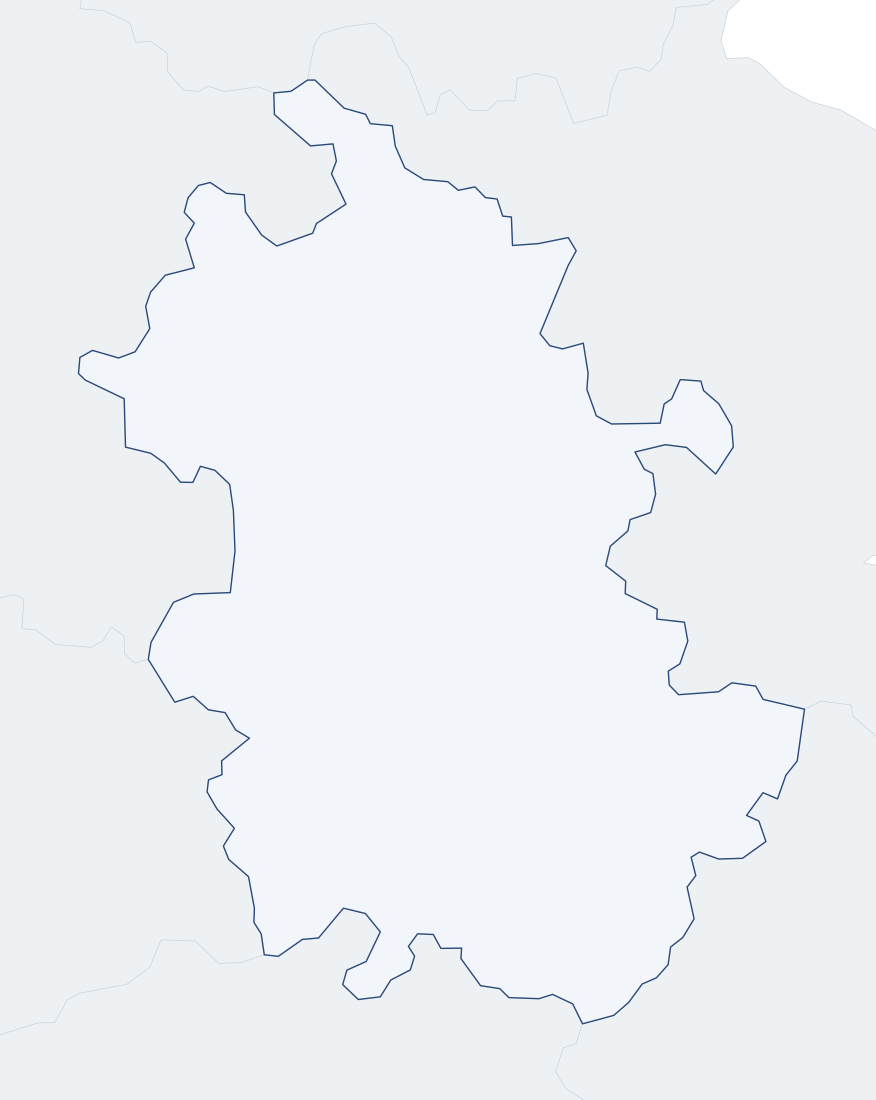
173 Major Historical and Cultural Sites Protected at the National Level in Anhui (batches 1–8, named by the State Council 1961–2019). Dots are coloured by category; click one to jump to its entry. See also Anhui and all provinces.
Batch:
Huangshan (49)
- Qiankou Dwellings 潜口民宅Ancient buildings · third batch (1988)Group of Ming-dynasty dwellings covering about 17,160 square meters, with six dwellings, three ancestral halls, a roadside pavilion and a mountain gate.
- Xu Guo Stone Archway 许国石坊Ancient buildings · third batch (1988)Stone archway built in the 12th year of the Wanli reign of the Ming for Xu Guo, Grand Secretary of the Wuying Hall, also called the Grand Secretary Archway and commonly the eight-legged archway; an outstanding example of Huizhou stone archways.
- Tangyue Stone Archways 棠樾石牌坊群Ancient buildings · fourth batch (1996)Group of seven archways built at different times in the Ming and Qing, grand in scale and richly carved, representative of Huizhou archway architecture.
- Laowuge and Lüraoting 老屋阁及绿绕亭Ancient buildings · fourth batch (1996)Ming-dynasty buildings beside Yuwengtang Pond in Xixinan Village, built by the Wu family of Xixinan after they grew rich in the salt trade in Huai-Yang; most were destroyed in 1856.
- Luo Dongshu Ancestral Hall 罗东舒祠Ancient buildings · fourth batch (1996)The largest branch ancestral hall of the Qianluo Luo clan at Chengkan, commemorating the 13th-generation ancestor Luo Dongshu, abbreviated as Dongshugong Ancestral Hall.
- Cheng Family Three Residences 程氏三宅Ancient buildings · fifth batch (2001)Three Ming dynasty residences on Baishu Dongli Lane in Tunxi, named because all the owners were surnamed Cheng; No. 6 was first built in the late Yuan or early Ming.
- Chengkan Village Ancient Building Complex 呈坎村古建筑群Ancient buildings · fifth batch (2001)A Ming and Qing ancient village building complex; Chengkan is ringed by mountains and belongs to the fourth batch of Famous Historical and Cultural Villages of China.
- Yuliang Dam 渔梁坝Ancient buildings · fifth batch (2001)An ancient dam across the Lian River, first built in the Tang and rebuilt in the 33rd year of Wanli of the Ming, about 140 m long and 27 m wide at the base.
- Hongcun Ancient Building Complex 宏村古建筑群Ancient buildings · fifth batch (2001)A Ming and Qing ancient village with a complete water system and an ox-shaped layout, a typical example of Huizhou dwellings.
- Xidi Village Ancient Building Complex 西递村古建筑群Ancient buildings · fifth batch (2001)A Ming and Qing ancient village, inscribed on the World Heritage List together with Hongcun in 2000 and announced as a Major Historical and Cultural Site Protected at the National Level in 2001.
- Xucun Ancient Building Complex 许村古建筑群Ancient buildings · sixth batch (2006)Fifteen ancient buildings in Xucun, including Gaoyang Covered Bridge, Wuma Archway, Weisheng Archway and Dabangbo Ancestral Hall.
- Qimen Ancient Stages 祁门古戏台Ancient buildings · sixth batch (2006)Qimen has eleven ancient stages, eight in Xin'an Township and three in Shanli Town, all built inside ancestral halls.
- Nanping Village Ancient Building Complex 南屏村古建筑群Ancient buildings · sixth batch (2006)A kinship settlement mainly of the Ye family, listed as a Famous Historical and Cultural Village in 2008; its buildings are Ming and Qing.
- Xitou Sanhuai Hall 溪头三槐堂Ancient buildings · sixth batch (2006)The Wang family ancestral hall initiated by Wang Jingtian in the 30th year of the Ming Wanli reign, also called the Wang Family Great Hall, originally of three courtyards.
- Zheng Family Ancestral Hall 郑氏宗祠Ancient buildings · sixth batch (2006)A representative ancestral hall of the Huizhou region, grand in scale and richly carved.
- Zhushan Academy 竹山书院Ancient buildings · sixth batch (2006)Founded in the 20th year of the Qing Qianlong reign, covering about 2,000 square meters; its main buildings include the Guanri Lingyun octagonal pavilion, Qingkuang Studio and Wenchang Pavilion.
- Qiyun Mountain Inscriptions 齐云山石刻Cave temples and stone carvings · sixth batch (2006)Inscriptions of successive periods from the Song to Qing on Qiyun Mountain, a famous Daoist mountain.
- Huangshan Mountain Trails and Historic Buildings 黄山登山古道及古建筑Ancient buildings · seventh batch (2013)Ancient mountain trails and buildings along them, begun in the Tang and formed in the Ming and Qing, divided into east, west, south and north routes centered on Tianhai.
- Changqing Temple Pagoda 长庆寺塔Ancient buildings · seventh batch (2013)Begun in the 2nd year of the Chonghe reign of the Northern Song, the oldest surviving pagoda in ancient Huizhou; the temple is gone but the pagoda remains, south of the Lian River.
- Former Residence of Cheng Dawei 程大位故居Ancient buildings · seventh batch (2013)The birthplace and residence of the late Ming mathematician Cheng Dawei, and the place where his Suanfa Tongzong was compiled and published.
- Huangcun Jinshi Mansion 黄村进士第Ancient buildings · seventh batch (2013)Also called Huangjia Great Hall, built in the 11th year of the Jiajing reign of the Ming to celebrate a clansman's success in the imperial examination of the 8th year.
- Hong Ancestral Hall 洪氏宗祠Ancient buildings · seventh batch (2013)The Hong Ancestral Hall of Sanyang, with three rows of buildings and a large scale; the Hong family of Sanyang were merchants for generations.
- Tangyue Old Dwellings 棠樾古民居Ancient buildings · seventh batch (2013)A village settled by the Bao clan, begun in the Southern Song and known for commerce in the Ming and Qing; the old dwellings date from the Ming to the Republic of China.
- Beian Wu Clan Ancestral Hall 北岸吴氏宗祠Ancient buildings · seventh batch (2013)The Wu clan ancestral hall, named Zhide Hall, begun in the 2nd year of the Tianqi reign of the Ming and rebuilt in the late Qianlong reign of the Qing; it takes Taibo as the founding ancestor of the Wu clan.
- Yuangong Branch Ancestral Hall 员公支祠Ancient buildings · seventh batch (2013)Also called the Wu Clan Shoule Hall, built in the Jiaqing reign of the Qing and covering 630 square meters.
- Changxi Zhou Clan Ancestral Hall 昌溪周氏宗祠Ancient buildings · seventh batch (2013)Also called Liushun Hall, built in the Daoguang reign of the Qing, covering 805 square meters, with three courtyards and five bays.
- Beian Covered Bridge 北岸廊桥Ancient buildings · seventh batch (2013)Originally named Beixi Bridge, built in the mid-Qing, a three-span stone arch bridge with two piers; the deck is 33 meters long and 4.7 meters wide.
- Xingcun Cheng Clan Ancestral Hall 兴村程氏宗祠Ancient buildings · seventh batch (2013)An ancestral hall begun in the Ming and rebuilt in the late Qing, covering 1,324.36 square meters.
- Huangshan Cliff Inscription Group 黄山摩崖石刻群Cave temples and stone carvings · seventh batch (2013)Cliff inscriptions of all ages scattered across Huangshan, about 300 in all, including more than 40 steles.
- Hong Family Great House 洪家大屋Modern historic sites · seventh batch (2013)Begun in the 24th year of the Daoguang reign of the Qing, covering over 1,200 square meters in all, including Cheng'en Hall and Yangxin Studio.
- Site of the New Fourth Army Headquarters at Yansi 岩寺新四军军部旧址Modern historic sites · seventh batch (2013)Mainly the Jin Family Compound, the former headquarters; Hongqiao, the former secretarial section; and Wenfeng Pagoda and Fengshan Terrace, the drill and inspection grounds.
- Hongkeng Archway Group and Hong Family Temple 洪坑牌坊群及洪氏家庙Ancient buildings · eighth batch (2019)The archway group and Hong family temple of Hongkeng Village; there were originally seven archways and four survive, two for scholarly achievement and two for chastity.
- Sanyang Hong Family Ancestral Hall 三阳洪氏宗祠Ancient buildings · eighth batch (2019)The Hong family ancestral hall in Sanyang Town, She County, with three rows front to back and a large volume; listed as a Major Historical and Cultural Site Protected at the National Level in 2019.
- Tunxi Zhenhai Bridge 屯溪镇海桥Ancient buildings · eighth batch (2019)Also called the Tunxi Bridge and commonly the Old Great Bridge; it spans the Hengjiang River and links Tunxi Old Street with Liyang Town.
- Shitan Wu Family Ancestral Halls 石潭吴氏宗祠Ancient buildings · eighth batch (2019)Two Wu family halls, Xulun Hall and Chunhui Hall, with fine carved decoration; Xulun Hall was built in the Ming, with five bays and three rows.
- Shuyuan Archway Group 蜀源牌坊群Ancient buildings · eighth batch (2019)Three Ming and Qing stone archways at the entrance of Shuyuan Village, including the Chastity-and-Filial-Piety Archway and the Zhenshou Gate Archway (Centenarian Archway).
- Pingshan Shu Family Ancestral Halls 屏山舒氏祠堂Ancient buildings · eighth batch (2019)Two Shu family ancestral halls, one in front of the other, in Pingshan Village; the front one is the Qing-dynasty Shuguangyu Hall and the rear one the Ming-dynasty Shuqingyu Hall, using a rare five-color archway gate.
- Choushu Archway Group 稠墅牌坊群Ancient buildings · eighth batch (2019)Four archways at the entrance of Choushu Village, including the Father-and-Son Grandees Archway built in the 1st year of Chongzhen of the Ming and the Wu Family Chastity-and-Filial-Piety Archway built in the 15th year of Qianlong of the Qing.
- She County Taiping Bridge 歙县太平桥Ancient buildings · eighth batch (2019)Also called the Hexi Bridge; a multi-arch stone bridge over the Lianjiang River, 268 meters long and 7.1 meters wide, with sixteen arches.
- Ba Weizu Residence 巴慰祖宅Ancient buildings · eighth batch (2019)Former residence of Ba Weizu, a famous Qing calligrapher and seal carver and Huizhou merchant, in Yuliang Village.
- She County Xu Family Ancestral Hall 歙县许氏宗祠Ancient buildings · eighth batch (2019)Named "Dunmu Hall," built in the 15th year of Jiajing of the Ming, with three rows front to back; its beams and columns bear a great deal of Huizhou "wrapped brocade" painting.
- Tangmo Tangan Garden 唐模檀干园Ancient buildings · eighth batch (2019)Commonly called the "Little West Lake"; built in the early Qing by a wealthy Xu merchant who dug a lake and built pavilions imitating the scenery of West Lake in Hangzhou for his aged mother's enjoyment.
- She County Bao Family Ancestral Hall 歙县鲍氏宗祠Ancient buildings · eighth batch (2019)A Bao family ancestral hall completed in 1787 and well preserved, in Fancun; listed as a Major Historical and Cultural Site Protected at the National Level in 2019.
- Xiuning Dengfeng Bridge 休宁登封桥Ancient buildings · eighth batch (2019)A stone arch bridge of in-line arches over the Hengjiang River, promoted in the 15th year of Wanli of the Ming by Gu Zhixian, prefect of Huizhou; the necessary route for climbing Qiyun Mountain on foot.
- Xiuning Tongan Hall 休宁同安堂Ancient buildings · eighth batch (2019)A well-preserved Qing-dynasty Huizhou merchant residence with five rows front to back, covering 1,309.6 square meters, with extremely fine brick and wood carving.
- Dafu Pan Family Ancestral Hall 大阜潘氏宗祠Ancient buildings · eighth batch (2019)A Pan family ancestral hall built in the 13th year of Wanli of the Ming, with three rows front to back and fine wood and brick carving.
- Changxi Taihu Hall 昌溪太湖祠Ancient buildings · eighth batch (2019)The Wu family ancestral hall in Changxi, well preserved, built in the Ming dynasty.
- Stone Carvings at the Tomb of Wang Youdun 汪由敦墓石刻Cave temples and stone carvings · eighth batch (2019)Carved by imperial order in the 23rd year of Qianlong of the Qing; the tomb owner was Wang Youdun, Minister of Personnel and Assistant Grand Secretary, and the tomb has a huge stele, ornamental pillars and stone figures.
- Former Seat of the CCP Anhui-Zhejiang-Jiangxi Provincial Committee 中共皖浙赣省委驻地旧址Modern historic sites · eighth batch (2019)A three-story building where the Anhui-Zhejiang-Jiangxi Provincial Committee was based after its founding in April 1936 until it left in January 1937.
Xuancheng (19)
- Site of the New Fourth Army Headquarters 新四军军部旧址Modern historic sites · first batch (1961)Headquarters of the New Fourth Army from 1938 to 1941, with the command, political department, training corps and other bodies spread over thirteen natural villages including Luoli, Nanbao and Zhongcun.
- Hu Family Ancestral Hall at Longchuan 龙川胡氏宗祠Ancient buildings · third batch (1988)Ancestral hall of the Hu family at Longchuan in Jixi, famed for its wood carving and called by architecture experts "number one under heaven in scale, duration, completeness and beauty of decoration."
- Twin Pagodas of Guangjiao Temple 广教寺双塔Ancient buildings · third batch (1988)Twin pagodas at the southeastern foot of Jingting Mountain, built in the third year of the Shaosheng reign of the Northern Song; both are seven-story timber-imitating pavilion-style brick pagodas 17 meters tall, and Guangjiao Temple itself is gone.
- Chenshan Site 陈山遗址Ancient sites · fifth batch (2001)Paleolithic site with deposits dating from 817,000 to 126,000 years ago, continuing from the early to the middle and late Paleolithic.
- Shuixi Twin Pagodas 水西双塔Ancient buildings · fifth batch (2001)Two Song dynasty multi-story brick pagodas west of the Qingyi River, the Daguan Pagoda and the Xiaofang Pagoda; the Daguan Pagoda is also called the Chongning Pagoda.
- Chaji Ancient Building Complex 查济古建筑群Ancient buildings · fifth batch (2001)An ancient village made up of Chacun and Jiyang villages, whose dwellings stretch three li along three streams and where the Zha clan has lived together since the Sui.
- Jiangcun Ancient Building Complex 江村古建筑群Ancient buildings · sixth batch (2006)A village inhabited mainly by the Jiang family, listed as a Famous Historical and Cultural Village in 2005, with many Ming and Qing ancient buildings.
- Huangtian Village Ancient Building Complex 黄田村古建筑群Ancient buildings · sixth batch (2006)A village mainly of the Zhu family, founded in the Song, with 56 Qing sites comprising 135 buildings and a total floor area of over 30,000 square meters.
- Maozhushan and Guanshan Sites 毛竹山、官山遗址Ancient sites · seventh batch (2013)Two adjacent Paleolithic sites in the upper reaches of the Shuiyang River; listed as national key cultural relics protection units in 2013.
- Huihang Ancient Road (Jixi Section) and Eastern Ancient Hui Road (Langxi Section) 徽杭古道绩溪段和古徽道东线郎溪段Ancient sites · seventh batch (2013)Ancient road sites from the Song dynasty to the Republic of China, comprising the Huihang Ancient Road in Jixi and the eastern route of the ancient Hui road in Langxi.
- Jianping Town Mound Tombs 建平镇土墩墓群Ancient tombs · seventh batch (2013)Mound tomb group of the Western Zhou to Warring States period, in Jianping Town, Langxi.
- Tianshou Temple Pagoda 天寿寺塔Ancient buildings · seventh batch (2013)Originally named the Tianshou Temple Great Sage Treasure Pagoda and commonly called Tiansi Pagoda, generally thought to have been built in the 4th year of the Taiping Xingguo reign of the Northern Song; it is located in Guangde County town.
- Xianren Pagoda 仙人塔Ancient buildings · seventh batch (2013)Also called the Dangyang Treasure Pagoda, built in the 13th year of the Shaoxing reign of the Southern Song, with seven hexagonal stories and a height of over 26 meters, set on a steep cliff.
- Yishi Shangshu Archway and Hu Bingheng Residence 奕世尚书坊和胡炳衡宅Ancient buildings · seventh batch (2013)A Ming to Qing archway and residence, located in Jixi.
- Shangzhuang Historic Building Complex 上庄古建筑群Ancient buildings · seventh batch (2013)Seven historic buildings including the Former Residence of Hu Shi, Hu Shi's private school, the Former Residence of Hu Chuan, Dunlü Hall and the Former Residence of Hu Kaiwen.
- Jingde Confucian Temple 旌德文庙Ancient buildings · seventh batch (2013)A Confucian temple begun in the Northern Song and repaired in the Yuan, Ming, Qing and Republican periods, covering 4,655.21 square meters.
- Former Residence of Wang Jiaxiang 王稼祥故居Modern historic sites · seventh batch (2013)The birthplace of the Communist Party leader Wang Jiaxiang, built in the late Qing, facing west; he was born here in 1906 and completed his primary schooling here.
- Jingxian Zhang Family Ancestral Hall 泾县张氏宗祠Ancient buildings · eighth batch (2019)First built in the Hongzhi era of the Ming and rebuilt in the 6th year of Guangxu of the Qing; it consists of the ancestral hall and a school building, with a floor area of about 1,300 square meters.
- Jixi Confucian Temple 绩溪文庙Ancient buildings · eighth batch (2019)First built in the 25th year of Shaoxing of the Southern Song and rebuilt in the Zhengde era of the Ming; on Liang'an Road in the county town.
Anqing (16)
- Xuejiagang Site 薛家岗遗址Ancient sites · fourth batch (1996)Type site of the Xuejiagang culture, covering 60,000 square meters, with archaeological excavation beginning in 1979.
- Baiyazhai 白崖寨Ancient buildings · fifth batch (2001)A defensive military stockade first built in the late Yuan and enlarged in the late Ming and late Qing; its wall is 4 km around and has five gate towers.
- Tianzhushan Valley Spring Cliff Inscriptions 天柱山山谷流泉摩崖石刻Cave temples and stone carvings · fifth batch (2001)A group of cliff inscriptions in the Tianzhu Mountain scenic area, spread across valley streams, cliff faces and rocks, dating from the Song to the Qing.
- Zhenfeng Pagoda 振风塔Ancient buildings · sixth batch (2006)Also called the "Ten Thousand Buddhas Pagoda," inside Yingjiang Temple, one of the famous ancient pagodas along the Yangtze.
- Shitaishi Mansion 世太史第Ancient buildings · sixth batch (2006)Begun in the Ming Wanli reign as the residence of Liu Shangzhi, a supervising secretary of the Ministry of Justice; the existing buildings are Qing residences.
- Sunjiacheng Site 孙家城遗址Ancient sites · seventh batch (2013)Site from the Neolithic to the Shang dynasty, with a surviving area of about 250,000 square meters, bordered by the Dasha River on the north and surrounded by earthen ramparts.
- Zhangsidun Site 张四墩遗址Ancient sites · seventh batch (2013)Site from the Neolithic to the Zhou dynasty, in Yixiu District.
- Tomb of Zhang Tingyu 张廷玉墓Ancient tombs · seventh batch (2013)Tomb of the Qing minister Zhang Tingyu, also called Wenhe Garden; Zhang served under the Kangxi, Yongzheng and Qianlong emperors and rose to Grand Secretary of the Baohe Hall.
- Taiping Pagoda 太平塔Ancient buildings · seventh batch (2013)A Song dynasty Buddhist pagoda in Meicheng Town, Qianshan, now within the grounds of the Qianshan Museum.
- Fayun Temple Pagoda 法云寺塔Ancient buildings · seventh batch (2013)A Ming dynasty Buddhist pagoda, also called Houchong Temple Pagoda or Thousand Buddha Pagoda, in Xiangchang Town, Yuexi.
- Tongcheng Confucian Temple 桐城文庙Ancient buildings · seventh batch (2013)The Confucian temple of the former Tongcheng county school, in the center of Tongcheng, now the home of the Tongcheng Museum.
- Anqing Nanguan Mosque 安庆南关清真寺Ancient buildings · seventh batch (2013)A Qing dynasty mosque located in Yingjiang District, Anqing.
- Anhui University Red Building and Site of Jingfu Academy 安徽大学红楼及敬敷书院旧址Modern historic sites · seventh batch (2013)Early buildings of the National Anhui University; Jingfu Academy was built in 1897 and is now on the Linghu campus of Anqing Normal University.
- Anqing Catholic Church 安庆天主堂Modern historic sites · seventh batch (2013)The Anqing Sacred Heart Cathedral, built in 1893, the cathedral of the former Catholic Archdiocese of Anqing.
- Tomb of Chen Duxiu 陈独秀墓Modern historic sites · seventh batch (2013)The grave of Chen Duxiu, one of the founders of the Communist Party of China, in Shili Township, Daguan District.
- Yezhai Cemetery of Fallen Anti-Japanese Soldiers 野寨抗日阵亡将士公墓Modern historic sites · eighth batch (2019)A cemetery for fallen anti-Japanese soldiers begun in 1942 and finished in 1943, on the campus of Yezhai Middle School.
Wuhu (12)
- Fanchang Kiln Site 繁昌窑遗址Ancient sites · fifth batch (2001)Song-dynasty kiln site in Fanchang.
- Southern Anhui Mound Tombs 皖南土墩墓群Ancient tombs · fifth batch (2001)Mound tombs of the Western Zhou to the Spring and Autumn period, in Nanling and Fanchang Counties.
- Renzidong Site 人字洞遗址Ancient sites · sixth batch (2006)A Paleolithic site over 2 million years old, possibly one of the earliest sites of early humans in China.
- Gunushan City Site 牯牛山城址Ancient sites · seventh batch (2013)City site of the Western Zhou to Spring and Autumn period, in Nanling.
- Golden Pagoda 黄金塔Ancient buildings · seventh batch (2013)A Song-dynasty pagoda in Wuwei.
- Wuhu Catholic Church 芜湖天主堂Modern historic sites · seventh batch (2013)A Catholic church of the Qing to Republican periods, in Jinghu District, Wuhu.
- Site of the British Consulate in Wuhu 英驻芜领事署旧址Modern historic sites · seventh batch (2013)The site of the consulate that Britain set up in Wuhu the year after the 1876 Chefoo Convention, on Fanluo Hill.
- Site of St. James Middle School 圣雅各中学旧址Modern historic sites · seventh batch (2013)The site of a middle school of 1910-1936, in Jinghu District, Wuhu.
- Wuhu Guangji Temple Pagoda 芜湖广济寺塔Ancient buildings · eighth batch (2019)A Northern Song pagoda of Guangji Temple; the temple was first built in the Qianning era of the Tang and renamed Guangji Temple in the Dazhong Xiangfu era of the Northern Song; at the southwest foot of Zheshan.
- Former Residence of Dai Anlan 戴安澜故居Modern historic sites · eighth batch (2019)The former residence of the anti-Japanese general Dai Anlan, who as commander of the 200th Division took part in the Battle of Kunlun Pass and the expedition to Burma.
- Old Wuhu Customs House 老芜湖海关旧址Modern historic sites · eighth batch (2019)A third-class customs house established in 1876 under the Sino-British Chefoo Convention; the site is in Binjiang Park and bears witness to Wuhu's opening as a trading port.
- Former Neisi Senior Industrial Vocational School in Wuhu 芜湖内思高级工业职业学校旧址Modern historic sites · eighth batch (2019)Built in 1934 by Spanish Jesuits at the south foot of Yugengshan, next to the Catholic St. Joseph's Cathedral of Wuhu.
Chizhou (12)
- Jugenguan Ancient Hui Road 榉根关古徽道Ancient sites · seventh batch (2013)Ancient Hui-region road on Xianyushan, dating from the Tang to the Qing dynasty.
- Taiping Mountain Lodge 太平山房Ancient buildings · seventh batch (2013)Originally the public hall of the Chen clan, converted into a school in the 36th year of the Qianlong reign of the Qing; it is one of the better-preserved ancient school buildings in Anhui.
- Qiyuan Temple, Mount Jiuhua 九华山祇园寺Ancient buildings · seventh batch (2013)A Buddhist temple on Jiuhua Street on Mount Jiuhua, one of the national key temples of Buddhism in Han areas.
- Huacheng Temple, Mount Jiuhua 九华山化城寺Ancient buildings · seventh batch (2013)A Buddhist temple on Huacheng Peak of Mount Jiuhua, the "foremost of the hundred temples on the whole mountain".
- Yueshen Hall, Mount Jiuhua 九华山月身殿Ancient buildings · seventh batch (2013)Also called the Yueshen Treasure Hall, on Shenguang Ridge of Mount Jiuhua; it holds the preserved body relic of Jin Dizang and faces north.
- Jiyang Cao Clan Ancestral Hall 济阳曹氏宗祠Ancient buildings · seventh batch (2013)Now part of the Qingyang County Museum, which is made up of the Cao Clan Ancestral Hall, Xiaosi Hall and Xiaoyi Archway and covers 7,680 square meters.
- Shangzhang Li Clan Ancestral Hall 上章李氏宗祠Ancient buildings · seventh batch (2013)Begun in the 46th year of the Qianlong reign of the Qing, with a building area of 890.75 square meters, composed of a gate hall, Xulun Hall and a rear sanctuary.
- Baisui Palace, Mount Jiuhua 九华山百岁宫Ancient buildings · seventh batch (2013)A temple on Mokong Ridge of Mount Jiuhua that holds one of the three flesh-body bodhisattvas of Mount Jiuhua.
- Qi Mountain Cliff Inscriptions 齐山摩崖石刻Cave temples and stone carvings · seventh batch (2013)Cliff inscriptions of the Tang to the Republic of China on Qi Mountain in Chizhou.
- Hualong Cave Site 华龙洞遗址Ancient sites · eighth batch (2019)A site of early humans from the middle and late Pleistocene, where the skull fossil of "Dongzhi Man" was excavated.
- Guichi Baiyashan Pagoda 贵池百牙山塔Ancient buildings · eighth batch (2019)Also called the Baiya Pagoda, built in the 17th year of Jiajing of the Ming of gray brick, 34.3 meters high with a hexagonal base.
- Guichi Qingxi Pagoda 贵池清溪塔Ancient buildings · eighth batch (2019)Also called the Miaoyin Pagoda; first built in the 37th year of Wanli of the Ming, with 7 stories and 8 sides, and rebuilt after being destroyed by lightning in the 15th year of Chongzhen.
Hefei (10)
- Site of the General Front Committee of the Campaign to Cross the Yangtze 渡江战役总前委旧址Modern historic sites · fourth batch (1996)Location of the General Front Committee of the PLA during the Campaign to Cross the Yangtze, at Yaogang, Cuozhen, Feidong.
- Former Residence of Liu Mingchuan 刘铭传旧居Modern historic sites · sixth batch (2006)A fortified-enclosure building, the only surviving former residence of Liu Mingchuan, a Huai Army general, on the north slope of Daqian Mountain.
- Former Residence of Feng Yuxiang 冯玉祥旧居Modern historic sites · sixth batch (2006)The residence of the modern general Feng Yuxiang during home visits, in Zhuke Village, Xiage Town.
- Yinshan Homo sapiens Site 银山智人遗址Ancient sites · seventh batch (2013)Paleolithic site in Yinping Town, Chaohu, about 50 km from the Hexian Homo erectus site; listed as an Anhui provincial cultural relics protection unit in 1984.
- Li Family Old Residence 李氏家族旧宅Modern historic sites · seventh batch (2013)The former residence of the late Qing statesman Li Hongzhang, covering 2,000 square meters, in the late Qing Jianghuai architectural style, the largest surviving former residence of a famous person in Hefei.
- Anhui Provincial Museum Exhibition Building 安徽省博物馆陈列展览大楼Modern historic sites · seventh batch (2013)The old building of the Luyang Hall of the Anhui Museum, completed in 1956.
- Hefei Cao Wei New City Site 合肥曹魏新城遗址Ancient sites · eighth batch (2019)Site of a military city built by Cao Wei in the Three Kingdoms period near the old city of Hefei to resist Eastern Wu; some wall foundations survive.
- Tomb of Wu Fu 吴复墓Ancient tombs · eighth batch (2019)Tomb of Wu Fu, a meritorious official of the early Ming, in Chenji Town, Feidong.
- Laoshan Pagoda 姥山塔Ancient buildings · eighth batch (2019)Also called the Wenfeng Pagoda and Wanghu Pagoda, on Laoshan Island in Chaohu Lake; 7 stories and 51 meters high, it holds 25 plaques and 802 brick-carved Buddha images inside.
- Former Residence of Zhang Zhizhong 张治中故居Modern historic sites · eighth batch (2019)A modern residence building of 1890, in Chaohu.
Bengbu (9)
- Shuangdun Site 双墩遗址Ancient sites · seventh batch (2013)Neolithic terrace site more than 7,300 years old, in Huaishang District, Bengbu, about 4 km north of the Huai River.
- Yuhuicun Site 禹会村遗址Ancient sites · seventh batch (2013)Neolithic site confirmed by archaeological work in 2020 to be a Longshan culture walled city.
- Gaixia Site 垓下遗址Ancient sites · seventh batch (2013)City site on the south bank of the Tuo River, popularly called Bawang City, dating from the Neolithic to the Han dynasty.
- Shuangdun Spring and Autumn Tomb 双墩春秋墓Ancient tombs · seventh batch (2013)Tomb of the Spring and Autumn period, in Huaishang District.
- Huamingtang Yan Family Tomb 化明塘严氏墓Ancient tombs · seventh batch (2013)Ming-dynasty tomb of the Yan family in Wuhe.
- Tomb of Tang He 汤和墓Ancient tombs · seventh batch (2013)Tomb of Tang He, a minister of the early Ming, the highest-ranking tomb occupant among known Ming tombs in Anhui; it covers 54.19 mu and now has a heritage park.
- Site of Huaiyuan Mission Buildings 怀远教会建筑旧址Modern historic sites · seventh batch (2013)The site of mission buildings built in 1903 and 1909, in Huaiyuan County.
- Huai River Iron Bridge of the Tianjin-Pukou Railway 津浦铁路淮河大铁桥Modern historic sites · eighth batch (2019)Also called the Huai River Bridge of the Beijing-Shanghai Railway, built in 1911 at the border of Bengshan and Longzihu districts; the Beijing-Shanghai Railway passes over it.
- Guohe No. 1 Bridge 涡河一桥Modern historic sites · eighth batch (2019)A highway bridge over the Guo River in Huaiyuan County, begun in 1959 with construction continuing from January 1964; an important route linking Bengbu and Fuyang.
Huainan (8)
- Anfengtang Reservoir (Quepi) 安丰塘(芍陂)Ancient buildings · third batch (1988)Ancient hydraulic work in the Huai River basin, also called Quepi, said to have been built by Sun Shu'ao of Chu in the Spring and Autumn period; after renovation in 1978 it holds about 66.77 million cubic meters.
- Shouchun City Site 寿春城遗址Ancient sites · fifth batch (2001)Site of the Chu capital in the late Warring States, to which King Kaolie of Chu moved the capital in the 22nd year of his reign (241 BC), called Ying, also Shouying.
- Shouzhou Kiln Site 寿州窑遗址Ancient sites · fifth batch (2001)Southern yellow-glazed porcelain kiln of the Tang, fired already in the Sui and most flourishing in the Tang, with kilns stretching about 2 kilometers.
- Shouxian Ancient City Wall 寿县古城墙Ancient buildings · fifth batch (2001)The ancient city wall of Shouxian, well preserved, with four gates, Binyang, Tongfei, Dinghu and Jinghuai, whose barbican walls still stand.
- Family Cemetery of Liu An, King of Huainan 淮南王刘安家族墓地Ancient tombs · seventh batch (2013)The cemetery of the family of Liu An, King of Huainan in the Han dynasty, in Shou County.
- Confucian Temple in Shou County 寿县孔庙Ancient buildings · seventh batch (2013)A Ming-Qing Confucian temple in Shou County.
- Mosque in Shou County 寿县清真寺Ancient buildings · seventh batch (2013)A Ming-Qing mosque in Shou County.
- Sites of Japanese Invaders' Crimes in Huainan 侵华日军淮南罪证遗址Modern historic sites · seventh batch (2013)Nine sites including a mass grave, a bunker and water dungeon, the Japanese army headquarters and ammunition depot, listed in 2013 in the seventh batch of national key cultural heritage sites.
Bozhou (8)
- Huaxilou (Flower Opera Tower) 花戏楼Ancient buildings · third batch (1988)Formerly the Shanxi-Shaanxi Guildhall and Great Guandi Temple, built in the Qianlong years of the Qing by Shanxi and Shaanxi medicine merchants, named for its lavishly carved opera tower.
- Yuchisi Site 尉迟寺遗址Ancient sites · fifth batch (2001)Prehistoric cultural site, excavated since 1989 by the Institute of Archaeology of the Chinese Academy of Social Sciences, where many tombs, ash pits and sacrificial pits were found.
- Cao Family Tombs 曹氏家族墓群Ancient tombs · fifth batch (2001)The tombs of Cao Cao's family, also called Caojia Gudui, south of Bozhou city and covering about 10 square kilometers.
- Bozhou Ancient Tunnels 亳州古地道Ancient buildings · fifth batch (2001)Tunnels beneath the old city of Bozhou, first built in the late Eastern Han, with most of what survives built in the Song, over 4,000 m in total length.
- Mengcheng Wanfo Pagoda 蒙城万佛塔Ancient buildings · sixth batch (2006)An octagonal 13-story pavilion-style brick pagoda built in the 1st year of Chongning of the Northern Song, originally the pagoda of Xinghua Temple; the temple is gone but the pagoda remains.
- Gujing Tribute Liquor Brewing Site 古井贡酒酿造遗址Ancient sites · seventh batch (2013)Ancient liquor-brewing industrial site, the historical source of Gujing Tribute Liquor, including a Ming-dynasty well, a Song-dynasty well and Ming-Qing brewing remains.
- Nanjing Lane Private Bank 南京巷钱庄Ancient buildings · seventh batch (2013)A Qing dynasty private bank building located in Qiaocheng District, Bozhou.
- Bozhou Xuege Pagoda 亳州薛阁塔Ancient buildings · eighth batch (2019)Originally the Wenfeng Pagoda; a seven-story octagonal brick pagoda imitating timber pavilion construction, 34.15 meters high, built between the Qianlong and Jiaqing eras of the Qing.
Chuzhou (6)
- Ming Zhongdu Imperial City Site and Imperial Tomb Stone Carvings 明中都皇故城及皇陵石刻Ancient sites · second batch (1982)Site of the first capital built in the Hongwu years of the early Ming; stone carvings of the imperial tomb also survive.
- Site of the Defense of Banta 半塔保卫战旧址Modern historic sites · sixth batch (2006)The site of the 1941 defense of Banta, in Lai'an.
- Langya Mountain Cliff Inscriptions and Steles 琅琊山摩崖石刻及碑刻Cave temples and stone carvings · seventh batch (2013)Cliff inscriptions and steles scattered around Langya Mountain and Fengle Pavilion, dating from the Tang to the Republic of China, with a total area of about 10,000 square meters.
- Chuzhou Beamless Hall 滁州无梁殿Ancient buildings · eighth batch (2019)Originally called the Yuhuang Hall, inside Langya Temple; first built in the Later Zhou and rebuilt in the early Ming, it uses a brick-and-stone vaulted structure with no wooden beams inside.
- Chihe Taiping Bridge 池河太平桥Ancient buildings · eighth batch (2019)An ancient bridge over the Chihe River, first built in the 8th year of Hongwu of the Ming, funded from the salary of Zhu Yu, magistrate of Dingyuan; now a road bridge.
- Xiaogang Village Site 小岗村旧址Modern historic sites · eighth batch (2019)One of the birthplaces of China's reform and opening-up, where in November 1978 eighteen farmers signed a land contract agreement to practice household output contracting.
Ma'anshan (6)
- Hexian Man Site 和县猿人遗址Ancient sites · third batch (1988)Early Paleolithic cave site with human fossils in Longtan Cave in Hexian, an important site in the Jianghuai region.
- Lingjiatan Site 凌家滩遗址Ancient sites · fifth batch (2001)Large Neolithic settlement site covering about 1.6 million square meters in total and existing more than 5,000 years ago, on the north bank of the middle Yuxi River.
- Zhu Ran Family Cemetery 朱然家族墓地Ancient tombs · fifth batch (2001)The family cemetery of Zhu Ran of Wu in the Three Kingdoms, found in 1984 during the expansion of a warehouse; it is now in the Zhu Ran Family Cemetery Museum.
- Tomb of Li Bai 李白墓Ancient tombs · sixth batch (2006)The burial site of the Tang poet Li Bai, at the western foot of Qingshan in Dangtu.
- Taibai Tower 太白楼Ancient buildings · seventh batch (2013)A Qing dynasty tower building located in Yushan District, Ma'anshan.
- Dongyang Eastern Wu Tombs 洞阳东吴墓Ancient tombs · eighth batch (2019)Eastern Wu tombs of the Three Kingdoms period, at Dongyang in Dangtu.
Lu'an (5)
- Li Family Manor 李氏庄园Modern historic sites · sixth batch (2006)A Qing-dynasty manor building in Huoqiu.
- Lu'an Han-Dynasty Royal Tombs 六安汉代王陵墓地Ancient tombs · seventh batch (2013)Tombs of the royal family of the Western Han Lu'an Kingdom; their discovery was named one of the Top Ten New Archaeological Discoveries in China in 2006.
- Tomb of Cheng Duanzhong 程端忠墓Ancient tombs · seventh batch (2013)Song-dynasty tomb in Jinzhai.
- Site of the Red 28th Army Reorganization Meeting 红二十八军重建会议旧址Modern historic sites · eighth batch (2019)Site of the Red 28th Army reorganization meeting of 1933, in Jinzhai.
- Foziling Reservoir Multiple-Arch Dam 佛子岭水库连拱坝Modern historic sites · eighth batch (2019)A large water-conservancy project on the upper Pi River, combining flood storage, irrigation and power generation, an important part of the Huai River control works, built in 1954.
Huaibei (4)
- Liuzi Canal Wharf Site 柳孜运河码头遗址Ancient sites · fifth batch (2001)Remains of the Tongji Canal of the Sui-Tang Grand Canal, inscribed in 2014 as part of the Grand Canal of China on the World Heritage list.
- Linhuan City Site 临涣城址Ancient sites · sixth batch (2006)A Warring States city site in Suixi County.
- Shishanzi Site 石山孜遗址Ancient sites · seventh batch (2013)Neolithic site, listed as an Anhui provincial cultural relics protection unit in 1989 and a national key cultural relics protection unit in 2013.
- Gucheng Han Tomb 古城汉墓Ancient tombs · seventh batch (2013)Eastern Han tomb in Suixi.
Suzhou (3)
- Xiaoshankou Site 小山口遗址Ancient sites · seventh batch (2013)Neolithic site found by a survey of the Suxian Cultural Relics Management Office in the mid-1980s.
- Gutaisi Site 古台寺遗址Ancient sites · seventh batch (2013)Neolithic site found by a survey of the Suxian Cultural Relics Management Office in the mid-1980s; in the same town, Caocun, as the Xiaoshankou Site.
- Jinzhai Site 金寨遗址Ancient sites · eighth batch (2019)A Neolithic site in Xiao County.
Tongling (3)
- Fu Mountain Cliff Inscriptions 浮山摩崖石刻Cave temples and stone carvings · seventh batch (2013)A group of cliff inscriptions around Fu Mountain, dating from the Tang to the Republic of China.
- Tangjiadun Site 汤家墩遗址Ancient sites · eighth batch (2019)A site of the Shang and Zhou periods, in Zongyang.
- Stone Carvings at the Tomb of Ruan E 阮鹗墓石刻Cave temples and stone carvings · eighth batch (2019)Stone carvings before the tomb of Ruan E of the Ming, in Zongyang.
Fuyang (1)
- Taijiasi Site 台家寺遗址Ancient sites · eighth batch (2019)A high-ranking central settlement site of the Shang dynasty, about 3,300 years old, with a complete square moat and large palace-style buildings.
Across several cities (2)
- Dagongshan-Fenghuangshan Copper Mine Site 大工山-凤凰山铜矿遗址Ancient sites · fourth batch (1996)A copper mining site from the Western Zhou to the Song dynasty, spread across Nanling County and Tongling City.
- Sites of the General Front Committee and East China Field Army Headquarters in the Huaihai Campaign 淮海战役总前委和华东野战军指挥部旧址Modern historic sites · sixth batch (2006)Sites of the General Front Committee and the East China Field Army headquarters during the Huaihai Campaign of 1948, spread across Suixi and Xiao counties.