 National Parks of China
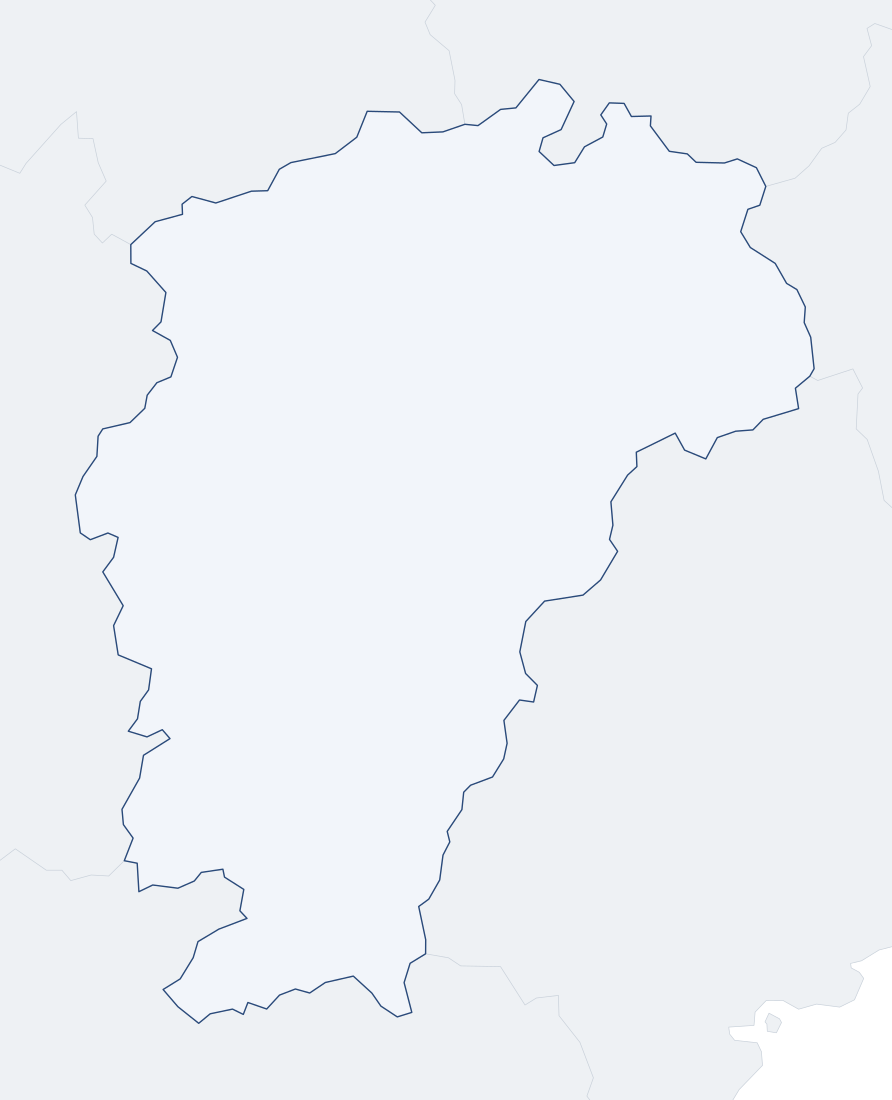
159 Major Historical and Cultural Sites Protected at the National Level in Jiangxi (batches 1–8, named by the State Council 1961–2019). Dots are coloured by category; click one to jump to its entry. See also Jiangxi and all provinces.
Batch:
Ganzhou (28)
- Ruijin Revolutionary Sites 瑞金革命遗址Modern historic sites · first batch (1961)Group of sites of the Provisional Central Government of the Chinese Soviet Republic, including former sites and memorial buildings at Yeping, Shazhouba and other places.
- Site of the Ningdu Uprising Headquarters 宁都起义指挥部旧址Modern historic sites · third batch (1988)Headquarters site of the 1931 Ningdu Uprising, formerly a pastor's residence at a Christian church, built in 1916 as a two-story brick-and-wood Western-style building.
- Tongtianyan Grottoes 通天岩石窟Cave temples and stone carvings · third batch (1988)Cave group in a Danxia landform with 279 niches and 359 statues, mostly Song carvings, one of the more concentrated groups of cave statues in southern China.
- Ganzhou City Wall 赣州城墙Ancient buildings · fourth batch (1996)City wall built mainly in the Song and Ming, the longest and best-preserved Song-dynasty city wall surviving in China.
- Guanxi Xinwei and Yanyiwei 关西新围、燕翼围Ancient buildings · fifth batch (2001)Hakka enclosed houses built from the 3rd year of Jiaqing to the 7th year of Daoguang of the Qing, nearly square in plan, with walls 10 m high, corner watchtowers, and gun and lookout holes in the walls.
- Dabaoguang Pagoda 大宝光塔Ancient buildings · sixth batch (2006)The tomb pagoda of the monk Zhizang, built in the 12th year of Yuanhe of the Tang and now inside the Dajue Hall of Baohua Temple; it was destroyed in the 5th year of Huichang during Emperor Wuzong's suppression of Buddhism.
- Ganzhou Buddhist Pagodas 赣州佛塔Ancient buildings · sixth batch (2006)Five Song-dynasty Buddhist pagodas located in Zhanggong District and Dayu, Xinfeng, Anyuan and Shicheng counties, similar in style and structure and close in date.
- Meiguan Pass and Ancient Post Road 梅关和古驿道Ancient buildings · sixth batch (2006)An ancient road opened by Zhang Jiuling of the Tang in the 4th year of Kaiyuan, on Meiling at the Jiangxi-Guangdong border; a pass tower and about 8 km of post road survive.
- Xingguo Revolutionary Sites 兴国革命旧址Modern historic sites · sixth batch (2006)Historic sites left from Xingguo, the "model county of the Soviet area" in the First Civil War, including five sites such as the Red Army reviewing stand and the Central Arsenal.
- Departure Sites of the Central Red Army's Long March 中央红军长征出发地旧址Modern historic sites · sixth batch (2006)Sites where the Central Red Army assembled and set out on the Long March in 1934, including eight sites such as the Long March ferry crossing, the Central Military Commission site and the army corps headquarters.
- Qilizhen Kiln Site 七里镇窑址Ancient sites · seventh batch (2013)Also known as the Ganzhou Kiln; porcelain firing began in the late Tang, reached its peak in the Song, declined in the Yuan, and ended between the Hongwu and Zhengde reigns of the Ming.
- Yangjiaoshui Fort 羊角水堡Ancient buildings · seventh batch (2013)A rural military fort begun in the 23rd year of the Jiajing reign of the Ming, where soldiers and civilians defended together; it is relatively well preserved and grand in scale.
- Taiping Bridge 太平桥Ancient buildings · seventh batch (2013)A Qing-dynasty ancient bridge in Longnan City.
- Yongzhen Bridge 永镇桥Ancient buildings · seventh batch (2013)A bridge founded in the 9th year of the Shunzhi reign of the Qing by the monk Ao Liu through fundraising, 38.5 meters long, recorded in the Tongzhi-era Anyuan County Gazetteer.
- Yudai Bridge 玉带桥Ancient buildings · seventh batch (2013)A curved covered bridge built in the 5th year of the Qianlong reign of the Qing, the longest surviving curved covered bridge south of the Yangtze.
- Ganzhou Confucian Temple 赣州文庙Ancient buildings · seventh batch (2013)The former Gan County school, nearly a thousand years old, located on Houde Road in Zhanggong District, Ganzhou.
- Dongsheng Enclosure 东生围Ancient buildings · seventh batch (2013)The largest square Hakka enclosed house, begun in the 22nd year of the Daoguang reign of the Qing (1842) and expanded three times over 25 years.
- Luotian Rock Inscriptions 罗田岩石刻Cave temples and stone carvings · seventh batch (2013)Cliff inscriptions on Shan Mountain on the south bank of the Gong River, dating from the Northern Song to the Republic of China.
- Site of the Xunwu Investigation 寻乌调查旧址Modern historic sites · seventh batch (2013)Originally the Matigang Catholic church, first built in 1917, where Mao Zedong carried out the Xunwu investigation in 1930.
- Site of the CCP Central Bureau of the Soviet Area 中共苏区中央局旧址Modern historic sites · seventh batch (2013)Originally the Gong Clan Ancestral Hall, commonly called "Xinwu", facing south, the seat of the CCP Central Bureau of the Soviet Area in 1931.
- Site of the Central Revolutionary Military Commission of the Chinese Soviet Republic 中华苏维埃共和国中央革命军事委员会旧址Modern historic sites · seventh batch (2013)Originally the Liu Clan Ancestral Hall in Yangxi Village, a brick-and-wood structure, the seat of the Central Revolutionary Military Commission in 1931-1932.
- Site of the Ruijin Central Workers' and Peasants' Red Army School 瑞金中央工农红军学校旧址Modern historic sites · seventh batch (2013)Made up of five connected ancestral halls of the Yang Clan Ancestral Hall group, the location of the Central Workers' and Peasants' Red Army School in 1932.
- Fushou Drain 福寿沟Ancient buildings · eighth batch (2019)An underground water-conservancy system first built in the Northern Song under the direction of Liu Yi, military prefect of Qianzhou, serving flood control, drainage and sewage discharge.
- Wushiwei Enclosure House in Longnan 龙南乌石围Ancient buildings · eighth batch (2019)A Ming-dynasty enclosed-house complex.
- Site of the First Enlarged Meeting of the CCP Soviet Area Central Bureau at Huangpi 黄陂中共苏区中央局第一次扩大会议旧址Modern historic sites · eighth batch (2019)Site of the first enlarged meeting of the CCP Soviet Area Central Bureau held in the Central Soviet Area period, in Shantang Village, Huangpi Town.
- Site of the Ningdu Meeting 宁都会议旧址Modern historic sites · eighth batch (2019)Site of the Ningdu Meeting of 1932, in Xiaoyuan Village, Dongshanba Town, Ningdu County.
- Former Marx Communist School at Yeping 叶坪马克思共产主义学校旧址Modern historic sites · eighth batch (2019)Originally the Liu family's private ancestral hall, the site of the first central-level Party school founded in the Chinese Soviet Republic period.
- Former CCP Central Sub-Bureau and Central Government Office at Jingtang 井塘中共中央分局、中央政府办事处旧址Modern historic sites · eighth batch (2019)Former base in the Central Soviet Area of the CCP Central Sub-Bureau and the Central Government Office after the main force of the Central Red Army set out on the Long March.
Ji'an (22)
- Jinggangshan Revolutionary Sites 井冈山革命遗址Modern historic sites · first batch (1961)A group of sites left from the Communist Party's founding of the Jinggangshan revolutionary base area, mostly in Jinggangshan City, with some in Yongxin and Suichuan counties.
- Site of the Hunan-Jiangxi Provincial Committee 湘赣省委机关旧址Modern historic sites · fourth batch (1996)Seat of the Hunan-Jiangxi Provisional Provincial Committee when it was established in 1931, the Xiao Clan Ancestral Hall built in 1914, of brick and wood, with a main facade resembling a church.
- Jizhou Kiln Site 吉州窑遗址Ancient sites · fifth batch (2001)An ancient kiln site first fired in the Tang and at its peak in the Song, with mainly white and purple wares; porcelain making continued until the late Ming, about six hundred years.
- Niutou City Site 牛头城址Ancient sites · sixth batch (2006)An ancient city site of the Shang and Zhou periods, with a wall totaling 3,200 m and an inner area of 380,000 sq m; a group of bronzes was found here in 1976.
- Baikou City Site 白口城址Ancient sites · sixth batch (2006)An ancient city site of the Han to the Northern and Southern Dynasties, also called Gaocheng, the best preserved and largest Han and Jin city site found in Jiangxi.
- Longgang Qianbiao Stele 泷冈阡表碑Cave temples and stone carvings · sixth batch (2006)A Northern Song stele with text composed and written by Ouyang Xiu; the Longgang Qianbiao is the epitaph he wrote in memory of his parents, now kept in Xiyang Palace in Shaxi Town.
- Dazhi Peng Family Stone Inscriptions 大智彭氏家族石刻Cave temples and stone carvings · sixth batch (2006)Family inscriptions cut on natural granite between the 12th year of Zhengtong and the 10th year of Hongzhi of the Ming, fifteen blocks with thirty-six entries, all in regular script.
- Jiebu Granary Site 界埠粮仓遗址Ancient sites · seventh batch (2013)A large Warring States site including an ancient city, residential area, kiln sites, tombs and a granary; the excavated granary is 61.5 m long and held carbonized japonica rice.
- Jishui Eastern Wu Tomb 吉水东吴墓Ancient tombs · seventh batch (2013)Large tomb of the Eastern Wu in the Three Kingdoms period, excavated in 1991 and known as "Jiangxi's Largest Tomb" before the Marquis of Haihun's tomb was found.
- Tomb of Wen Tianxiang 文天祥墓Ancient tombs · seventh batch (2013)Tomb of Wen Tianxiang, chancellor of the Southern Song, in Futian Town, Qingyuan District, Ji'an.
- Chatan Weir 槎滩陂Ancient buildings · seventh batch (2013)A water-diversion weir on the Niuhou River first built by Zhou Ju of the Southern Tang, an ancient water conservancy project.
- Wan'an City Wall 万安城墙Ancient buildings · seventh batch (2013)A city wall begun in the Song; about 1,000 meters of Ming wall survive, one of the most completely preserved county-level ancient city walls in Jiangxi.
- Bailuzhou Academy 白鹭洲书院Ancient buildings · seventh batch (2013)An academy in Ji'an, with historic buildings of the Ming and Qing periods.
- Anfu Confucian Temple 安福孔庙Ancient buildings · seventh batch (2013)A Confucian temple begun in the Northern Song, now in Qing style; it served as the Anfu county school in the Ming and Qing and is now the county museum.
- Site of the Donggu Civilian Bank 东固平民银行旧址Modern historic sites · seventh batch (2013)In spring 1928 Huang Qishou and others set up the Donggu Civilian Lending Office, which grew into the Civilian Bank; the site is in the center of the street of Donggu She Ethnic Township.
- Site of the Junbu General Headquarters of the First Front Army of the Red Army 君埠红一方面军总司令部旧址Modern historic sites · seventh batch (2013)Originally the Wanshou Temple, first built in the late Ming and early Qing; the existing brick-and-timber building was rebuilt in the Republic, 17 m wide and 39 m deep.
- Futian Village Chengjing Hall 富田村诚敬堂Modern historic sites · seventh batch (2013)An ancestral hall begun in the mid-Ming, mostly late Qing buildings today, facing west and protected with other cultural relic buildings of Futian Village, 23 in all.
- Site of the Red Fourth Army Headquarters at Meibei 渼陂红四军总部旧址Modern historic sites · seventh batch (2013)Originally the Yongmu Hall of the Liang Clan Ancestral Hall, the headquarters of the Red Fourth Army in 1930; the former residence of Liang Xingchu and the site of the Red Fourth Army health team are protected in the same batch.
- Site of the "February 7th" Pitou Conference “二七”陂头会议旧址Modern historic sites · seventh batch (2013)The site where Mao Zedong convened a joint meeting of the Red Fourth Army Front Committee and the Red Fifth and Sixth Army military committees at Pitou from February 7 to 9, 1930.
- Site of the First CCP Congress of Southwest Jiangxi 中共赣西南第一次党代会旧址Modern historic sites · eighth batch (2019)Venue of the First CCP Congress of Southwest Jiangxi in 1930, in Bixia Village, Futian Town.
- Site of the Xiajiang Meeting 峡江会议旧址Modern historic sites · eighth batch (2019)Site of the Xiajiang Meeting of September 1930, on Hengjie Street, Baqiu Town, Xiajiang County.
- Former Majiazhou Concentration Camp 马家洲集中营旧址Modern historic sites · eighth batch (2019)Former concentration camp of the War of Resistance against Japan, 1940-1945, in Xianqiao Village, Mashi Town, Taihe County.
Shangrao (21)
- Site of Shangrao Concentration Camp 上饶集中营旧址Ancient buildings · third batch (1988)Site of the camp where the Nationalist government held New Fourth Army members and Communists in 1941 and 1942, in the south of Shangrao city.
- Site of the Fujian-Zhejiang-Jiangxi Provincial Committee 闽浙赣省委机关旧址Modern historic sites · fourth batch (1996)Group of sites of the Fujian-Zhejiang-Jiangxi revolutionary base, including the provincial committee, Soviet government, provincial military district headquarters, Red Square and a branch of the Red Army school.
- Xianren Cave and Diaotonghuan Site 仙人洞、吊桶环遗址Ancient sites · fifth batch (2001)A Neolithic site of human activity, selected as one of China's Top Ten New Archaeological Discoveries and among the 100 Great Archaeological Discoveries of China in the 20th century.
- Qinghua Rainbow Bridge 清华彩虹桥Ancient buildings · sixth batch (2006)A covered beam bridge 140 meters long with 4 piers and 5 spans; one account says it was begun in the Song, another that it was built in the Qianlong reign.
- Ehu Academy 鹅湖书院Ancient buildings · sixth batch (2006)An academy at the north foot of Ehu Mountain, renamed Wenzong Academy in the Chunyou era of the Southern Song, named Ehu Academy in the Jingtai era of the Ming and enlarged in the Kangxi reign of the Qing.
- Wuyuan Ancestral Halls 婺源宗祠Ancient buildings · sixth batch (2006)A representative example of Huizhou architecture, including several Ming and Qing ancestral halls such as the Yu Ancestral Hall in Huangcun, the Yu Ancestral Hall in Wangkou and Chengyi Hall in Zhifeng.
- Likeng Village Residences 理坑村民居Ancient buildings · sixth batch (2006)A kinship village of the Yu family founded in the late Yuan to early Ming, preserving Ming and Qing residences and historically rich in scholarship, producing several eminent Confucian scholars.
- Sheshantou Site 社山头遗址Ancient sites · seventh batch (2013)Also called the Sheshantou Site (the "Snake Hill Head" Site), an ancient cultural site of the late Neolithic to the Shang and Zhou periods.
- Yinshan Silver Mine Site 银山银矿遗址Ancient sites · seventh batch (2013)Silver mine site of the Tang and Song dynasties covering 5.67 square kilometers; mining continued for more than 1,300 years, and several ancient mining and smelting shafts survive.
- Baojia Gold Mine Site 包家金矿遗址Ancient sites · seventh batch (2013)Gold mine site from the Tang to the Ming dynasty, found during the Third National Survey of Cultural Relics and named among Jiangxi's Top 100 New Discoveries.
- Yongfu Temple Pagoda 永福寺塔Ancient buildings · seventh batch (2013)A Buddhist pagoda built in the 2nd year of the Tiansheng reign of the Northern Song (1024).
- Sanqing Mountain Historic Building Complex 三清山古建筑群Ancient buildings · seventh batch (2013)A Ming dynasty Daoist building complex on the north side of Mount Sanqing, mostly within Dexing.
- Longxi Zhu Clan Ancestral Hall 龙溪祝氏宗祠Ancient buildings · seventh batch (2013)An ancient building complex in a village of the Zhu clan, mainly the Zhu Clan Ancestral Hall, Wenchang Pavilion and Jiang-Zhe Society hall; the ancestral hall dates from the Ming and Qing.
- Two Archways of the Gong Ancestral Halls and Stone Carvings of the Huansha Ji 龚氏宗祠两牌楼及浣纱记石雕Ancient buildings · seventh batch (2013)The Daigong Hall and Xuqian Hall in Ankeng Village, about 80 m apart, both built in the Qing Qianlong reign; on both sides of the rear hall of Daigong Hall are bluestone carvings of the 'Qian Huansha' and 'Hou Huansha'.
- Fengshan Zha Clan Ancestral Hall 凤山查氏宗祠Ancient buildings · seventh batch (2013)An ancestral hall built in 1664, named Xiaoyi Hall by the prefect of Huizhou, destroyed by war fire in 1854 and rebuilt in 1864.
- Xinyuan Yu Clan Ancestral Hall 新源俞氏宗祠Ancient buildings · seventh batch (2013)Also called Yiqing Hall, the ancestral hall of the Yu clan begun in the 44th year of the Jiajing reign of the Ming (1565).
- Nanyan Grottoes 南岩石窟Cave temples and stone carvings · seventh batch (2013)Grottoes cut in the Southern Song Jiading reign in a natural cave in a Danxia hill, with 28 surviving niches and 45 statues; the main niche holds Shakyamuni and the Eighteen Arhats.
- Wufushan Silver and Lead Mine Site 五府山银铅矿遗址Ancient sites · eighth batch (2019)A silver and lead mining and smelting site of the Tang and Song periods, in Tangli Village, Wufushan Town.
- Guanxi Hu Family Ancestral Hall 官溪胡氏宗祠Ancient buildings · eighth batch (2019)The ancestral hall of the Hu family, a prominent family of Yushan, a Ming and Qing building; Guanxi originally belonged to Jiangshan in Zhejiang and was transferred to Yushan in 1952.
- Shidu Wang Family Mansion 十都王家大屋Ancient buildings · eighth batch (2019)Built in the 34th year of Qianlong of the Qing (1769) by the local paper merchant Wang Zhixian, originally called the "Zhixian Mansion."
- Yushan Examination Sheds 玉山考棚Ancient buildings · eighth batch (2019)Examination sheds built in the Qianlong era of the Qing; south of the Yangtze only the Jiangnan Examination Hall in Nanjing and the Yushan Examination Sheds survive, witnesses of the imperial examination system.
Jiujiang (19)
- Guanyin Bridge 观音桥Ancient buildings · third batch (1988)Northern Song stone arch bridge over the Sanxia Stream, originally named Qixian Bridge and also called Sanxia Bridge; one of the earliest surviving stone arch bridges in China.
- White Deer Grotto Academy 白鹿书院Ancient buildings · third batch (1988)Academy first built in the Southern Tang at the southern foot of Five Old Men Peak on Mount Lu, rebuilt in the Song by Zhu Xi, who lectured there himself; known as the "foremost academy under heaven."
- Site of the Lushan Conference and Lushan Villa Complex 庐山会议旧址及庐山别墅建筑群Modern historic sites · fourth batch (1996)The Lushan Auditorium of the 1930s and the surrounding villas; the hall blends Chinese and Western styles with blue glazed-tile eaves and later became the site of the Lushan Conference.
- Tonglingtongkuang Copper Mine Site 铜岭铜矿遗址Ancient sites · fifth batch (2001)A Shang and Zhou copper mining site, worked from the early Shang to the Warring States period; it is the earliest-mined mine yet found in China.
- Pagoda Forest of Zhenru Temple 真如寺塔林Ancient buildings · sixth batch (2006)The pagoda forest of Zhenru Temple (Yunju Chan Monastery) on Yunju Mountain; the temple was first built in the Tang Yuanhe reign and is one of the national key Buddhist temples in Han Chinese areas.
- Xiufeng Cliff Inscriptions 秀峰摩崖Cave temples and stone carvings · sixth batch (2006)Cliff inscriptions and steles of the Tang to the Republic at Xiufeng on the south slope of Lushan, such as "Qingyu Gorge" and "First Mountain."
- Site of the Mobil Oil Company Depot 美孚洋行旧址Modern historic sites · sixth batch (2006)Oil depot and office buildings built about 1910 when the Standard Oil company set up a branch in the British concession of Jiujiang, on Binjiang Road.
- Xiaoyangcheng Site 鄡阳城遗址Ancient sites · seventh batch (2013)Han-dynasty ancient city site; Xiaoyang County was under Yuzhang Commandery, and the site lies on a lake islet in Zhouxi Town, Duchang County.
- Shizhong Mountain Historic Buildings and Stone Inscriptions 石钟山古建筑及石刻Ancient buildings · seventh batch (2013)Located where Poyang Lake meets the Yangtze River, with the Upper and Lower Shizhong mountains together called the "Twin Bells"; the mountains preserve historic buildings and stone inscriptions from the Tang to the Republic of China.
- Dasheng Pagoda 大胜塔Ancient buildings · seventh batch (2013)A Song to Ming multi-storied brick pagoda in Nengren Temple, also called the Nengren Temple Pagoda; hexagonal in plan with a hollow core, 42.38 meters high.
- Ziyang Embankment 紫阳堤Ancient buildings · seventh batch (2013)Built in 1179 (Southern Song Chunxi 6) when Zhu Xi was prefect of Nankang, by enlarging an older embankment; stacked with stone slabs, about 1 km long and 7-8 m wide, on the west shore of Poyang Lake.
- Suojianglou Pagoda 锁江楼塔Ancient buildings · seventh batch (2013)A seven-story, hexagonal tower-style brick-and-stone pagoda about 25 m high, begun in 1586 (Ming Wanli 14) and finished in 1604; also called Huilong Pagoda.
- Lushan Cijing Pavilion 庐山赐经亭Ancient buildings · seventh batch (2013)A square stone pavilion built in the 15th year of the Wanli reign of the Ming to mark the Empress Dowager Cisheng's gift of scriptures to Huanglong Temple, with a stele standing inside.
- Lushan Imperial Stele Pavilion 庐山御碑亭Ancient buildings · seventh batch (2013)Named after the stele to the immortal Zhou Dian that Ming Taizu Zhu Yuanzhang erected, with a pavilion, at the ancient Bailu Shengxian Terrace; it stands southwest of Flower Path on Mount Lu.
- Tongwen Academy 同文书院Modern historic sites · seventh batch (2013)The site of the Jiujiang Tongwen Academy of the Qing to Republican period.
- Former Residences of Chen Baozhen and Chen Sanli 陈宝箴、陈三立故居Modern historic sites · seventh batch (2013)Also called the Chen Family Great House or Fengzhu Hall, made up of a new and an old building joined together; the old house was built in the 58th year of the Qianlong reign of the Qing (1793) and is the birthplace of Chen Baozhen and Chen Sanli.
- Shanbei Site 山背遗址Ancient sites · eighth batch (2019)A large site cluster of 43 sites including Paomaling and Yangjiaping, dating from the late Neolithic to the Shang and Zhou periods.
- Former Jiujiang Gutang Customs House 九江姑塘海关旧址Modern historic sites · eighth batch (2019)Customs facilities from the Qing dynasty to the Republic of China near where Poyang Lake meets the Yangtze, hailed as the "First Pass of the Ten-Thousand-Li Tea Road"; the only fairly well-preserved modern customs house in Jiangxi.
- Former Headquarters of the 1st Regiment, 1st Division, 1st Army of the Workers' and Peasants' Revolutionary Army 工农革命军第一军第一师第一团团部旧址Modern historic sites · eighth batch (2019)Originally Fenggang Academy, the headquarters of the 1st Regiment, 1st Division, 1st Army of the Workers' and Peasants' Revolutionary Army on the eve of the Autumn Harvest Uprising of 1927.
Yichun (19)
- Wucheng Site 吴城遗址Ancient sites · fourth batch (1996)A Shang-dynasty site surrounded by partly broken earthen walls, and the first large-scale Shang settlement found south of the Yangtze River.
- Hongzhou Kiln Site 洪州窑遗址Ancient sites · fourth batch (1996)Celadon kiln site begun in the late Eastern Han and flourishing from the Jin to the mid-Tang, one of the six great kilns of the Tang and one of the early cradles of Chinese celadon.
- Zhuweicheng Site 筑卫城遗址Ancient sites · fifth batch (2001)An ancient site from the Neolithic to the Eastern Zhou, named for the earthen city wall that guarded it; the cultural deposit is over 3 m thick at most, with an Eastern Zhou layer on top.
- Fanchengdui Site 樊城堆遗址Ancient sites · sixth batch (2006)A Neolithic mound-type site, found in 1975 and excavated three times, standing 1 to 3 m above the surrounding fields.
- Tomb of Zhu Shi 朱轼墓Ancient tombs · sixth batch (2006)The tomb mound of Zhu Shi, Qing Grand Secretary and Minister of Personnel, with a spirit-way stele, grave marker, stone archway and stone beasts before the tomb.
- Mingshui Bridge 鸣水桥Ancient buildings · sixth batch (2006)A single-span stone arch bridge built in the 1st year of Zhenghe of the Northern Song, spanning the Gezao Mountain gorge, with dated inscriptions on its walls.
- Yuanzhou Qiaolou 袁州谯楼Ancient buildings · sixth batch (2006)A gate tower on the middle of Gulou Road in Yichun city, now the Yichun Drum Tower, begun in the Song and repaired in successive dynasties.
- Sites of the Hunan-Hubei-Jiangxi Revolutionary Base 湘鄂赣革命根据地旧址Modern historic sites · sixth batch (2006)A group of sites of the Hunan-Hubei-Jiangxi revolutionary base, including five sites: the provincial committee, the provincial Soviet government, the military school branch, the Red Flag newspaper office and the provincial military district.
- Mengshan Silver Mine Site 蒙山银矿遗址Ancient sites · seventh batch (2013)Silver mine site of the Song, Yuan and Ming dynasties on Mengshan, south of Shanggao County, at the border with Xinyu.
- Hualin Papermaking Workshop Site 华林造纸作坊遗址Ancient sites · seventh batch (2013)Papermaking workshop site of the Song, Yuan and Ming dynasties; an industrial site named among the Top 100 New Discoveries of the Third National Survey of Cultural Relics.
- Lizhou'ao Eastern Zhou Tombs 李洲坳东周墓葬Ancient tombs · seventh batch (2013)Eastern Zhou tombs named among the Top Ten New Archaeological Discoveries in China in 2007; bronzes were dug up by villagers building a road in 1979.
- Wuping Tombs 吴平墓群Ancient tombs · seventh batch (2013)Tomb group of the Western Han to the Sui, near the ancient city of Wuping; Hanping County was established in the second year of the Zhongping reign of the Eastern Han and renamed Wuping County under the Sun Wu.
- Fengqu Bridge 逢渠桥Ancient buildings · seventh batch (2013)A stone bridge built in the 5th year of the Shaosheng reign of the Northern Song (1098), the third Northern Song stone bridge with an exact dated inscription found in Jiangxi.
- Mazu Pagoda Pavilion 马祖塔亭Ancient buildings · seventh batch (2013)A Song dynasty pagoda pavilion in Baofeng Temple, commemorating the Tang Chan master Mazu Daoyi.
- Jingxian Jia Clan Ancestral Hall 景贤贾氏宗祠Ancient buildings · seventh batch (2013)A Ming dynasty ancestral hall with four courtyards, in the center of Jingxian Jiajia Village, the earliest, largest and most complete surviving village in Gao'an.
- Site of the Hunan-Jiangxi Border Autumn Harvest Uprising Front Committee 湘赣边界秋收起义前敌委员会旧址Modern historic sites · seventh batch (2013)Originally the Xiao Yongweng Ancestral Hall, commonly called Xiao Family Ancestral Hall, the seat of the front committee of the Hunan-Jiangxi Border Autumn Harvest Uprising in 1927.
- Shanggao Campaign Sites 上高会战遗址Modern historic sites · seventh batch (2013)Sites of the 1941 Shanggao Campaign, including the headquarters of the Chinese 19th Army Group and the command post of the 58th Division of the 74th Army.
- Laohudun Site 老虎墩遗址Ancient sites · eighth batch (2019)A Neolithic site.
- Jimei Stone Archway 济美石坊Ancient buildings · eighth batch (2019)A stone archway built in the Ming dynasty, the only four-sided archway in Jiangxi.
Jingdezhen (12)
- Hutian Ancient Porcelain Kiln Site 湖田古瓷窑址Ancient sites · second batch (1982)Ancient kiln site begun in the Five Dynasties, firing celadon and white porcelain; Yuan wares are slightly yellowish-black; it operated until the mid-Ming, for over six hundred years.
- Xiangjinong Dwellings 祥集弄民宅Ancient buildings · third batch (1988)Dwellings built in the Chenghua years of the Ming; Nos. 3 and 11 have timber frames, face west, and are of five-purlin column-and-tie construction with corridors and firewall gables.
- Imperial Kiln Factory Site 御窑厂窑址Ancient sites · sixth batch (2006)An official kiln established in the 2nd year of Hongwu of the Ming, called the Imperial Porcelain Factory in the Ming; it was a kiln that fired porcelain only for the imperial court in the Ming and Qing, lasting over four hundred years.
- Liyang Kiln Site 丽阳窑址Ancient sites · seventh batch (2013)Kiln site of the Yuan to Ming dynasties; as a component of the Jingdezhen Imperial Kiln heritage, it is on China's tentative list for World Cultural Heritage.
- Ming Garden 明园Ancient buildings · seventh batch (2013)Composed of seven Ming dynasty buildings including the Xiatian Lumen gate, the Yaoli shop, the Wugu ancestral hall and the former residence of Wang Bai, now located in the Ancient Kiln Folk Customs Expo Area.
- Xuyan Mingfentang Opera Stage 浒崦名分堂戏台Ancient buildings · seventh batch (2013)Mingfen Hall is the Cheng clan ancestral hall, and its opera stage is a Qing dynasty building in Xuyan Village, Zhenqiao Town, Leping.
- Zhen Kiln 镇窑Ancient buildings · seventh batch (2013)The most completely preserved and most valuable ancient porcelain kiln to date, able to fire dozens of types of porcelain at high and low temperatures at the same time.
- Site of the Yaoli Reorganization 瑶里改编旧址Modern historic sites · seventh batch (2013)The site where Chen Yi presided over the reorganization of the Red Army guerrillas in the south in January 1938 at Yaoli; it includes three buildings, Hongyi Ancestral Hall, Jingyi Hall and the Cheng Family Ancestral Hall.
- Nanyao Site 南窑遗址Ancient sites · eighth batch (2019)A Tang-dynasty kiln site.
- Fuliang Shuangfeng Pagoda 浮梁双峰塔Ancient buildings · eighth batch (2019)A brick pavilion-style Buddhist pagoda built in the Tiansheng era of the Northern Song by the Huang family of Legong Village, hexagonal with five stories and 19 meters high.
- Fuliang Red Pagoda 浮梁红塔Ancient buildings · eighth batch (2019)Also called the Dasheng Precious Pagoda and commonly the Red Pagoda; built in the 2nd year of Jianlong of the Northern Song and repaired in the 3rd year of Wanli of the Ming, with six sides and nine stories, 40.47 meters high.
- Fuliang County Yamen 浮梁县衙Ancient buildings · eighth batch (2019)Built in the Daoguang era of the Qing, with six parts surviving, including the middle gate, yamen courtyard, main hall and second hall; one of only four ancient county yamen surviving in China.
Fuzhou (11)
- Baoshan Gold and Silver Mining and Smelting Site 宝山金银矿冶遗址Ancient sites · seventh batch (2013)Tang-dynasty gold and silver mining and smelting site in northern, central and southern parts, the northern part being the gold mine.
- Baishe Kiln Site 白舍窑遗址Ancient sites · seventh batch (2013)Also called the Nanfeng Kiln, a Song-Yuan folk kiln mainly firing qingbai porcelain, ranked with the Jingdezhen and Jizhou kilns among the five famous kilns of Jiangxi.
- Tomb of Tan Lun 谭纶墓Ancient tombs · seventh batch (2013)Tomb of the Ming official Tan Lun, who was posthumously made Senior Guardian of the Crown Prince and given the title Xiangmin.
- Ming Prince of Yi Cemetery 明益藩王墓地Ancient tombs · seventh batch (2013)Cemetery of the Ming Prince of Yi family, made up of the Hongmen and Yuekou tomb groups, burying Zhu Youbin, Prince Duan of Yi, Zhu Houye, Prince Zhuang of Yi, and others.
- Guodishan Site 锅底山遗址Ancient sites · eighth batch (2019)A moated settlement site of the late Neolithic to the Shang and Zhou periods, in Tangyin Town, Yihuang County.
- Dasima Archway 大司马牌坊Ancient buildings · eighth batch (2019)Erected in the 2nd year of Wanli of the Ming (1574) to honor the achievements of Tan Lun, Minister of War, in fighting Japanese pirates; six columns and three bays.
- Tangyin Ancient Building Complex 棠阴古建筑群Ancient buildings · eighth batch (2019)A fairly well-preserved group of Ming and Qing ancient buildings, of which five are protected: Cheng'en Archway, Bafujun Shrine, Ying'en Pagoda, Luo Family Compound and Guanmaoting residence.
- Kuibi Lianhui Residence 奎璧联辉民宅Ancient buildings · eighth batch (2019)A Qing-dynasty residence, an important part of the Yiqian ancient building complex, in Yiqian Town.
- Huwan Bookshop Building Complex 浒湾书坊建筑群Ancient buildings · eighth batch (2019)A complex of book-printing and bookselling buildings of the Qing to the Republic of China period, including printing workshops such as Hongxing Shanfang, Zhongxintang and Liangyitang, and the Xu family ancestral hall.
- Sites of the Fourth Counter-Encirclement Campaign in the Central Soviet Area 中央苏区第四次反“围剿”战役遗址Modern historic sites · eighth batch (2019)Sites of the Fourth Counter-Encirclement Campaign in the Central Soviet Area, including the former Red First Front Army headquarters at Zuofang in Jinxi and the site of the Dengxianqiao victory in Le'an.
- Former Sites of the CCP Fujian-Jiangxi Provincial Committee, Provincial Revolutionary Committee and Military District at Hufang 湖坊中共闽赣省委、省革委、省军区旧址Modern historic sites · eighth batch (2019)Former site where the CCP Fujian-Jiangxi Provincial Committee, Provincial Revolutionary Committee and other bodies were set up in May 1933, in Hufang Township, Lichuan County.
Nanchang (10)
- Site of the August 1 Uprising Headquarters “八一”起义指挥部旧址Modern historic sites · first batch (1961)General headquarters of the August 1 Nanchang Uprising of 1927, formerly the Jiangxi Grand Hotel, a five-story brick-and-wood building in a square-ring layout, now a memorial hall.
- Lidu Shaojiu Distillery Site 李渡烧酒作坊遗址Ancient sites · sixth batch (2006)A Yuan dynasty distillery site, the earliest, most complete and longest-running ancient spirits distillery site found in China.
- Chen Family Archways 陈氏牌坊Ancient buildings · sixth batch (2006)Two Ming archways, Zhoujin Archway and Lixue Mingxian Archway, erected in the 8th year of Yongle and the 10th year of Chongzhen respectively.
- Qingyunpu 青云谱Ancient buildings · sixth batch (2006)Originally the Qingyunpu Daoist temple, now the Bada Shanren Memorial Hall in Jiangnan garden style; the late Ming and early Qing painter Bada Shanren lived there in seclusion.
- Site of the New Fourth Army Headquarters in Nanchang 南昌新四军军部旧址Modern historic sites · sixth batch (2006)The headquarters of the New Fourth Army after the southern Red Army and guerrillas were reorganized in 1937, on Youzhu Road, Xihu District, Nanchang.
- Zijincheng City Site and Tiehe Ancient Tombs 紫金城城址与铁河古墓群Ancient tombs · seventh batch (2013)Zijincheng is the city site of the Han-dynasty fief of the Marquis of Haihun; the Tiehe tombs comprise 163 tombs in western, southern and other groups.
- Tombs of Zhu Quan and the Prince of Le'an 朱权墓与乐安王墓Ancient tombs · seventh batch (2013)The tombs of Zhu Quan, Prince of Ning, and the Prince of Le'an of the Ming dynasty; Zhu Quan's tomb is in Huangyuan Village, Shibu Township, Xinjian District, a living tomb he built himself in 1442 (Zhengtong 7), called the largest underground Ming tomb in Jiangxi.
- Yuling Mountain Lodge and Yunting Villa 羽琌山馆和云亭别墅Ancient buildings · seventh batch (2013)Qing dynasty buildings; Yuling Mountain Lodge is the west manor and Yunting Villa the east manor of the Aixi Chen family complex.
- Deng Xiaoping Residence and Workshop 邓小平旧居与劳动车间Modern historic sites · seventh batch (2013)Includes four sites, Xiaoping Building, Xiaoping Path, Xiaoping Workshop and Xiaoping Square; Deng Xiaoping was sent down to Nanchang in October 1969, worked at the tractor repair factory in Xinjian County, and left in February 1973.
- Former CCP Southeast Bureau 中共中央东南分局旧址Modern historic sites · eighth batch (2019)Former site of the CCP Central Committee's Southeast Bureau, 1938-1939, about 100 meters from the former New Fourth Army headquarters in Nanchang.
Pingxiang (5)
- Site of the Anyuan Railway and Mine Workers' Club 安源路矿工人俱乐部旧址Modern historic sites · second batch (1982)Revolutionary memorial building commemorating the Anyuan railway and mine workers' strike; the site of the 1922 workers' club is on the hillside of Niuxingling in Anyuan Town.
- Pagodas of Chan Masters Chengguang and Zhenshu 乘广禅师塔和甄叔禅师塔Ancient buildings · seventh batch (2013)Tang dynasty tomb pagodas of Chan masters, located in Putong Temple on Yangqi Mountain; Yangqi Mountain is the ancestral seat of the Yangqi school of Chan, begun in the Kaiyuan reign of the Tang.
- Sheng Gong Ancestral Hall 盛公祠Modern historic sites · seventh batch (2013)Originally the general office of the Pingxiang Coal Mine headquarters, built in 1898 when the mine opened and once the residence of German engineers; renamed Sheng Gong Hall after Sheng Xuanhuai died in 1916. A three-story brick-and-timber building in German style.
- Zongpingxiang Mine Entrance 总平巷矿井口Modern historic sites · seventh batch (2013)The entrance of the main shaft of the Anyuan Coal Mine, a red-brick archway-style facade with the three characters 'Zongpingxiang'; workers poured out of it in the Anyuan strike of 1922.
- Site of the Anyuan Railway and Mine Workers' Evening Supplementary School 安源路矿工人补习夜校旧址Modern historic sites · eighth batch (2019)The site of the Anyuan railway and mine workers' evening supplementary school of 1922, in Anyuan, part of the sites of the Anyuan railway and mine workers' movement.
Fuzhou (Jiangxi) (5)
- Liukeng Village Ancient Building Complex 流坑村古建筑群Ancient buildings · fifth batch (2001)An ancient village founded in the Southern Tang, whose villagers are mostly surnamed Dong; it has 19 Ming buildings and many Qing ones and is praised as the "first village of all ages".
- Archway Gates of Longtu Xueshi and Cishi Chuanfang 龙图学士和刺史传芳牌楼门Ancient buildings · seventh batch (2013)Two adjoining archway gates; the Longtu Xueshi archway was first built in the first year of Ming Hongwu and the Cishi Chuanfang archway in the Yuan dynasty. The former is the earliest dated timber building found in Jiangxi.
- Wannian Bridge and Juxing Pagoda 万年桥和聚星塔Ancient buildings · seventh batch (2013)Wannian Bridge was begun in the 8th year of the Chongzhen reign of the Ming (1635) and completed in the 4th year of the Shunzhi reign of the Qing, spanning the Xu River; Juxing Pagoda stands nearby.
- Fuzhou Yulong Wanshou Palace 抚州玉隆万寿宫Ancient buildings · seventh batch (2013)A Wanshou Palace built in the Ming, with existing buildings of the Qing, facing east on a west-sitting axis with a front court, gate arch, opera tower and front hall in sequence along it.
- Yiqian Shiwuli Dwelling 驿前石屋里民宅Ancient buildings · seventh batch (2013)A dwelling built in the 55th year of the Kangxi reign of the Qing (1716), facing south with a rectangular plan 21 meters wide.
Xinyu (4)
- Site of the Luofang Conference and Xingguo Investigation Conference 罗坊会议和兴国调查会旧址Modern historic sites · sixth batch (2006)A group of sites of the 1930 Luofang Conference and the Xingguo Investigation Conference, including four sites such as the former residences of Mao Zedong, Zhu De and Zeng Shan.
- Shiniansan Site 拾年山遗址Ancient sites · seventh batch (2013)Terrace-type ancient cultural site of the late Neolithic and the Shang and Zhou periods, east of Shinian Village, Shuibei Town.
- Fenghuangshan Iron Mine Site 凤凰山铁矿遗址Ancient sites · seventh batch (2013)Iron mine site from the Tang to the Ming dynasty, 500 m north-south and 300 m east-west, on Fenghuangshan.
- Former Command Post of the Red 3rd Army Corps at Shuixi 水西红三军团指挥部旧址Modern historic sites · eighth batch (2019)Seat of the Red 3rd Army Corps' command during its important military activities in 1930, in Shapi Village, Shuixi Town.
Yingtan (3)
- Xianshuiyan Cliff Tombs 仙水岩崖墓群Ancient tombs · fifth batch (2001)A group of cliff tombs of the Spring and Autumn and Warring States period; over seventy have been found in cliff caves along the Luxi River, yielding flat drums, zithers and parts of primitive looms.
- Jiaoshan Banlishan Site 角山板栗山遗址Ancient sites · seventh batch (2013)Shang-dynasty site on the northwest slope of Jiaoshan and on Banlishan, a terrace by the river, facing Jiaoshan across a north-south line.
- Longhu Mountain Historic Building Complex 龙虎山古建筑群Ancient buildings · seventh batch (2013)Remains of successive Zhang Celestial Masters' development of Daoism on Mount Longhu, mainly several buildings of the Sihan Celestial Masters' Mansion and Shangqing Palace.