 National Parks of China
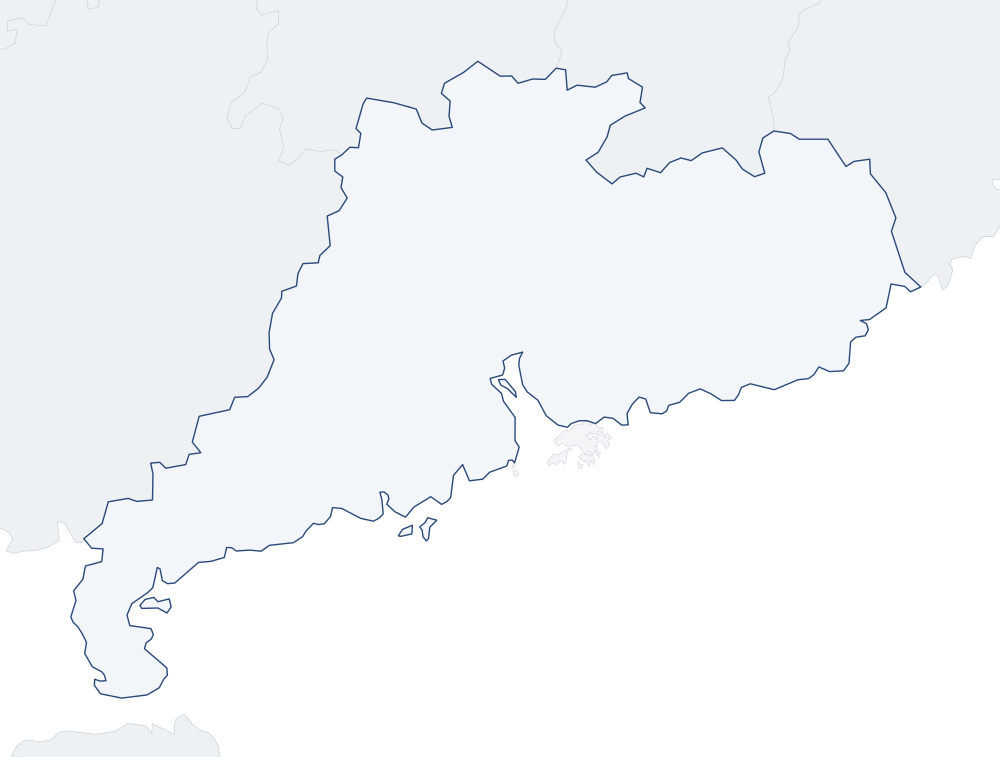
131 Major Historical and Cultural Sites Protected at the National Level in Guangdong (batches 1–8, named by the State Council 1961–2019; 1 of them cross provincial borders, such as the Great Wall and the Grand Canal). Dots are coloured by category; click one to jump to its entry. See also Guangdong and all provinces.
Batch:

Guangzhou (32)
- Site of the Sanyuanli Anti-British Struggle 三元里平英团遗址Modern historic sites · first batch (1961)Memorial site of the Sanyuanli anti-British incident; originally a Beidi Temple dating from the early Qing, it was the assembly point of the Pingyingtuan militia and is now an anti-British struggle memorial hall.
- Tomb of the Seventy-Two Martyrs at Huanghuagang 黄花岗七十二烈士墓Modern historic sites · first batch (1961)Cemetery built in memory of the seventy-two martyrs who died in the 1911 Huanghuagang Uprising, located on Xianlie Zhong Road in Yuexiu District.
- Site of the Guangzhou Peasant Movement Institute 广州农民运动讲习所旧址Modern historic sites · first batch (1961)Former Panyu Confucian Academy, where Mao Zedong ran the Peasant Movement Institute; it is now a memorial hall on Zhongshan 4th Road in Yuexiu District.
- Site of the Guangzhou Commune 广州公社旧址Modern historic sites · first batch (1961)Site where Zhang Tailei led the Guangzhou Uprising and founded the Guangzhou Commune in December 1927; formerly the Guangdong Provincial Capital Public Security Bureau, now the Guangzhou Uprising Memorial Hall.
- Guangxiao Temple 光孝寺Ancient buildings · first batch (1961)The oldest temple complex in Guangzhou, with the full name Bao'en Guangxiao Chan Temple, one of the four great monasteries of Guangzhou.
- Former Residence of Hong Xiuquan 洪秀全故居Modern historic sites · third batch (1988)Former residence of Hong Xiuquan, with the Shufang Pavilion, the Hong Clan Ancestral Hall and the remains of Hong Rengan's former residence on the same site; the remains of Feng Yunshan's former residence are nearby.
- Site of the First National Congress of the Kuomintang (including Revolution Square) 国民党“一大”旧址、(包括革命广场)Modern historic sites · third batch (1988)Site of the hall where the First National Congress of the Kuomintang was held in January 1924, at the Bell Tower on Wenming Road.
- Site of the Whampoa Military Academy 黄埔军校旧址Modern historic sites · third batch (1988)First campus of the Whampoa Military Academy founded by Sun Yat-sen, on Changzhou Island, including the school headquarters, the Sun Yat-sen Memorial Room and a monument.
- Site of the All-China Federation of Trade Unions 中华全国总工会旧址Modern historic sites · third batch (1988)Seat of the All-China Federation of Trade Unions from 1925 to 1927, on Yuexiu South Road, now a branch of the Guangdong Revolution Museum.
- Chen Clan Ancestral Hall 陈家祠堂Ancient buildings · third batch (1988)Also called the Chen Clan Academy, a shared ancestral hall funded in the 14th year of the Guangxu reign of the Qing by Chen clansmen from 72 counties of Guangdong.
- Qin Shipyard Site, Nanyue Palace Site and Tomb of King Wen of Nanyue 秦代造船遗址、南越国宫署遗址及南越文王墓Ancient sites · fourth batch (1996)Includes the Qin-Han shipyard site, the Nanyue palace site and the tomb of King Wen of Nanyue; a sizable Qin-Han shipyard was excavated in 1975.
- Guangta Minaret of Huaisheng Mosque 怀圣寺光塔Ancient buildings · fourth batch (1996)First built in the Tang, one of the earliest mosques surviving in China, containing the Guangta minaret.
- Shamian Building Complex in Guangzhou 广州沙面建筑群Modern historic sites · fourth batch (1996)An artificial islet of about 0.3 sq km north of Baietan on the north bank of the Pearl River, with many modern Western-style buildings.
- Sacred Heart Cathedral, Guangzhou 广州圣心大教堂Modern historic sites · fourth batch (1996)Commonly called the Stone House, begun in 1863 and completed in 1888, built entirely of granite; it is one of the largest Gothic Revival buildings in China.
- Site of the Generalissimo's Headquarters in Guangzhou 广州大元帅府旧址Modern historic sites · fourth batch (1996)Place where Sun Yat-sen set up the Generalissimo's Headquarters from 1917, now the Sun Yat-sen Generalissimo's Headquarters Memorial Hall.
- Lianhuashan Ancient Quarry 莲花山古采石场Ancient sites · fifth batch (2001)An ancient quarry site dating from the early Western Han, with a history of two thousand years that lasted until the Qing.
- Sun Yat-sen Memorial Hall 中山纪念堂Modern historic sites · fifth batch (2001)One of the landmark buildings of Guangzhou, completed in the 20th year of the Republic (1931), backed by Yuexiu Hill to the north.
- Yuyin Shanfang 余荫山房Modern historic sites · fifth batch (2001)Also called Yuyin Garden, the private garden of the juren Wu Bin in the Daoguang reign of the Qing, one of the four famous gardens of Guangdong.
- Two Tombs of the Southern Han 南汉二陵Ancient tombs · sixth batch (2006)The mausoleums of two rulers of the Southern Han state of the Five Dynasties and Ten Kingdoms period, now the Southern Han Two Tombs Museum.
- Liurong Temple Pagoda 六榕寺塔Ancient buildings · sixth batch (2006)A Song-dynasty flower pagoda in Liurong Temple, a temple of more than 1,460 years and one of the four great monasteries of Guangzhou.
- Guangyu Ancestral Hall 广裕祠Ancient buildings · sixth batch (2006)The Lu clan's Guangyu Ancestral Hall, built in the 4th year of the Ming Yongle reign (1406) by descendants of Lu Xiufu, a late Song chancellor, combining northern and southern architectural styles.
- Former Guangdong Customs House 粤海关旧址Modern historic sites · sixth batch (2006)The Guangdong Customs building, commonly called the Big Clock Tower, completed in 1916, a model of modern Western architecture in Guangzhou.
- Site of the Guangdong Provincial Assembly 广东咨议局旧址Modern historic sites · sixth batch (2006)The Guangdong Provincial Assembly established in 1909, now the Guangzhou Museum of Modern History, in the Martyrs' Cemetery.
- Qingzhen Xianxian Ancient Tombs 清真先贤古墓Ancient tombs · seventh batch (2013)Cemetery for Muslims from China and abroad, covering 2,200 square meters, on Jiefang North Road, Yuexiu District.
- Wuxian Temple and Lingnan Diyi Lou 五仙观及岭南第一楼Ancient buildings · seventh batch (2013)A Daoist temple that the Ming and Qing each listed among the Eight Sights of Yangcheng under the names "Suishi Dongtian" and "Wuxian Xiadong"; it is now the home of the Yuexiu District Museum.
- Zhenhai Tower and Guangzhou Ming City Wall 镇海楼与广州明城墙Ancient buildings · seventh batch (2013)Originally named Wanghai Tower and commonly called the Five-Story Tower, begun in the 13th year of the Hongwu reign of the Ming (1380), the highest point of the Ming and Qing Guangzhou city wall.
- Nanhai God Temple 南海神庙Ancient buildings · seventh batch (2013)Also called the Boluo Temple, where ancient emperors worshiped the sea god Hongsheng, begun in the Kaihuang reign of the Sui and a starting point of the Maritime Silk Road.
- Site of the Third National Congress of the Communist Party of China 中国共产党第三次全国代表大会会址Modern historic sites · seventh batch (2013)Where the Communist Party of China held its Third National Congress in June 1923; located on Xuguyuan Road, Dongshan, Yuexiu District.
- Shawan Liugeng Hall 沙湾留耕堂Ancient buildings · eighth batch (2019)Ancestral hall of the He family of Shawan, first built in the 1st year of Zhiyuan of the Yuan (1335), preserving Lingnan stone carving, wood carving and brick carving.
- Wanmu Caotang 万木草堂Modern historic sites · eighth batch (2019)A gray-brick ancestral-hall-style building with three bays, three rows, two skywells and a flush gable roof, first built in the 9th year of Jiaqing of the Qing, covering 663 square meters.
- Site of the Guangdong Regional Executive Committee of the Communist Party of China 中国共产党广东区执行委员会旧址Modern historic sites · eighth batch (2019)The seat of the Guangdong Regional Executive Committee of the Communist Party from 1922 to 1927, which led Party work in Guangdong, Guangxi, Fujian and Yunnan.
- Site of the Guangdong Provincial Peasants' Association 广东省农民协会旧址Modern historic sites · eighth batch (2019)Originally the villa of Chen Gongshou, deputy head of the Guangzhou Merchants' Corps, confiscated after the Merchants' Corps incident in 1924; the Kuomintang's Peasant Movement Training Institute moved here in 1925, and the provincial peasants' association was founded here in the same year.
Meizhou (11)
- Former Residence of Ye Jianying 叶剑英故居Modern historic sites · fifth batch (2001)Ye Jianying's early residence, in Yanshang Village, Yangyang Town, Meixian District.
- Former Residence of Qiu Fengjia 丘逢甲故居Modern historic sites · sixth batch (2006)The former residence of the writer and educator Qiu Fengjia, in Jiaoling County.
- Father-and-Son Jinshi Archway 父子进士牌坊Ancient buildings · seventh batch (2013)Also called the "Silun Shimei" archway, built in the Ming and standing at the gate of Dabu Middle School in Chayang Town, Dabu County.
- Renjinglu and Ronglu Mansion 人境庐和荣禄第Modern historic sites · seventh batch (2013)Former residence of Huang Zunxian, comprising the study Renjinglu and the dwelling Ronglu Mansion; now a memorial museum.
- Former Residence of Xie Jinyuan 谢晋元故居Modern historic sites · seventh batch (2013)The former residence of Xie Jinyuan, an officer of the National Revolutionary Army and a graduate of the fourth class of Whampoa Military Academy, a native of Jiaoling County.
- Shixiongshan Site 狮雄山遗址Ancient sites · eighth batch (2019)A building site of the Qin and Han periods, from which large numbers of flat tiles, half-cylindrical tiles, tile-ends and pottery have been unearthed.
- Lianfeng Hua'e Tower 联丰花萼楼Ancient buildings · eighth batch (2019)Built in the 36th year of Wanli of the Ming (1608), a round tulou where the Lin family lived.
- Dabu Tai'an Tower 大埔泰安楼Ancient buildings · eighth batch (2019)A square tulou where the Lan family lived, built in the 28th year of Qianlong of the Qing (1763), covering 6,684 square meters with 200 rooms.
- Dabu Guanglu Mansion 大埔光禄第Ancient buildings · eighth batch (2019)Former residence of Zhang Bishi, a Qing-dynasty entrepreneur of Meizhou, built in the 34th year of Guangxu of the Qing (1908); a Hakka enclosed house with three halls, four side blocks and one enclosure.
- Dabu Zhaoqing Hall 大埔肇庆堂Modern historic sites · eighth batch (2019)A building of the early Republic of China in Baihou Town, Dabu County, designated a county-level protected site in 2005.
- Sanhe Sun Yat-sen Memorial Hall 三河中山纪念堂Modern historic sites · eighth batch (2019)Completed in the 18th year of the Republic of China (1929), in Sanhe Sun Yat-sen Park in Sanhe Town.
Shaoguan (10)
- Yunlong Temple Pagoda 云龙寺塔Ancient buildings · third batch (1988)Five-story solid pavilion-style pagoda with flat-seat balconies, built in the Qianning to Guanghua years of the Tang and rebuilt in the Ming.
- Sanying Pagoda 三影塔Ancient buildings · third batch (1988)Also called the Yanxiang Temple Pagoda, a hexagonal pavilion-style pagoda 50.2 meters tall, completed in the second year of the Dazhong Xiangfu reign of the Northern Song (1009).
- Mantang Weiwu 满堂围Ancient buildings · fourth batch (1996)Hakka enclosed house first built in the 13th year of the Daoguang reign of the Qing (1833) by the Guan family, covering over 13,000 square meters.
- Shixia Site 石峡遗址Ancient sites · fifth batch (2001)A Neolithic site at Shizi Rock in Maba Town, protected together with the Maba Man site since 2006.
- Nanhua Temple 南华寺Ancient buildings · fifth batch (2001)Also called Caoxi Temple and once named Baolin Temple, a famous Chinese Buddhist temple beside the Cao Stream.
- Shuangfeng Stockade 双峰寨Modern historic sites · sixth batch (2006)A fortress begun in the 25th year of the Qing Guangxu reign and completed after twelve years, financed with 30,000 taels by the local gentry Li Zisheng against bandits, originally named Shitang Stockade.
- Nanyue Mighty Pass and Ancient Road 南粤雄关与古道Ancient buildings · seventh batch (2013)An ancient post road and pass tower on Meiling, cut in 716 (Tang Kaiyuan 4) by Zhang Jiuling; about 8 km of the pass tower and road survive.
- Changwei Village Enclosed Houses 长围村围屋Ancient buildings · seventh batch (2013)A Hakka enclosed house built in the 5th year of the Xianfeng reign of the Qing, in Changwei natural village, Luoba Town, Shixing County; it was chosen among the top 100 new discoveries of the Third National Survey of Cultural Relics.
- Danxia Mountain Cliff Inscriptions 丹霞山摩崖石刻Cave temples and stone carvings · seventh batch (2013)Cliff inscriptions on Zhanglao Peak of Danxia Mountain, from the Song to the Republic of China.
- Ruyuan Xijing Ancient Road 乳源西京古道Ancient sites · eighth batch (2019)The remains of an ancient road from the Tang to the Qing dynasty, in Ruyuan Yao Autonomous County.
Dongguan (9)
- Lin Zexu's Opium Destruction Pool and Site of the Humen Forts 林则徐销烟池与虎门炮台旧址Modern historic sites · second batch (1982)Place where Lin Zexu publicly destroyed confiscated opium at Humen in 1839; the pool was rebuilt in 1957, and the site also includes the Humen fort remains.
- Dongguan Ke Garden 东莞可园Ancient buildings · fifth batch (2001)The best preserved of Guangdong's four famous gardens, representative of Lingnan gardens.
- Nanshe and Tangwei Village Ancient Building Complex 南社村和塘尾村古建筑群Ancient buildings · sixth batch (2006)Nanshe is a kinship village mainly of the Xie family with typical Cantonese buildings; together with Tangwei Village it forms a Ming and Qing ancient building complex.
- Quejin Pavilion Stele 却金亭碑Cave temples and stone carvings · sixth batch (2006)A stele erected in the 21st year of the Ming Jiajing reign, recording how Li Kai, magistrate of Panyu, refused a payment after handling the affairs of a Siamese merchant ship.
- Sites of the Dalingshan Anti-Japanese Base 大岭山抗日根据地旧址Modern historic sites · sixth batch (2006)Nine sites of the anti-Japanese base from 1940 to 1943, including the guerrilla battalion headquarters, meeting room, newspaper office, liaison station and clinic.
- Haogang Shell Midden Site 蚝岗贝丘遗址Ancient sites · seventh batch (2013)Neolithic shell midden site in Shenghe Village, Nancheng Subdistrict.
- Shilong South Bridge of the Guangzhou-Kowloon Railway 广九铁路石龙南桥Modern historic sites · seventh batch (2013)A railway bridge across the southern branch of the Dongjiang River, built in 1911; the earliest surviving railway bridge in Guangdong.
- Dongguan Suntou Site 东莞村头遗址Ancient sites · eighth batch (2019)A site of the Xia-Shang period.
- Former Residence of Jiang Guangnai 蒋光鼐故居Modern historic sites · eighth batch (2019)Also called "Liyin Garden," first built in the Daoguang era of the Qing under the direction of Jiang Guangnai's grandfather Jiang Lixiang; Jiang Guangnai spent his youth here.
Chaozhou (9)
- Guangji Bridge 广济桥Ancient buildings · third batch (1988)Commonly called Xiangzi Bridge, combining arch, beam and floating bridge sections; China's first openable floating bridge, ranked with Zhaozhou Bridge, Luoyang Bridge and Lugou Bridge as the four great ancient bridges.
- Xu Fuma Mansion 许驸马府Ancient buildings · fourth batch (1996)Private mansion of the Northern Song official Xu Jue, one of the "three treasures" of the ancient city of Chaozhou, a Ming-dynasty building on Putao Lane, Zhongshan Road.
- Bijiashan Chaozhou Kiln Site 笔架山潮州窑遗址Ancient sites · fifth batch (2001)The main production area of the Song dynasty Chaozhou kilns, which stopped firing in the Yuan; the site includes remains of eleven kilns.
- Chaozhou Kaiyuan Temple 潮州开元寺Ancient buildings · fifth batch (2001)A Buddhist temple first built in the 26th year of Kaiyuan of the Tang (738), a nationally key Buddhist temple.
- Jilue Huang Ancestral Hall 己略黄公祠Ancient buildings · fifth batch (2001)A Qing dynasty ancestral hall of the Huang family, on Tiexiang Lane, Yi'an Road, Xiangqiao District.
- Han Wengong Shrine 韩文公祠Ancient buildings · sixth batch (2006)The present site was begun in the 16th year of Chunxi of the Southern Song (1189), with main buildings basically Ming and Qing, on Bijia Hill on the east bank of the Han River.
- Daoyun Tower 道韵楼Ancient buildings · sixth batch (2006)Also called the Bagua Tower, begun in 1477 and completed in 1587, the largest octagonal Hakka enclosed-dwelling in China.
- Congxi Gong Ancestral Hall 从熙公祠Ancient buildings · sixth batch (2006)A Qing-dynasty ancestral hall in Jinsha No. 1 Village, Caitang Town, Chao'an District.
- Chaozhou Old Town Ancient Dwellings 潮州老城古民居建筑群Ancient buildings · seventh batch (2013)Fourteen ancient dwellings in the old town of Chaozhou, from the Ming, Qing and Republican periods, models of Chaozhou residential architecture.
Foshan (8)
- Foshan Ancestral Temple 佛山祖庙Ancient buildings · fourth batch (1996)Temple enshrining the Xuantian Emperor, with Ming and Qing buildings covering 32,000 square meters, now the Foshan Ancestral Temple Museum, including a Confucian temple.
- Former Residence of Kang Youwei 康有为故居Modern historic sites · fourth batch (1996)Also called the "Yanxiang Old House," where Kang Youwei was born and grew up, a typical Pearl River Delta dwelling.
- Donghuali Ancient Building Complex 东华里古建筑群Ancient buildings · fifth batch (2001)Originally called Yangwu Street after the Yang and Wu families who lived together there in the early Qing; renamed in the Qianlong reign, it is a group of Qing and Republican ancient buildings.
- Nanfeng Ancient Kiln and Gaozao Pottery Kiln 南风古灶、高灶陶窑Other · fifth batch (2001)Dragon kilns first built in the 1st year of Zhengde of the Ming (1506), over five hundred years old, of great value for studying ceramic production technology.
- Guye Shell Midden Site 古椰贝丘遗址Ancient sites · seventh batch (2013)A shell midden beside Liyugang, dating to about the Xia-Shang period of the Central Plains; one of the top ten new archaeological discoveries in China in 2008.
- Qinghui Garden 清晖园Ancient buildings · seventh batch (2013)A garden built in the Jiaqing reign of the Qing, one of the four famous gardens of Guangdong and a representative of Lingnan gardens.
- Early Buildings of Shunde Sugar Factory 顺德糖厂早期建筑Modern historic sites · seventh batch (2013)A sugar factory built in 1934 while Chen Jitang governed Guangdong, on the north bank of the Desheng River; its early buildings are modern industrial remains.
- Xiqiaoshan Quarry Site 西樵山采石场遗址Ancient sites · eighth batch (2019)A quarry site of the Ming and Qing periods, on Xiqiao Mountain in Nanhai District.
Zhaoqing (6)
- Mei Convent 梅庵Ancient buildings · fourth batch (1996)Ancient convent built by the monk Zhiyuan in the second year of the Zhidao reign of the Northern Song (996); the Sixth Patriarch Huineng is said to have planted a plum branch on the hill while passing through Zhaoqing in the Tang.
- Deqing Confucian Academy 德庆学宫Ancient buildings · fourth batch (1996)A Confucian academy first built in 1011 (Northern Song Dazhong Xiangfu 4), covering more than 8,000 sq m, with its main structures dating from the Yuan dynasty.
- Yuecheng Dragon Mother Ancestral Temple 悦城龙母祖庙Ancient buildings · fifth batch (2001)A temple worshipping the Dragon Mother Pu Ao, anciently called Boquan Temple, where the Yuecheng River meets the Xi River.
- Zhaoqing Ancient City Wall 肇庆古城墙Ancient buildings · fifth batch (2001)A city wall begun in the Song, mostly well preserved, roughly rectangular with a perimeter of 2,801 m.
- Qixingyan Cliff Inscriptions 七星岩摩崖石刻Cave temples and stone carvings · fifth batch (2001)Cliff inscriptions in the Xinghu scenic area, 531 in all, including inscriptions of the Tang, Song, Yuan, Ming, Qing, Republic and the present day.
- Former Headquarters of Ye Ting's Independent Regiment 叶挺独立团团部旧址Modern historic sites · eighth batch (2019)Yuejiang Tower, on the north bank of the Xijiang River, now a memorial museum at the former headquarters of Ye Ting's Independent Regiment.
Jiangmen (5)
- Former Residence of Liang Qichao 梁启超故居Modern historic sites · fourth batch (1996)Place where Liang Qichao was born and grew up, a building group built in the Guangxu years of the Qing at Chakeng Village.
- Kaiping Diaolou 开平碉楼Modern historic sites · fifth batch (2001)The Kaiping diaolou and villages, with 1,833 diaolou surviving, inscribed on the World Heritage List in 2007.
- Chen Baisha Shrine 陈白沙祠Ancient buildings · eighth batch (2019)A courtyard-style ancestral shrine built to commemorate the Ming thinker Chen Baisha (Chen Xianzhang); now a memorial museum to Chen Baisha.
- Former Residence of Situ Meitang 司徒美堂故居Modern historic sites · eighth batch (2019)The former residence of Situ Meitang, an overseas Chinese leader in the United States and founder of the Hongmen Zhigong Party.
- Fengcai Hall in Kaiping 开平风采堂Modern historic sites · eighth batch (2019)The Fengcai Hall of the Yu clan, built in 1914.
Shantou (5)
- Wenguang Pagoda 文光塔Ancient buildings · seventh batch (2013)Founded in 1131 (Southern Song Shaoxing 1), with a stone tablet over the pagoda door reading 'Wenguang Pagoda', in Wenguang Subdistrict.
- Qilu Fort 崎碌炮台Modern historic sites · seventh batch (2013)Commonly called the Stone Fort; a coastal defense fort begun in the 13th year of Tongzhi and completed in the 5th year of Guangxu of the Qing dynasty.
- Former Headquarters and Political Department of the Eastern Expedition Army of the National Revolutionary Army 国民革命军东征军总指挥部、政治部旧址Modern historic sites · seventh batch (2013)Now the Shantou Eastern Expedition Army Revolutionary History Exhibition Hall; located at No. 207 Waima Road.
- Dadian Patriarch Pagoda 大颠祖师塔Ancient buildings · eighth batch (2019)Also called the Tongue Mirror Pagoda; founded in the 4th year of Changqing of the Tang (824), a stone stupa-form pagoda that is the burial place of the monk Dadian.
- Former Chaohai Customs House 潮海关旧址Modern historic sites · eighth batch (2019)Originally the Chaohai Customs office building, completed in 1921, one of the earliest buildings since Shantou was opened as a port; now the Shantou Customs History Exhibition Hall.
Yunfu (5)
- Dawan Historic Building Complex 大湾古建筑群Ancient buildings · seventh batch (2013)A historic building complex of the Qing and Republican periods, 14 buildings of which are listed as national key cultural heritage sites.
- Longkan Rock Cliff Inscriptions 龙龛岩摩崖石刻Cave temples and stone carvings · seventh batch (2013)The earliest surviving cliff inscriptions in Guangdong, on the stone wall inside the cave of Longkan Rock.
- Modaoshan Site 磨刀山遗址Ancient sites · eighth batch (2019)A Paleolithic site.
- Guo'en Temple 国恩寺Ancient buildings · eighth batch (2019)Also called Longshan Temple; a Chan Buddhist temple in Liuzu Town, Xinxing County.
- Changgangpo Aqueduct 长岗坡渡槽Modern historic sites · eighth batch (2019)An aqueduct completed in 1981, in the basin of Luoping Town, Luoding.
Zhanjiang (4)
- Leizu Shrine 雷祖祠Ancient buildings · fourth batch (1996)Shrine to Chen Wenyu, the first Tang governor of Leizhou, first built in the 16th year of the Zhenguan reign of the Tang; the present buildings are mostly Ming and Qing.
- Naozhou Lighthouse 𥒚州灯塔Modern historic sites · fourth batch (1996)Lighthouse first built in the 25th year of the Guangxu reign of the Qing (1899), one of only two crystal-ground-lens lighthouses surviving in the world, on Naozhou Island.
- Tang Family Tombs 唐氏墓群Ancient tombs · seventh batch (2013)Tomb group of the Song to Qing dynasties, at Keshanling, Tangjia Town, Leizhou.
- Sites of the French Legation and French Army Command at Guangzhouwan 广州湾法国公使署旧址和法军指挥部旧址Modern historic sites · seventh batch (2013)Sites of the French legation and the French army command, facing each other across Yan'an Road, built in 1903 and 1905 respectively.
Jieyang (4)
- Gurong Wu Temple 古榕武庙Ancient buildings · seventh batch (2013)Also called the Jieyang Guandi Temple, a Qing dynasty building on Tianfu Road in Rongcheng District.
- Jieyang Imperial Academy 揭阳学宫Ancient buildings · seventh batch (2013)Also called the Jieyang Confucian Temple; a school was built when Jieyang County was re-established in the 10th year of the Shaoxing reign of the Southern Song, and the buildings date from the Qing.
- Ding Family Guanglu Ancestral Hall 丁氏光禄公祠Modern historic sites · seventh batch (2013)Residence of Ding Richang, a late Qing official, commonly known as the Ding Mansion; built in 1878.
- Jieyang City God Temple 揭阳城隍庙Ancient buildings · eighth batch (2019)A City God temple first built in the 10th year of Shaoxing of the Song (1140) and rebuilt in the 2nd year of Hongwu of the Ming.
Zhongshan (3)
- Former Residence of Sun Yat-sen 孙中山故居Modern historic sites · third batch (1988)Former residence at Cuiheng Village, where Sun Yat-sen was born and grew up, now a memorial hall and one of the core scenic areas of the Sun Yat-sen Hometown tourist area.
- Chadong Chen Clan Ancestral Halls 茶东陈氏宗祠群Ancient buildings · seventh batch (2013)Made up of four building groups including the Chen Clan Ancestral Hall and the Liren Ancestral Temple; the existing buildings date from the Qing, and it is one of the more complete and larger ancestral hall complexes in the Pearl River Delta.
- Former Site of Zhongshan Memorial Middle School 中山纪念中学旧址Modern historic sites · seventh batch (2013)Site of a middle school built in 1936 in Cuiheng Village; an archway gatehouse stands on the central axis, with Yixian Hall at the highest point.
Shenzhen (3)
- Dapeng Fortress 大鹏所城Ancient buildings · fifth batch (2001)A Ming-Qing coastal defense fortress facing Daya Bay and a Chinese Historical and Cultural Village; most of its original residents emigrated to Hong Kong.
- Sino-British Street Boundary Markers 中英街界碑Modern historic sites · eighth batch (2019)Boundary stones on Sino-British Street marking the boundary between Hong Kong and Shenzhen; the street is in Shatoujiao and is jointly administered by both sides.
- Site of the East River Column Headquarters at Tuyang Village 土洋村东江纵队司令部旧址Modern historic sites · eighth batch (2019)The headquarters site of the East River Column, in Tuyang Village, a revolutionary historic site.
Zhuhai (3)
- Baojingwan Site 宝镜湾遗址Ancient sites · sixth batch (2006)A Neolithic to Bronze Age site of the dune-and-hill type, in the southwest of Gaolan Island.
- Chen Fang Residence 陈芳家宅Ancient buildings · sixth batch (2006)An ancient building complex built by the late Qing overseas Chinese merchant Chen Fang, begun in the 17th year of the Guangxu reign (1891), including his former residence, ancestral hall and Meixi Temple.
- Sites of Japanese Invasion Crimes on Sanzao Island 三灶岛侵华日军罪行遗迹Modern historic sites · seventh batch (2013)Sites of crimes committed by the invading Japanese army during the War of Resistance, including the Mass Grave of Ten Thousand, the Mass Grave of One Thousand, a comfort station, Japanese cliff inscriptions and bunkers.
Huizhou (3)
- Former Residence of Ye Ting 叶挺故居Modern historic sites · sixth batch (2006)The former residence of Ye Ting, in Zhoutian Village, Qiuchang Subdistrict, Huiyang District.
- Chongxu Ancient Temple 冲虚古观Ancient buildings · eighth batch (2019)A Qing-dynasty Daoist temple in Boluo County.
- Hehu Enclosure House in Longmen 龙门鹤湖围Ancient buildings · eighth batch (2019)A Qing-dynasty enclosed-house complex in Longmen County.
Shanwei (2)
- Site of the Haifeng Red Palace and Red Square 海丰红宫、红场旧址Modern historic sites · first batch (1961)Formerly the Haifeng County Confucian school (Confucian temple) with a Lingxing Gate, Pan Pond, Ji Gate and Dacheng Hall; it served as the Red Palace and Red Square in 1927 and 1928.
- Yuanshan Temple 元山寺Ancient buildings · fifth batch (2001)A temple worshipping Xuantian Shangdi, first built in the 1st year of Jianyan of the Southern Song (1127) and enlarged in the 5th year of Wanli of the Ming.
Qingyuan (2)
- Huiguang Pagoda 慧光塔Ancient buildings · sixth batch (2006)A hexagonal nine-story pavilion-style brick pagoda, begun in the 4th year of Taishi of the Liu Song of the Southern Dynasties (468) and rebuilt in the Song.
- Qingtang Site 青塘遗址Ancient sites · eighth batch (2019)A site marking the transition from the Paleolithic to the Neolithic, on the middle reaches of the Wengjiang River, a tributary of the Beijiang River; discovered in 1959.
Heyuan (2)
- Guifeng Pagoda 龟峰塔Ancient buildings · sixth batch (2006)A brick pagoda begun in the 2nd year of Shaoxing of the Southern Song (1132), known as the "foremost pagoda of the Dongjiang"; the only early Southern Song brick pagoda in Guangdong with a firmly datable year.
- Site of the Command Post for the Rescue of Hong Kong Cultural Figures 香港文化名人大营救指挥部旧址Modern historic sites · eighth batch (2019)That is the Laolong Fujian Guild Hall, built by Fujian merchants in the Qing dynasty, a transit point for Hong Kong cultural figures going to the interior during the War of Resistance.
Yangjiang (2)
- Dushizai Cave Site 独石仔洞穴遗址Ancient sites · seventh batch (2013)Cave site from the Paleolithic to the Neolithic, in a limestone peak about 50 m high.
- Shiwang Coin-Casting Site 石望铸钱遗址Ancient sites · eighth batch (2019)A coin-casting site of the Southern Han of the Five Dynasties period.
Maoming (2)
- Tomb of Lady Xian, Madame of Qiao of the Sui 隋谯国夫人冼氏墓Ancient tombs · seventh batch (2013)Tomb of Lady Xian, a Li leader of the Southern Liang; first built in the Sui and repaired in the Song, Ming and Qing, with a site area of about 13,530 square meters.
- Gaozhou Baoguang Pagoda 高州宝光塔Ancient buildings · eighth batch (2019)Commonly called the "Powder Pagoda"; an octagonal nine-story pavilion-style brick pagoda standing along the Jianjiang River, ranked with the Wenguang Pagoda and Gen Pagoda as the "Three Pagodas of Gaozhou."
Across provinces (1)
- Sites of the Central Red Transport Line 中央红色交通线旧址Modern historic sites · eighth batch (2019)Sites of the Central Red Transport Line of the Land Revolution period, including the Mengliang Gong Hall, Chunsheng Gong Hall and Yantian Hall in Longyan, and the Shantou station.