National Parks of China
Overview
| Designation | National Park of China (first batch) |
| Province | Shandong |
| Location | Shandong Peninsula, on Laoshan Bay of the Yellow Sea at Qingdao |
| Latitude, longitude | 36.2, 120.6 Google Maps |
| Highlights | Taoist mountain; seaside |
| Top sights | Laoding summit, the Shangqing and Xiaqing palaces |
| Highest point | 1,132.7 m |
| Nearby cities | Qingdao, Shanghai, Beijing, Tianjin |
| Nearby sites | Jiaodong Peninsula Coast, Qingzhou, Mount Yuntai, Lianyungang, Boshan |
| Themes | Mountains, Famous mountains, Sea, Taoism, Springs, Cascades, Temples, Stamps |
About
Mount Lao, a famous Taoist mountain, lies in Laoshan County 40 km east of Qingdao, Shandong, on Laoshan Bay of the Yellow Sea. Its summit, Laoding or Jufeng, is 1,133 m, the highest point of the Shandong Peninsula. It is called “the first famous mountain on the sea”; locals say “Mount Tai may be high, but not like Lao by the Eastern Sea”. The main sights are the Shangqing and Xiaqing palaces, springs and waterfalls.
The scenic area has a front and a back: the front centred on the Taiqing and Shangqing palaces and the Longtan waterfall, the back on the Taiqing Palace, the White Cloud Cave and the Chaoyin waterfall.
The Qing writer Pu Songling is said to have written his tales “The Taoist of Laoshan” and “Xiangyu” and his Song of the Mirage at Laoshan in the Taiqing Palace.
Laoshan rises straight from the sea, mountain and ocean joined: the highest peak on China’s coastline. The granite massif is steep, with many streams and famous mineral water, from which Tsingtao beer is brewed. It is an important seat of the Quanzhen school of Taoism: Qiu Chuji and Liu Chuxuan of the “seven masters of Quanzhen” taught here in the Jin and Yuan, when it had “nine palaces, eight temples and seventy-two hermitages”; Taiqing, Shangqing, Taiping and Hualou palaces and the Mingxia Cave survive.
Main sights
Taiqing Palace: the Taoist temple by the sea at the southern foot, founded in the Western Han, the largest and oldest on the mountain; in its courtyards stand a Han cypress, a Tang elm and the camellia of Pu Songling’s tale “Xiangyu”.
Jufeng: the summit, Laoding, climbed from Taiqing Palace or Beijiushui, with a cable car to the mid-station and sunrise over the sea from the top.
Shangqing Palace and Mingxia Cave: a Taoist temple and a cave on the slopes above Taiqing Palace; the cave on Kunlun Hill looks out to sea.
Beijiushui (“Nine Northern Waters”): the gorge of the upper Baisha River on the northern side, where the stream bends nine times through linked pools and falls, the best water scenery on the mountain.
Yangkou: the area on the north-east coast with Taiping Palace, Lion Peak and the Mitian Cave, and a sandy bay for bathing.
Hualou Palace and Huayan Temple: a Yuan Taoist temple on Hualou Hill and the only Buddhist temple, on the eastern foot.
The Laoshan coast: the coast road from Qingdao to Yangkou runs between mountain and sea, past the Shilaoren (“Old Stone Man”) shore.
Travel notes
Buses and tourist lines from Qingdao serve three entrances: the southern route (Taiqing Palace, Jufeng), the northern (Beijiushui) and the eastern (Yangkou); one route is usually enough for a day. Summer and autumn are best; Beijiushui runs dry in winter.
Stamps
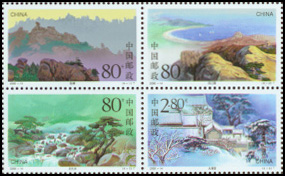
In 2000 China Post issued “Mount Lao”, four stamps and a sheetlet: Jufeng, Yangkou Bay, Beijiushui and the Taiqing Palace.