National Parks of China
Overview
| Designation | National Park of China (first batch) |
| Province | Gansu |
| Location | South-east of Tianshui, Gansu |
| Latitude, longitude | 34.4, 106.0 Google Maps |
| Highlights | Buddhist grottoes |
| Top sights | The Maijishan Grottoes |
| Area | 215 km² |
| Nearby cities | Chongqing, Chengdu, Xi’an |
| Nearby sites | Mount Taibai, Mount Kongtong, Jiuzhaigou and Huanglong, Guanshan Lianhuatai, Mount Tiantai, Baoji, Silk Roads |
| Themes | Grottoes, Statues, Buddhism, Mountains, Stamps |
About
Maijishan (“Wheat Stack Mountain”) rises about 45 km south-east of Tianshui in south-east Gansu, a spur of the Qinling named for its shape like a stack of wheat. Its grottoes are among China’s famous grotto complexes, renowned for their exquisite clay sculpture.
The caves were begun in AD 384 and carved and restored through more than ten dynasties; 194 survive, holding over 7,200 clay and stone sculptures from the 4th to the 19th century and more than 1,300 m² of murals. They became a national protected site in 1961. The caves were cut into the cliff of the stack-shaped hill and were once continuous, but an earthquake in the Kaiyuan reign of the Tang brought down the middle section, dividing them into an east and a west cliff: 140 caves on the west, mainly Western Qin, Northern Wei and Western Wei, and 54 on the east, mostly Northern Zhou, Sui, Tang and later.
Most of the work predates the Sui and Tang; the best known caves are the Seven Buddha Pavilion, the Ten Thousand Buddha Cave, the Ox Hall and the Jiling. Cave 4, the Upper Seven Buddha Pavilion of the Northern Zhou, is the finest: the five groups of flying apsaras above its first five niches, combining painting and relief, are unique in ancient China, solid and real yet airy and graceful. Cave 127 has the finest murals, a grand and accomplished Vimalakirti sutra scene regarded as the origin of later large Vimalakirti paintings, together with China’s largest, earliest and most complete mural of the Western Pure Land and native subjects such as King Mu of Zhou visiting the Queen Mother of the West.
Stamps
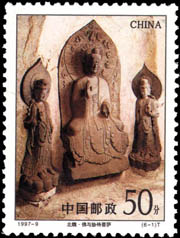
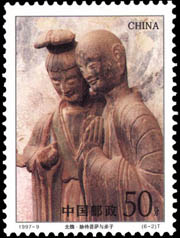
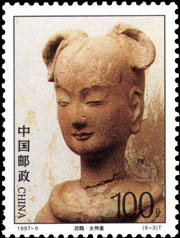
On 13 June 1997 China Post issued 1997-9 “Maijishan Grottoes”, six stamps: a Buddha with attendant bodhisattvas and a bodhisattva with disciple (Northern Wei), a maidservant and a Buddha (Western Wei), an attendant bodhisattva (Northern Zhou) and a donor (Song).
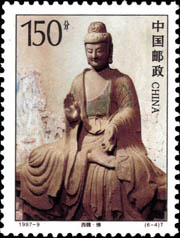
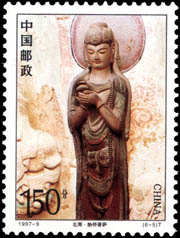
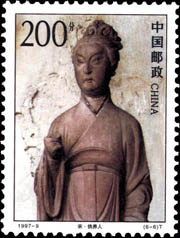
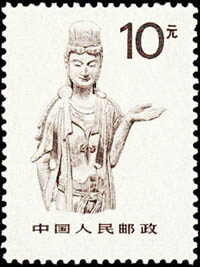
The third stamp of the 1988 definitive set R24 “Chinese Grotto Art” shows a Western Wei bodhisattva from Maijishan.