 National Parks of China
Overview
| Designation | National Park of China (first batch) AAAAA tourist attraction |
| Province | Hubei |
| Location | The Yangtze gorges from Fengjie, Chongqing, to Yichang, Hubei |
| Latitude, longitude | 31.0, 109.0 |
| Highlights | Deep V-shaped gorges |
| Top sights | Kuimen, Wu Gorge |
| Wildlife | Baiji (Yangtze river dolphin) |
| Length | 193 km |
| Nearby cities | Chongqing, Wuhan, Chengdu, Xi’an |
| Nearby sites | Shennongjia, Wulingyuan (Zhangjiajie), Furong River, Wulong, Mount Wudang, Tiankeng and Difeng (Sinkhole and Fissure) |
| Themes | Great rivers, Mountains, Peaks, Canyons, Culture & history, Reservoirs, Stamps, Banknotes & coins |
The Three Gorges
The Three Gorges are the Qutang, Wu and Xiling gorges, running more than 193 km from Baidicheng at Fengjie, Chongqing, to Nanjin Pass at Yichang, Hubei.
Qutang Gorge, the uppermost, is 8 km long and famed for its grandeur; its entrance, Kuimen, “the mightiest gate under heaven”, is one of the four great sights of Sichuan. A 40 m rock, the Yanyu Heap, once stood in the mouth of the gorge; it was blown up in 1959 for safe navigation.
Wu Gorge runs 45 km from the mouth of the Daning River to Guandukou, past the Twelve Peaks of Wushan, the most famous being Goddess Peak. In the Warring States period the poet Song Yu of Chu wrote the Gaotang and Goddess rhapsodies on the legend of the clouds and rain of Wushan. Wushan County also has the Lesser Three Gorges of the Daning River and the Mini Three Gorges.
Xiling Gorge is 66 km long, with the Military Books and Precious Sword Gorge, the Ox Liver and Horse Lung Gorge and the Lantern Shadow Gorge.
Other sights
Other famous sights on the Chongqing–Yichang route: the Baiheliang inscriptions at Fuling, the “ghost city” of Fengdu, Shibaozhai at Zhongxian, the Zhang Fei Temple at Yunyang, Taibai Rock at Wanxian, Baidicheng at Fengjie, and the Qu Yuan Shrine and Wang Zhaojun’s home at Zigui.
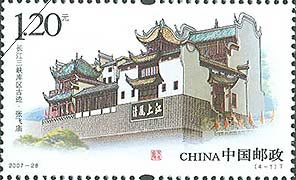
The Zhang Fei Temple originally stood at the foot of Feifeng Hill on the south bank at the old Yunyang county seat; in July 2003 it was moved to Panshi town across the river from the new seat. It combines the Chinese temple tradition of successive courtyards with the hillside in a layout like the character 品, its flying eaves and plain walls blending with rock and old trees: “the finest view of Shu, a haven of letters”.
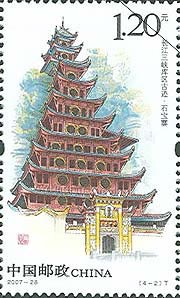
Shibaozhai stands on Yuyin Hill on the north bank at Zhongxian. Begun in the Wanli reign of the Ming, its nine-storey tower with a three-storey Kuixing pavilion on top rises 56 m, the largest and tallest surviving timber-frame building of its kind in China. Built against the cliff, each floor is joined by mortise and tenon without a single nail; from the river the lone peak rises between sky and water, red walls and grey tiles amid green leaves.
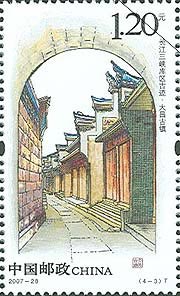
The old town of Dachang on the east bank of the Daning River in Wushan County has only two main streets, 150 m and 240 m long, mostly Ming and Qing buildings with a complete town wall: grey brick and dark tiles, double eaves, upturned corners and carved beams, the only complete old town in the gorges. Under the heritage plan for the Three Gorges reservoir it was dismantled and rebuilt at Xibaoling 5 km away.
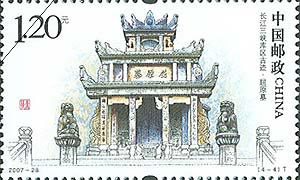
The Qu Yuan Shrine was first built as a temple in Qu Yuan village, Zigui County. In 1080 the Song emperor Shenzong ennobled Qu Yuan as Duke Qinglie and renamed the restored shrine after him. When the Gezhouba dam raised the water in 1976 it was moved to Xiangjiaping in Guizhou town and renamed the Qu Yuan Shrine, with a gate, side rooms, a stele gallery, a memorial hall and Qu Yuan’s tomb; the gate is a six-column, five-bay archway with “Qu Yuan Shrine” in the hand of Guo Moruo. After the Three Gorges reservoir filled it was rebuilt on Phoenix Hill in the new Zigui county town.
The Three Gorges Dam
The Three Gorges Dam stands at Sandouping in Xiling Gorge, Hubei. The Gezhouba dam lies downstream near Yichang.
Stamps and banknotes
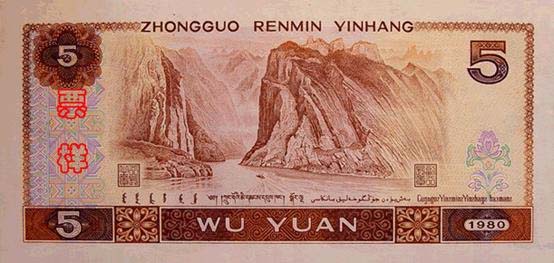
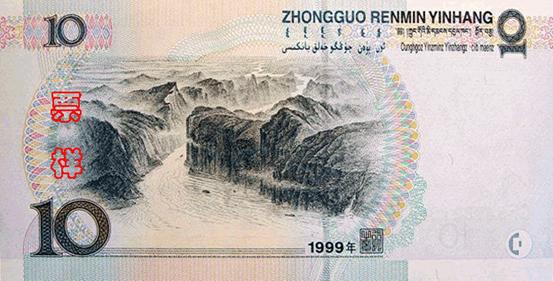
The backs of the 5-yuan note of the fourth series (1988) and the 10-yuan note of the fifth series show the Three Gorges.
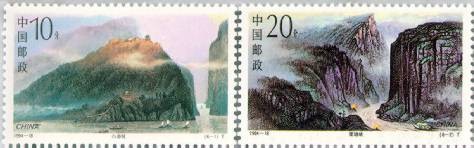
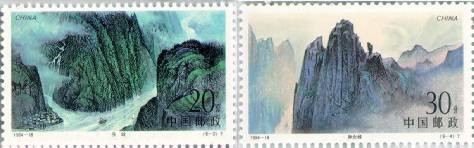
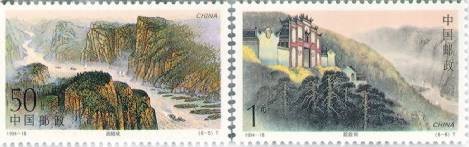
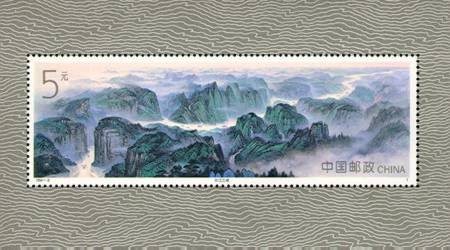
In 1994 China Post issued “The Three Gorges”, six stamps and a souvenir sheet: Baidicheng, Qutang Gorge, Wu Gorge, Goddess Peak, Xiling Gorge and the Qu Yuan Shrine.
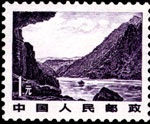
The 15th stamp of the 1981 definitive set R21 “Scenery of the Motherland” shows the Three Gorges.
On 20 August 2003 2003-21 “Three Gorges Project: Power Generation”, three stamps: the reservoir filling, the ship locks opening and the power station generating. On 13 October 2007 2007-28 “Monuments of the Three Gorges Reservoir Area”, four stamps: the Zhang Fei Temple, Shibaozhai, Dachang old town and Qu Yuan’s tomb.
News
In November 2007 a survey team from the Institute of Botany of the Chinese Academy of Sciences found four Stranvaesia trees, estimated to be about 1,000 years old, beside the path to Goddess Peak on the north bank; the largest is about 20 m tall and 80 cm thick. A member of the rose family with glossy foliage and red-yellow fruit that lasts through winter, it is a fine ornamental tree.
In 2007 scientists declared the baiji, the Yangtze river dolphin, functionally extinct.
In literature
Old song of Badong: “Of the Three Gorges of Badong the Wu Gorge is longest; three cries of the gibbon and tears wet my robe.”
Liu Yuxi: “The twelve peaks of Wushan stand dark and green; a slab of rock stands slender, called the Goddess. The dawn mist parts as if a curtain were drawn; mountain flowers fading are like the last of her make-up.”
Li Bai, “Leaving Baidicheng at Dawn”: “At dawn I left Baidicheng among the coloured clouds; a thousand li to Jiangling, back in a day. The gibbons on both banks never stopped crying; my light boat had already passed ten thousand mountains.”