 National Parks of China
Overview
| Designation | UNESCO World Heritage (natural, 2016) |
| Province | Hubei |
| Location | Western Hubei |
| Latitude, longitude | 31.5, 110.4 |
| Highlights | Rich wildlife; the “wild man” |
| Wildlife | Golden snub-nosed monkey |
| Elevation | 1,700 m |
| Highest point | 3,105.4 m |
| Nearby cities | Wuhan, Chongqing, Xi’an |
| Nearby sites | The Three Gorges of the Yangtze, Mount Wudang, Wulingyuan (Zhangjiajie), Tiankeng and Difeng (Sinkhole and Fissure), Danjiangkou Reservoir, Longzhong |
| Themes | Forests, Plants, Animals, Stamps, Mysteries |
Shennongjia
Shennongjia lies in western Hubei in the Shennongjia range, the eastern end of the Daba Mountains of the Qinling system: subalpine in the south-west, middle and low mountains in the north-east. It borders Baokang County to the east, Wushan County of Chongqing to the west, Xingshan and Badong and the Three Gorges to the south and Fang and Zhushan counties, near Mount Wudang, to the north, 3,253 km² in all. The average elevation is 1,700 m and the highest peak, Shennongding, 3,105.4 m. Wildlife is extraordinarily rich.
It is the only well-preserved oasis in the interior of China and the only such green treasure in the world’s middle latitudes, with the only intact subtropical forest ecosystem at that latitude, a world-class resource. Its flora and fauna are rich, ancient, endemic and rare: the firs, Fokienia, Reevesia, dove tree and Tsuga among the rare plants.
The name comes from the Yan Emperor Shennong, who, legend says, built thirty-six ladders to heaven here to gather and taste the hundred herbs.
Stamps
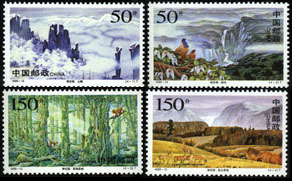
On 6 June 1998 China Post issued 1998-13 “Shennongjia”, four stamps: peaks, gorge, primeval forest and alpine meadow.
The “wild man”
For many years there have been stories of a “wild man” in Shennongjia, and many people claim to have seen one. Whether such an upright hominid exists remains unproven.
News
In March 2008 it was reported that a regional airport would be built for Shennongjia, to open within three years.