 National Parks of China
Overview
| Designation | UNESCO World Heritage (cultural, 2000) |
| Province | Anhui |
| Location | Yi County, southern Anhui |
| Latitude, longitude | 29.9, 118.0 Google Maps |
| Highlights | Ancient villages |
| Nearby cities | Hangzhou, Nanchang, Hefei |
| Nearby sites | Huangshan (Yellow Mountains), Mount Qiyun, Gaoling and Yaoli, Huashan Mystery Caves and the Jian River, Mount Lu (Lushan), West Lake, Hangzhou, Mount Jiuhua, Mount Sanqing |
| Themes | Historic buildings, Culture & history, Stamps |
Xidi
Xidi is a village in Yi County in southern Anhui. On 30 November 2000 the 24th session of the World Heritage Committee, meeting in Cairns, Australia, inscribed the ancient villages of Xidi and Hongcun on the World Heritage List.
Xidi was founded in the Yuanyou reign of the Song emperor Zhezong. As the river flows west past the village it was first called Xichuan (“West Stream”); a post station for relaying mail gave it the name Xidi (“West Relay”). It is known as “a home in the Peach Blossom Land”.
The village’s fortunes are bound up with the Hu clan. Its founder was a son of the Tang emperor Zhaozong who fled into hiding during the dynasty’s fall and took the surname Hu. The Hus went into trade from 1465, prospered and built houses, ancestral halls, roads and bridges; in the mid-17th century some moved from trade into officialdom, and the village grew further. Its heyday was the 18th and 19th centuries, when it had about 600 splendid houses.
A main street runs east–west with a parallel street on either side, crossed by many narrow lanes; small squares open in front of public buildings such as the Jing’ai Hall, the Lüfu Hall and the Prefect’s Archway. Today the main sights are 124 well-preserved Ming and Qing buildings, most of them open to visitors, including the stone archway of 1578 and the Dafudi mansion of 1691.
Hongcun
Hongcun lies at the foot of Huangshan in southern Anhui, an ancient village rich in Ming and Qing buildings, with an elaborate water system and a distinctive plan in the shape of an ox, a classic example of Huizhou architecture. It was inscribed on the World Heritage List with the other ancient villages of southern Anhui in 2000, listed as a national protected site in 2001 and named a Historic and Cultural Village of China in 2003.
The village lies 11 km north-east of the Yi county seat and is now the seat of Hongcun township. It faces south with Leigang Hill, an outlier of Huangshan, behind it; the Yongxi and Yangzhan rivers flow past on the west. The village covers about 280,000 m².
Founded in 1113 as Hongcun (“Grand Village”), it was the home of the Wang clan. In the Yongle reign of the Ming the clan head had a geomancer survey the site, re-planned the buildings and led water into the village. In the mid-Qing it was rebuilt on a large scale and renamed with a different character for hong to avoid the Qianlong Emperor’s personal name Hongli. It still keeps many old buildings: 1 of the Ming, 102 of the Qing and 34 of the Republican period, mostly well preserved.
One great feature is the water system. River water from the west is led into the village along a winding channel nearly 1 m wide that supplies every household, moderates the temperature and beautifies the village. In the centre it widens into the crescent-shaped Moon Pond and in the south into the bow-shaped South Lake, giving Hongcun its unique look.
The other feature is the ox-shaped plan: Leigang Hill is the head, two ancient trees at the entrance the horns, Moon Pond the heart, South Lake the belly, the winding channel the intestines, the houses the body and four old bridges the hooves: “hill for head, trees for horns, bridges for hooves, houses for body”.
Architecture: the buildings are mainly houses and private gardens, with public buildings such as an academy and ancestral halls, forming a complete ensemble. All are richly decorated, the wood, brick and stone carving delicate and of great artistic value. The lanes follow the water and the houses cluster round Moon Pond. Most houses have two courtyards; some lead the channel water indoors to make water courts and fish ponds. Typical buildings are the South Lake Academy and the Lexu, Chengzhi, Deyi and Songhe halls and the Bi Garden.
The South Lake Academy on the north shore of the lake began as six private schools of the late Ming, the “Six Courts by the Lake”, merged and rebuilt in 1814 as the Yiwen Family School. It has six parts: the Zhidao Hall, the Wenchang, Qimeng and Huiwen pavilions, the Lake View Tower and the Zhi Garden, white walls and dark tiles against blue water and sky. The Lexu Hall, the Wang ancestral hall, stands at the centre of the pond’s north shore and is the only surviving Ming building, with superb wood carving.
The Chengzhi Hall, built in 1855 for the salt merchant Wang Dinggui, is the largest complex in the village: about 2,100 m², more than 60 rooms around nine light wells. The front and rear halls are three-bay buildings with galleries, flanked by the family school hall and the fishpond hall, with a garden behind. It even has an opium-smoking room, the Cloud-Swallowing Studio, and a mahjong room, the Paishan Pavilion. Its 136 wooden columns and the lintels between them are carved with scenes such as the fisherman, woodcutter, ploughman and scholar, episodes from the Three Kingdoms, a hundred children at the Lantern Festival, Guo Ziyi’s birthday and the Tang emperor Suzong’s banquet.
Surrounded by green hills and clear water, Hongcun was a location for the film Crouching Tiger, Hidden Dragon.
Stamps
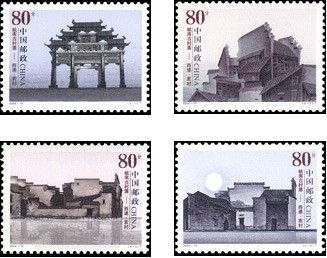
On 25 June 2004 China Post issued 2004-13T “Ancient Villages of Southern Anhui: Xidi and Hongcun”, four 80-fen stamps: the archway, the old buildings, South Lake and Moon Pond.
Parts of this page are adapted from Wikipedia under the GNU Free Documentation License.