 National Parks of China
Overview
| Designation | UNESCO World Heritage (cultural, 1997) National Park of China (second batch) AAAAA tourist attraction |
| Province | Yunnan |
| Location | Lijiang and Ninglang counties, Yunnan |
| Latitude, longitude | 27.1, 100.2 Google Maps |
| Highlights | Snow mountain, old town, gorge, lake, matriarchal Mosuo culture |
| Top sights | Jade Dragon Snow Mountain, the Old Town of Lijiang, Tiger Leaping Gorge on the Jinsha River, Lugu Lake in Ninglang |
| Area | 777 km² |
| Highest point | 5,596 m |
| Nearby cities | Dali, Chengdu, Kunming |
| Nearby sites | Three Parallel Rivers of Yunnan, Qionghai Lake and Mount Luoji, Mount Emei and the Leshan Giant Buddha, Stone Forest of Lunan, Mount Qingcheng and the Dujiangyan Irrigation System, Mount Siguniang and the Sichuan Giant Panda Sanctuaries |
| Themes | Mountains, Snow mountains, Peaks, Great rivers, Canyons, Forests, Ancient towns, Lakes, Stamps, Cable cars |
Jade Dragon Snow Mountain
Jade Dragon Snow Mountain (Yulong Xueshan) in north-west Yunnan is the highest range of the Yunling Mountains and the southernmost mountain in the northern hemisphere with living glaciers. Its thirteen peaks all exceed 5,000 m; the main peak, Shanzidou, is 5,596 m, the second highest in Yunnan. The range runs 35 km north to south and about 20 km east to west; with snow on the summits all year and cloud about the slopes, from afar it looks like a jade dragon in flight, hence the name.
The Naxi people tell this story: Jade Dragon and Haba were twin brothers who lived by panning gold in the Jinsha River. One day a cruel demon king came from the north, seized the river and forbade panning. The brothers fought him with their swords; Haba, the younger, was beheaded, while Jade Dragon fought for two days and three nights, breaking thirteen swords before driving the demon away. Haba became the headless Haba Snow Mountain; Jade Dragon, holding his thirteen swords aloft day and night against the demon’s return, became the thirteen peaks, and the sweat of his battle became the Black Water and White Water rivers. The mountain is the outward symbol of the Naxi, and the hero of the legend their inner spirit; the Naxi protector god Sanduo is the mountain’s incarnation.
Shanzidou rises abruptly from the flat Lijiang basin, its ridge spread like a fan, like a warrior in silver helmet and jade armour. It is only 15 km from the Old Town of Lijiang yet 3,200 m higher: eternal ice above, dense forest on the slopes and spring all year below, a rare “spring snow” landscape. The steep main peak has never been climbed.
Above 4,500 m are nineteen glaciers, with ice pinnacles and the “green snow” wonder; they are hanging and cirque glaciers, and the horns and comb-like arêtes between the cirques thrust skyward like swords, the basalt peaks cut into great pyramids. The sightseeing cable car runs from 3,365 m to 4,506 m, a length of 2,911 m. The ski ground on the north-east slope by the upper station is 1,000 m long and 600 m wide at 4,500 to 4,700 m; the mean temperature is 3.65 °C, the oxygen content 19.3% and the maximum wind 20 m/s.
The Old Town of Lijiang
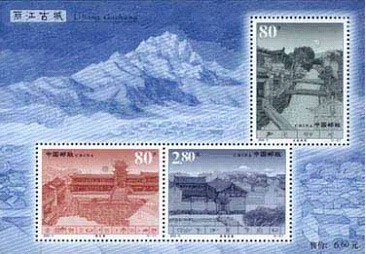
In 2002 China Post issued 2002-9T “The Old Town of Lijiang”, three stamps: Sifang Street, clear streams of the old town and Naxi houses, with a souvenir sheet 2002-9M.
News
In April 2007 a tour guide from Jilin attacked other guides and tourists with a knife in the Old Town of Lijiang, injuring 20 people.