 National Parks of China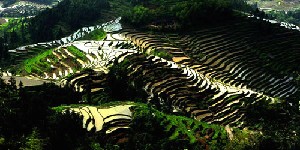
Overview
| Designation | National Park of China (sixth batch) |
| Province | Hunan |
| Location | Xinhua County, central Hunan |
| Mountains | Xuefeng Mountains |
| Latitude, longitude | 27.6, 111.0 Google Maps |
| Highlights | Rice terraces, caves, sea of clouds |
| Area | over 50 km² |
| Highest point | 1,585 m |
| Nearby cities | Hunan, Changsha, Fenghuang, Guangzhou, Wuhan, Chongqing |
| Nearby sites | Shaoshan, Mount Heng (Southern Sacred Mountain), Yuelu Mountain, Peach Blossom Land (Taohuayuan), Fenghuang, Wulingyuan (Zhangjiajie), Mount Lang (Langshan), Baishui Cave, Mount Huxing and the Huayao |
| Themes | Cave, Karst, Stream, Culture, Mountain |
About
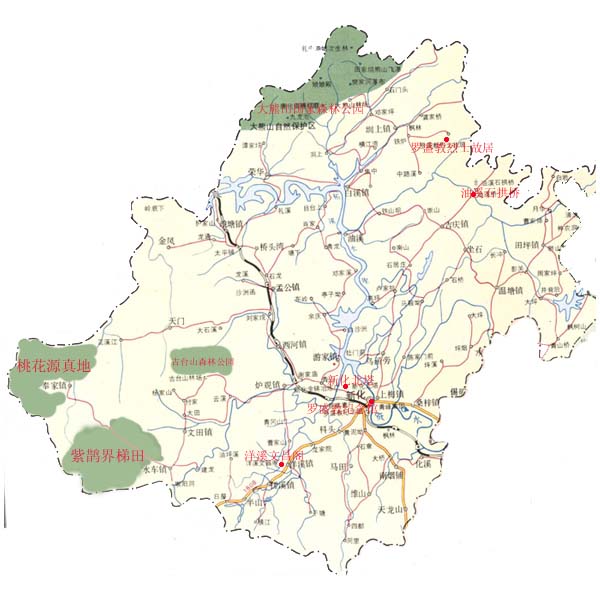
The Ziquejie Terraces–Meishan Dragon Palace scenic area in Xinhua County, central Hunan, is a sixth-batch national park.
The terraces lie in the Xixi area of Shuiche township and the Shuanglin area of Fengjia township, in the Fengjia hills of the central Xuefeng range, over 50 km² in all with more than 13 km² of terraces concentrated around Ziquejie, chiefly in Baishui, Longpu, Shifeng and Jinlong villages. The Shuiche–Fengjia road winds for more than ten kilometres among them; the terraces climb a dozen hills between 500 and over 1,000 m, none bigger than a mu. Ziquejie is rainy and humid, and a sea of clouds forms along the Xixi River in every season, a fine place for clouds and sunrise. The terraces are over 2,000 years old, the work of Miao, Yao, Dong and Han farmers, famed for their height, extent and beauty. Behind Ziquejie are ten thousand mu of honeysuckle and the remains of 48 Yao villages.
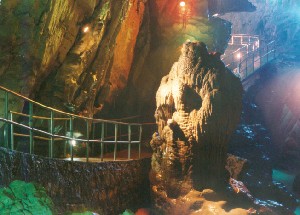
The Meishan Dragon Palace is a karst cave explored for 2,876 m with a 466 m underground river on nine levels; its sights include the Gorge in the Clouds, the Birth of Nezha, the Jade Emperor’s Palace, the Heavenly Garden and the ancient riverbed.
It is in the sixth batch of national parks of China (national scenic areas) named by the State Council in 2005.
Travel tips
Getting there: the nearest big city is Changsha. Take a high-speed train from Changsha to Loudi, then a coach to Xinhua county, about an hour. From Xinhua to Ziquejie at Shuiche town is about 40 km, roughly an hour, and Meishan Longgong in Youxi township is some distance beyond the terraces.
Layout: the Ziquejie terraces lie between 500 and over 1,000 m, with the Shuifeng road winding among them. Meishan Longgong is a karst cave, and the area also has Daxiongshan, rafting at Youxi and the Zi River scenery.
The terraces: those at Longpu and Shifeng are the most concentrated. Stop at viewing points along the road, or walk between the villages.
Meishan Longgong: a cave of nine levels, 2,876 m explored, mainly of interest for its karst formations, and open to visitors on a ticket.
Time: one day for the terraces and two if you add Meishan Longgong.
Season: in spring the fields are flooded and look like sheets of water, early summer is fresh green, autumn the rice turns gold, and in winter there is often cloud sea and mist. For sunrise and cloud, get up early.
Where to stay: the area is still being developed, and most people stay in farmhouses by the terraces. Shuiche town has small hotels, and Xinhua county town has better ones.
Nearby: the area has Meishan cultural sites; to the west lie Huaihua and Zhangjiajie, and to the east Loudi and Shaoshan.
Caution: the hills are often misty and the road is narrow; field banks are slippery in the rainy season, so keep out of the fields.
Travel information
Route: Changsha – Loudi – Xinhua – Shuiche (terraces) – Youxi – Meishan Dragon Palace. the terraces are free. Lodging: the terraces are still being developed; stay with local farmers.
More photos
Map
Ziquejie
Ziquejie lies in the Fengjia hills of the central Xuefeng range, which fan out north-east from the 1,585 m Fengchexiang peak with more than 30 peaks over 1,000 m. Ziquejie itself, originally Zhikejie, 1,236 m, is the first peak on the road from Shuiche over Fengjia to Xupu; a flagstone path zigzags up it over 600 m of height.
In 1508 famine drove the Yao to rebellion here, a war of 70 years with countless dead; afterwards the kind burned paper money for the wronged souls, and the place became Zhiqianjie (“paper money ridge”), in the Qing Zhiquejie; scholars recently changed it to Ziquejie (“purple magpie ridge”), which has stuck.
The monsoon climate is marked, rain abundant, the forest cover good and the ground holds water well, giving rich groundwater: over 20 streams flow south-east into the Xixi and the Dayang River to the Zi River, and nine north-west into the Qu River, 120 km of streams in all. The summit forest, the solid granite with few cracks and the sandy loam that absorbs rain and releases it evenly make an excellent natural storage system, 0.2 to 0.4 m³ of water per cubic metre of soil; with 1,600 mm of rain a year, 200 mm more than the nearby plains, the fields never want for water. The abundant surface water and humidity make the weather changeable and the clouds and mist frequent.
The terraces
The terraces exploit the terrain, geology and soil: set into the slopes and watered by seepage springs, each small spring feeding its own system of soil pores, rock cracks, tiny ditches and plots. The whole hillside is a mosaic of such irrigation groups. Each terrace’s length, width and step follow the ground, usually 1 to 3 m wide with a drop of 1 to 1.5 m, for stability and water retention; the size of each group depends on the spring and the slope, so that water is ample yet never rushes, with carefully built bunds to prevent erosion. Terraces on low hilltops are watered by bamboo or plastic pipes buried in the soil leading water down from above, or by diverting hillside streams into channels dug along the slope and irrigating step by step: an ingenious system.
The Longpu and Shifeng terraces drape slopes steep and gentle, large and small, tier upon tier between heaven and earth, thousands of mu linked, hundreds of steps piled, like ladders hung from the summits to the valley floor. South of them on the Xixi River a sea of clouds forms on more than 60 days a year after mist or sudden rain, drifting among the hills and floating over the terraces; at sunrise the dawn glow and the white mist answer each other in ever-changing colours.
The Longpu terraces have two parts: in the east, looking south from the heights, terraces blanket ridge after ridge, grand and graceful, especially at dawn when sunlight fills the fields and the plank houses among them send up threads of smoke into the thin mist, clear near and hazy far, with the road winding through; in the west the Yaorenchong terraces, once a Yao village with two Yao rock houses and stone-house ruins still on the heights, fill a hollow between two ridges, the western ridge terraced from foot to summit in over 200 steps.
The Shifeng terraces seen from the Linggong Temple wind round hill after hill like stars round the moon; from Huangjiling looking back they are grander still, and the 300 mu of tribute-grain fields of Huangjiling and the Laozhuang and Longxiang terraces run on along the hills.
The Changshi terraces are the broadest, most layered and most beautiful of all: tier on tier over every slope and ridge, each a delicate ripple, each fold a scale-like wave; close to, a grid of bunds; looking up, a ladder to the clouds; looking down, gleaming water and winding bunds like an ink landscape.
The Baishui terraces follow the slopes, concave and convex, large and small, long and short, light and dark, some stacked like crescent moons to the sky, some racing like long snakes over the hills, their winding bunds drawn as if by an immortal’s brush.
Between Laishi’ao and Yajizhai twelve ridges rise and fall one after another, their thousands of mu of terraces called the Jinlong (Golden Dragon) terraces.
Other sights
Bainiudang (“Hundred Oxen Hollow”) lies on the north slope of Fengchexiang where Shuiche and Fengjia meet: a strange landscape of several hundred mu with a hundred hummocks from a few to a dozen metres high, with springs welling between them into little lakes that drain in streams towards Fengjia; from Tudi’ao it looks like a hundred immortal oxen playing in the water.
At Louxia village on the eastern foot stands a thousand-year camphor said to have been planted in the Tang, 28 m high and 7.5 m round, with a hollow 4 m up from which a sapling as thick as a bowl has grown out of the accumulated leaf mould, a tree within a tree. Locals say it has a spirit, flourishing in good years and withering in bad; families “entrust” their children to it for its protection, and on the first and fifteenth of the month incense and firecrackers surround it.
The Dragon King Pools where Longxiang and Zhenglong villages meet are three dark-green pools linked by waterfalls; a natural bridge 3 m long and half a metre wide leads to the upper pool, the bed is a single rock sculpted by the water, and the fall between the middle and lower pools is 8 m wide and 3 m high, with a Dragon King temple beside it.
Baiqi Peak, formerly Shilong Mountain, 1,465 m, is ringed by hills with fine views on all sides. The Yao, who were Buddhists, built a Guanyin shrine here in the early Yuanfeng reign of the Song; in 1414 the brothers Luo Putong and Luo Pudao, who had trained from childhood at Mount Wudang, returned at ninety and built the Patriarch’s Hall beside it, renaming the peak Baiqi; it has been busy with bells, drums and incense ever since. In the Qianlong reign the monk Pubai, styled Caicai, led a flourishing community here, “two sheng of silver a day”; he built a flagstone road 5 ft wide, 700 m and 240 steps, and his own tomb, 11 m across and 2.5 m high with a vaulted chamber, a stone door inscribed “boundless night”, a railing on top and a three-storey stone pagoda inscribed “tomb of the monk Caicai”. He died in 1773 and was laid in a stone coffin under glazed tiles like a palace, sealed with a single stone; the coffin was destroyed in the Cultural Revolution and only the stone bed remains, the largest and best-preserved monk’s pagoda tomb in Loudi. The hall was repaired in 1586, 1820 and 1880 and rebuilt in 2001 with 100,000 yuan raised by villagers, with stone walls and glazed eaves and the Guanyin hall restored beside it in timber; before the hall is a strange rock, the “temple-guarding turtle”, 8 m long with a shell rising over a metre and markings like a real turtle.
The Yang ancestral hall at Shangxi village, Shuiche, built in the Qing, faces west in brick and timber around a courtyard, 1,368 m² of site and 2,166 m² of building: a theatre, a main hall and side wings round a rectangular light well. The gate tower has eight columns, three doors, bracket sets and a double-eaved hip-and-gable roof, with drum stones and a stele of Yang Shifu’s “Record of the Sweet Spring of Huanqing Hall”; inside are plaques, couplets, a bridal sedan and a fine openwork carving of two dragons playing with a pearl, and the beams, doors, windows and walls are rich in carved and painted birds, beasts and flowers.
The Meishan Dragon Palace
The Dragon Palace lies at Gaoqiao village on the west bank of the Zi River in Youxi township, bounded by the Xinbai road on the east, the ridges of Huangmaoli and Dongfanghong to the south-west and Qingshi Mountain to the north, 3 km²: two hills enclosing a valley (Hidden Dragon Valley), two waters embracing a bend (Coiled Dragon Bay) and hill and water joining at a cave (the Dragon Palace, also the Hidden Soldiers Cave). The scenery unfolds from broad water to enclosed valley to cave to sudden openness, the karst passages crossing in three dimensions. Xinhua was anciently called Meishan, hence the name.
The cave has been explored for 2,876 m with 58,600 m² developed and a 466 m underground river. It is a multi-storey structure of unusual form, by water and by land, nine levels and tens of thousands of chambers, safe and sound: experts find the cave has reached natural equilibrium over 500,000 years with a roof of thick, strong rock, and it is well ventilated.
It has abundant flowstone, stalagmites and stalactites, cross-section and residual micro-forms, in six groups: the Dragon Palace Welcome, the Blue Water Lotus Palace, the Creation, the Heavenly Garden, Meishan Customs and Dragon and Phoenix. Its four wonders are the 80 m multi-storey Cave Mansion in the Clouds, the Birth of Nezha, the Heavenly Rime and the Golden Mountain in the Water.
Confucius Travelling to Teach, life-size, vivid and lifelike, is one of the cave’s emblems. The Blue Water Lotus Palace is the 466 m underground river: boating through, the channel is narrow and winding, the banks jagged with rocks and peaks, stalactites, stalagmites, stone flags and curtains everywhere, and a huge Lotus Hall with clear veins and water flowing like a curtain. The Birth of Nezha is a huge natural stalactite lotus split down the middle, a fallen petal and the red-clotted body of Nezha, the lotus seeming able to open and close. The Golden Mountain in the Water has tens of thousands of flawless white soda straws and varied stalactites above and a natural Jade Pool of 368 m² below, its floor flat as a mirror, with a gracefully curved natural dam about a metre high on one side; the straws and stalactites reflected in the pool make a huge glittering golden mountain. The Heavenly Rime is cave deposit formed by capillary action, growing without pattern and fine as ox hair. Treasure within Treasure, about 6 m high, is divided into two storeys by a thin sandy section of ancient riverbed: strange stalactites, pagoda-like stalagmites and translucent veined curtains above, a surface of fine white soda straws below, supported by columns marked by flowing water, like a richly decorated antique pavilion.
Daxiong Mountain National Forest Park
Daxiong Mountain National Forest Park lies in northern Xinhua over 70 km from the county seat, 76 km²; the main peak, Jiulong, is 1,662 m. It has rare species such as yew and clouded leopard and a thousand-year gingko with a crown of over 320 m².
Youxi rafting
The Youxi, the second largest tributary of the Zi in the county, is named for water clear as oil. Rising at Jiaolaoling in Lianyuan, it joins the Zi at Youxi village after 67 km, draining 719 km² with a fall of 281 m and a mean flow of 16.84 m³/s. The Chetianjiang reservoir on its upper course irrigates six townships east of the river, and five hydro stations step down its middle course.
The river is deep and secluded, mountains at source and mouth, gorges above and below, its banks of towering green hills, cliffs stabbing the sky and a winding mysterious bed, with hundreds of crags strung along it like pearls: Moonlight, Star, Gold, Red, Green and Horizontal rocks, Lion, Ape, Bamboo Shoot and Stegosaurus rocks, and the Chuanmen, Humen, General’s and Immortals’ gorges. Tea gardens and bamboo cover the hills, the air is fresh, the Jingyankou spring is cool in summer, Qinglong Temple adds mystery, the old Qinglong wind-and-rain bridge and the legend of the twin bridges, the clear water, the rolling green hills, the fields and scattered farmhouses make a perfect picture.
The Zi River
The Zi rises in Ziyuan County, Guangxi, sharing a source with the Li, and is famed for its clarity. It enters Xinhua from Lengshuijiang as the Zhuyu River, mother river of ancient Meishan culture, crossing the county through nine townships for 91 km with a fall of 26 m, many bends and rapids; its main tributaries here are the Dayang, Youxi, Zhuxi, Meixi and Qu, draining 3,112.5 km². The Zhexi hydro station of 1961 turned the county’s stretch into a lake-like reservoir, 149,900 mu of water, 110 km², up to 1.27 km wide with 630 km of shoreline.
Along it are eight sights: Tianzi Mountain, Wushi Mountain, Crane Rock, Shiliu Mountain, Ziyun Nunnery and Guanyin Watching the Moon at Suhu, mountains, water, springs and caves within the hundred-li reservoir.
The Xinhua North Pagoda is a seven-storey octagonal brick pagoda 46 m high with a stone-railed base carved with the eighteen Tang scholars, short upturned eaves on each storey, a carved stone boat with dragon head and fish tail, a cast-metal finial and a south door with the couplet “wishing to lean on the rail and stretch the eye afar, one must climb step by step to the top” and “key to the north gate” above the arch.
The former home of Luo Shengjiao, who died in 1952 rescuing a Korean child from a river and was honoured as a special-class hero, is at Tongzi village, Zhenshang township; his memorial hall stands on the west bank by the Zi River bridge in the county town.