 National Parks of China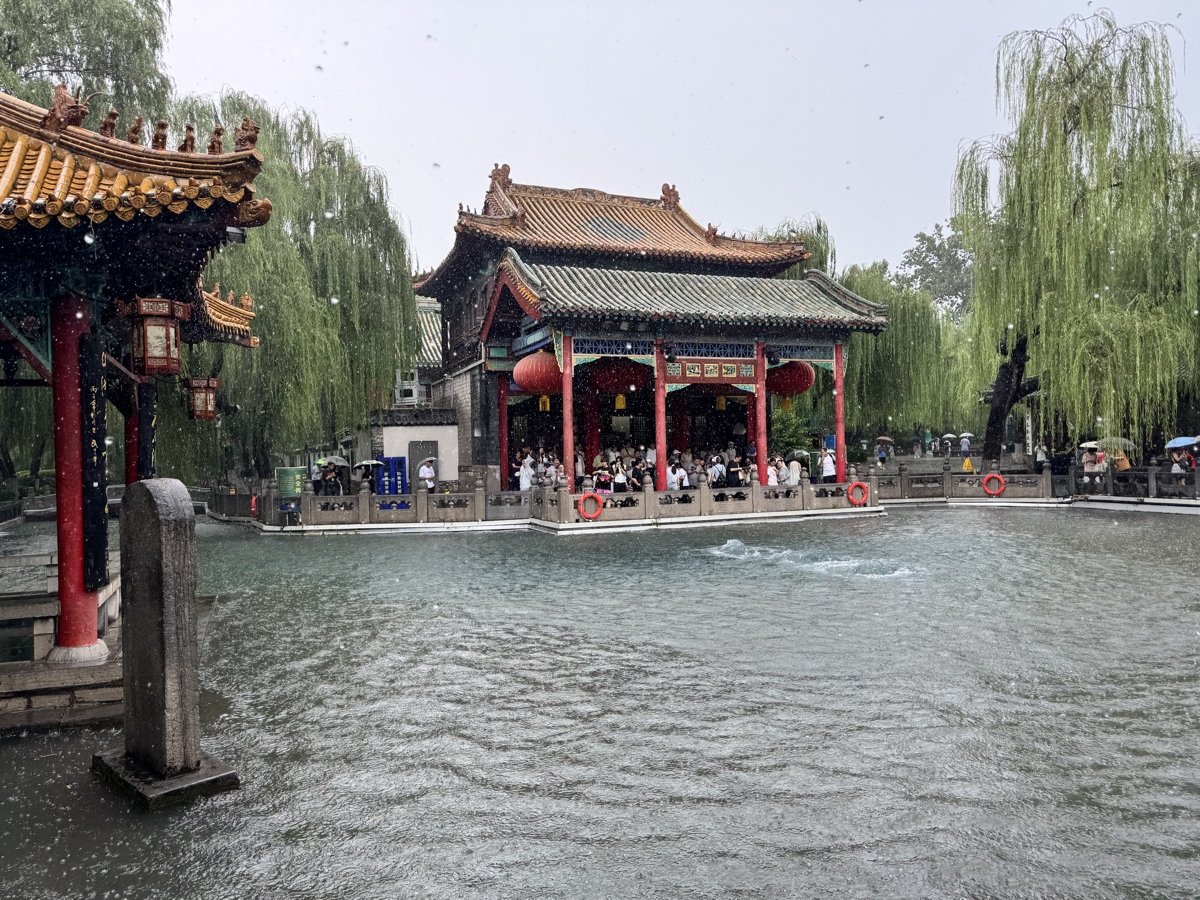
Overview
| Province | Shandong |
| Latitude, longitude | 36.66, 117.01 Google Maps |
| Themes | Spring, Karst, City, Chinese gardens, Literary landmarks, Inscription |
About
Baotu Spring lies just outside the south-west corner of the old city of Jinan, Shandong, on the south bank of the city moat. It is the first of Jinan's Seventy-two Famous Springs. The rectangular pool is about 30 m from east to west and 18 m from north to south, and three vents side by side push water up through it; the water stays at about 18°C all year. The pool is in the west of Baotu Spring Park, laid out in 1956, which also contains the Shuyu, Jinxian, Mapao, Huanghua and Dukang springs.
The spring was anciently called Luo and is the source of the old Luo River. The Spring and Autumn Annals record that in 694 BC Duke Huan of Lu met Duke Xiang of Qi “at Luo”, its earliest mention in writing, some 2,700 years ago. According to the Zuo Zhuan, Duke Huan travelled with his wife Wen Jiang, Duke Xiang’s sister, and the two went on together to Qi. Wen Jiang had an affair with her brother; when Duke Huan rebuked her, Duke Xiang gave him a banquet and afterwards had Prince Pengsheng help him into his carriage and kill him there. Eight years later, in 686 BC, Duke Xiang himself was killed in an uprising in Qi, and Prince Xiaobai returned to take the throne as Duke Huan of Qi. Li Daoyuan of the Northern Wei wrote in the Shuijing Zhu that the water “rises from the source and wells up like a wheel”. Zeng Gong, prefect of Qizhou in the Northern Song, built the Luoyuan Hall beside it and in his Record of the Two Halls of Qizhou called it “the Baotu spring”, the name it has kept. The Yuan painter-calligrapher Zhao Mengfu wrote that its mist moistens Mount Huabuzhu and the sound of its waves shakes Daming Lake. The Qianlong Emperor, touring the south, wrote the characters “Jituan” (rushing torrent), now on a stele south-east of the pool; the spring is also known as the “First Spring under Heaven”.
The Luoyuan Hall stands on the north side of the pool and the Ming-dynasty Guanlan Pavilion on the west, with a “Baotu Spring” stele in the water in front of it and a “First Spring” stele, written by Wang Zhonglin in the Qing, at the poolside. Beside the Shuyu Spring is the Li Qingzhao Memorial Hall. The Wanzhu Garden in the west of the park, a courtyard residence built in 1917, became a Major Historical and Cultural Site Protected at the National Level in 2019.
South of Jinan is the limestone country of the northern flank of Mount Tai. Rain soaks into the ground and flows north through the rock until, under the old city, it is blocked by impermeable igneous rock and forced to the surface, forming four spring groups: Baotu Spring, Black Tiger Spring, Five Dragon Pool and Pearl Spring. Their water feeds the moat and Daming Lake. As the city drew more groundwater, Baotu Spring stopped flowing for the first time on record in 1976, and from 1999 to 2001 it was dry for 926 days. Jinan then restricted groundwater pumping and recharged the aquifer in the southern hills, and the spring flowed again from September 2003.
Baotu Spring
Baotu Spring lies just outside the south-west corner of the old city of Jinan, Shandong, on the south bank of the city moat. It is the first of Jinan's Seventy-two Famous Springs. The rectangular pool is about 30 m from east to west and 18 m from north to south, and three vents side by side push water up through it; the water stays at about 18°C all year. The pool is in the west of Baotu Spring Park, laid out in 1956, which also contains the Shuyu, Jinxian, Mapao, Huanghua and Dukang springs.
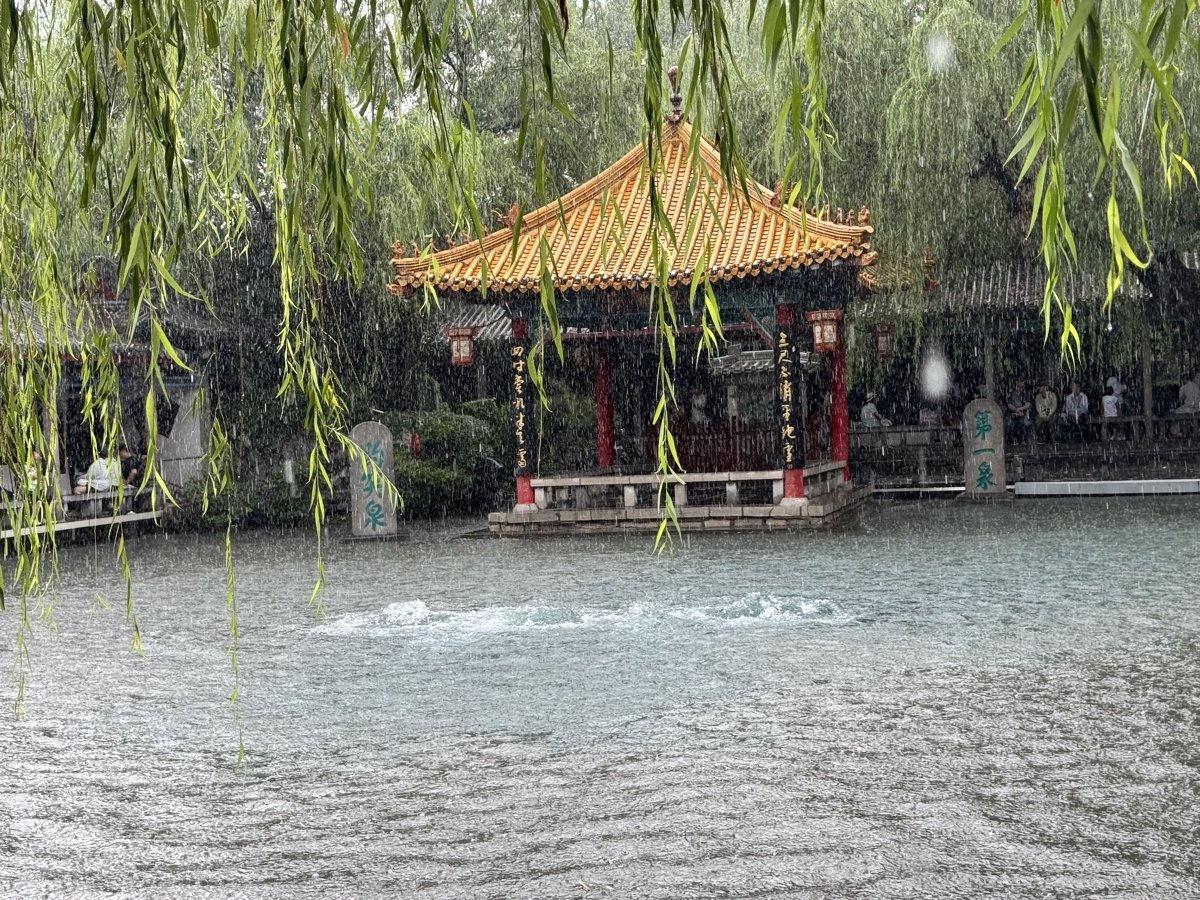
The spring was anciently called Luo and is the source of the old Luo River. The Spring and Autumn Annals record that in 694 BC Duke Huan of Lu met Duke Xiang of Qi “at Luo”, its earliest mention in writing, some 2,700 years ago. According to the Zuo Zhuan, Duke Huan travelled with his wife Wen Jiang, Duke Xiang’s sister, and the two went on together to Qi. Wen Jiang had an affair with her brother; when Duke Huan rebuked her, Duke Xiang gave him a banquet and afterwards had Prince Pengsheng help him into his carriage and kill him there. Eight years later, in 686 BC, Duke Xiang himself was killed in an uprising in Qi, and Prince Xiaobai returned to take the throne as Duke Huan of Qi. Li Daoyuan of the Northern Wei wrote in the Shuijing Zhu that the water “rises from the source and wells up like a wheel”. Zeng Gong, prefect of Qizhou in the Northern Song, built the Luoyuan Hall beside it and in his Record of the Two Halls of Qizhou called it “the Baotu spring”, the name it has kept. The Yuan painter-calligrapher Zhao Mengfu wrote that its mist moistens Mount Huabuzhu and the sound of its waves shakes Daming Lake. The Qianlong Emperor, touring the south, wrote the characters “Jituan” (rushing torrent), now on a stele south-east of the pool; the spring is also known as the “First Spring under Heaven”.
The Luoyuan Hall stands on the north side of the pool and the Ming-dynasty Guanlan Pavilion on the west, with a “Baotu Spring” stele in the water in front of it and a “First Spring” stele, written by Wang Zhonglin in the Qing, at the poolside. Beside the Shuyu Spring is the Li Qingzhao Memorial Hall. The Wanzhu Garden in the west of the park, a courtyard residence built in 1917, became a Major Historical and Cultural Site Protected at the National Level in 2019.
Black Tiger Spring
Black Tiger Spring lies outside the south-east corner of the old city, on the south bank of the southern moat, facing Liberation Pavilion across the water. The water comes out of a cave at the foot of a rock face and spouts through three carved stone tiger heads, side by side, into a stone-lined pool about 13 m long and 9 m wide, then pours over the north side of the pool into the moat. Its flow among Jinan's famous springs is second only to Baotu Spring. People from the neighbourhood often come here to fill bottles with spring water.
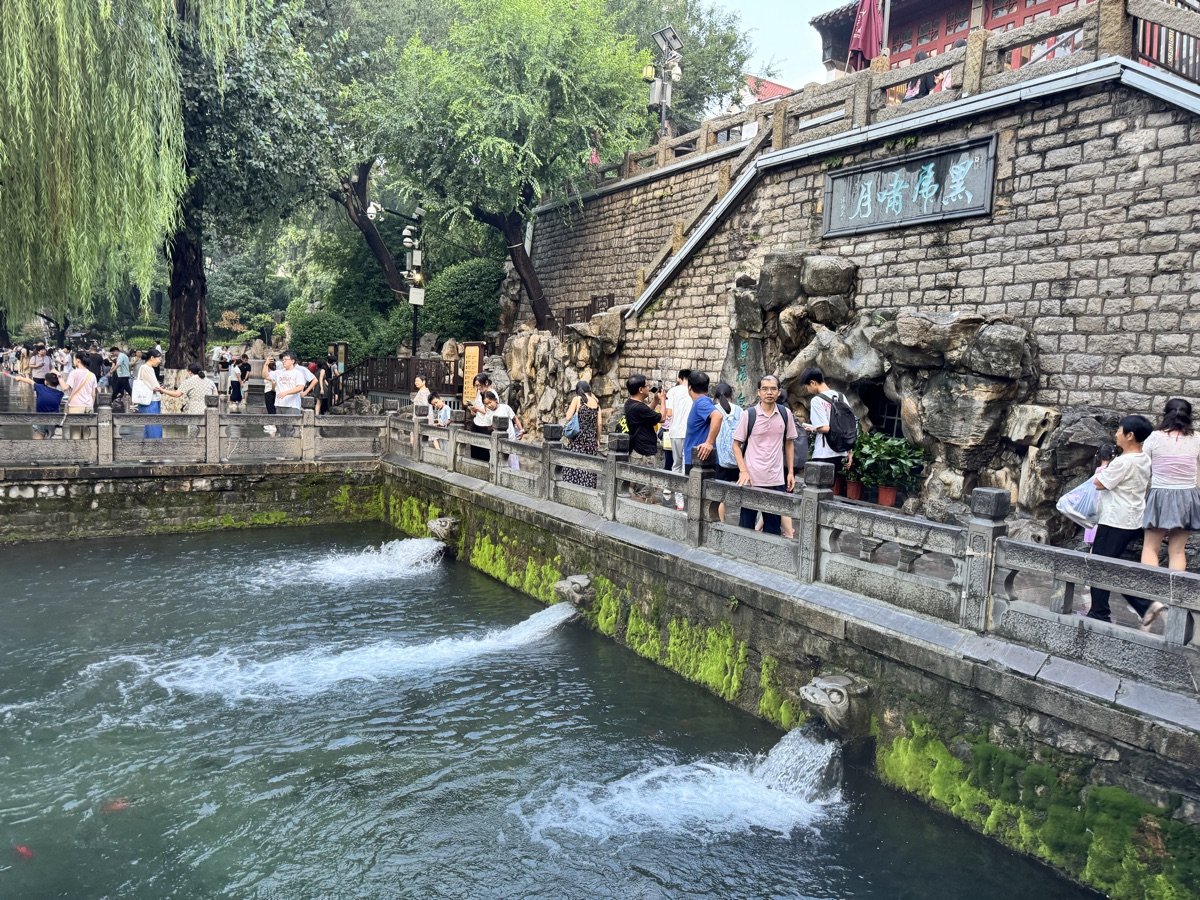
The name is already recorded on the Jin-dynasty Stele of Famous Springs. The usual explanation is that a moss-covered black boulder in the cave looks like a crouching tiger and the water striking it sounds like a tiger's roar. A Black Tiger Temple built over the cave in the Ming later collapsed; when the pool was walled in the Qing, a stone tiger head was used as the spout, and an enlargement in 1931 increased the heads to three. The Black Tiger Spring group lines both banks of the southern moat for about 700 m westward from Liberation Pavilion and has 14 spring pools, among them the Pipa, Agate, White Stone and Nine Maidens springs; it is the second-largest spring group in Jinan.
Five Dragon Pool
Five Dragon Pool is about 500 m north of Baotu Spring, on the west bank of the western moat, formerly outside the west gate of the old city. The pool is about 70 m long, 35 m wide and 6 m deep, the deepest spring pool in Jinan. According to records, a temple to the dragon gods of the five directions was built beside it in the Yuan dynasty, giving the pool its name. Legend has it that the mansion of the Tang general Qin Qiong (Qin Shubao) stood here and sank to form the pool; a Qin Qiong Shrine stands in the north of the park.
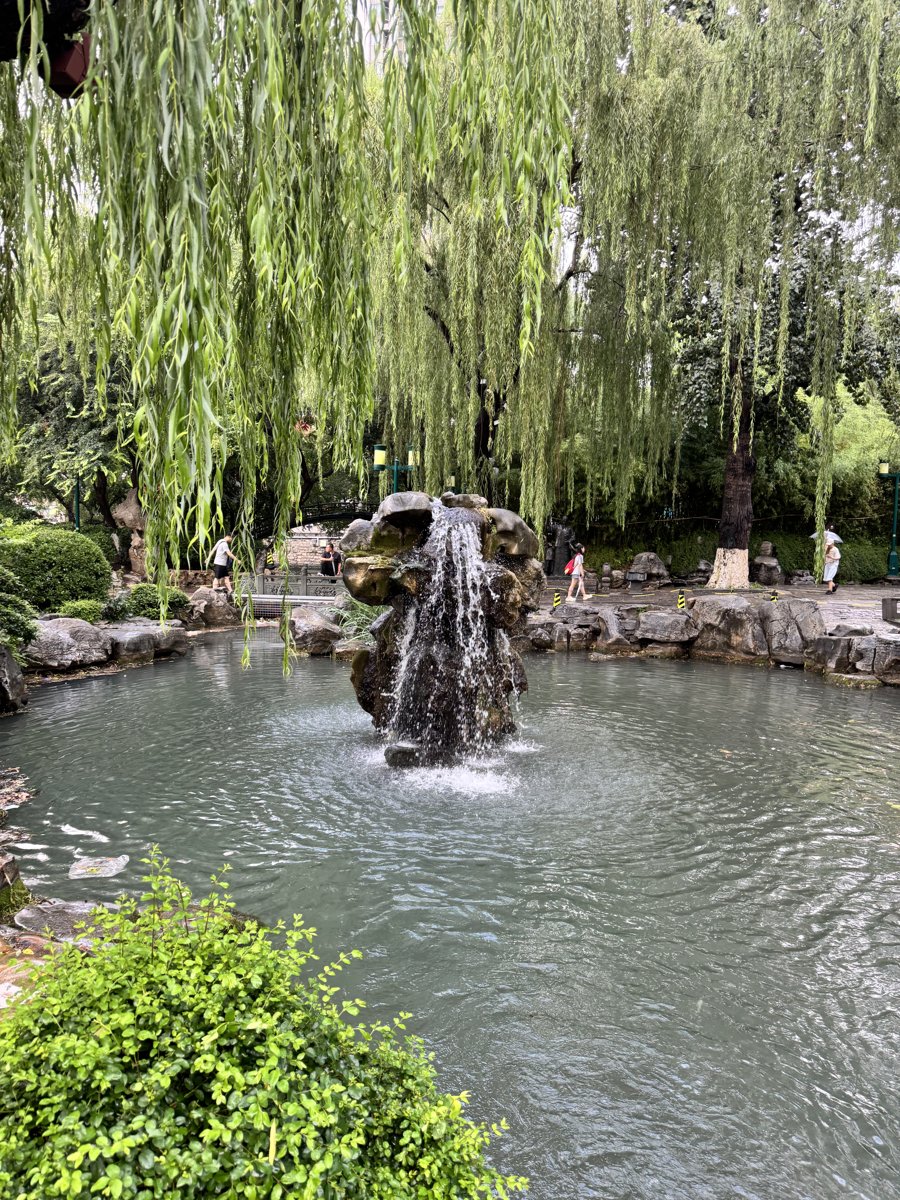
Five Dragon Pool Park was opened in 1985. It contains the Ancient Warm Spring, Xianqing, Tianjing, Crescent, West Mizhi, Guanjia, Huima, Qiuxi, Jade and Lian springs, which make up the Five Dragon Pool spring group. The Crescent Spring flows only when the groundwater rises to about 29 m, the highest threshold among the Seventy-two Famous Springs. The original Lixia Pavilion, where Du Fu attended a banquet, is generally thought to have stood near Five Dragon Pool and was moved to Daming Lake after the Song.
Its Crescent Spring (Yueya Quan) needs the highest groundwater of any spring in old Jinan: it usually starts flowing only when the water table at Baotu Spring reaches about 29 m, falling over the rocks as the “Crescent Waterfall”.
Pearl Spring
Pearl Spring is in the middle of the old city, north of Quancheng Road, in a walled compound at the north end of Yuanqian Street. Strings of bubbles rise continuously from the bottom of the pool like pearls, hence the name. The Pearl Spring group also includes the Sanshui, Xiting, Chu, Zhuoying (Wangfu Pool), Shun Well, Yuhuan, Furong, Tengjiao and Shuangzhong springs, scattered through the lanes north of Quancheng Road.
In the Ming dynasty this was the palace of the Prince of De, begun in 1466, with the spring inside its grounds. The palace was destroyed when Qing troops took Jinan in 1639. In 1667 the governor of Shandong built his yamen on the site, and until 1937 it remained the seat of the Shandong provincial government. Since 1979 it has housed the Standing Committee of the Shandong Provincial People's Congress; the offices are kept separate from a visitor area, which is open to the public. The whole compound became a Shandong provincial protected site in 2015.
Wangfu Pool and Qushuiting Street
Wangfu Pool – properly Zhuoying Spring – is about 100 m west of Pearl Spring on Wangfuchizi Street and belongs to the Pearl Spring group. When the Prince of De's palace was built in the Ming, the spring was enclosed within it and came to be called the Prince's Pool; when the site became the Qing governor's yamen, it was left outside the wall. The pool has stone banks, 30 m long and 19 m wide, with houses right up to its east and west sides. The name comes from an old song quoted in Mencius: “When the waters of the Canglang are clear, I can wash my hat-strings in them.” Local people used to do their washing and swim in the pool; both are now banned to protect the water.
The water from Wangfu Pool runs north as a small stream, and the flagstone lane beside it is Qushuiting Street, about 300 m long from south to north, its north end facing the south gate of Daming Lake. The stream is on one side of the lane and old houses on the other; residents once washed rice and clothes in it. The street now draws many visitors. Baihuazhou, the spring-fed pond to the east of its north end, is surrounded by a restored historic quarter.
Daming Lake
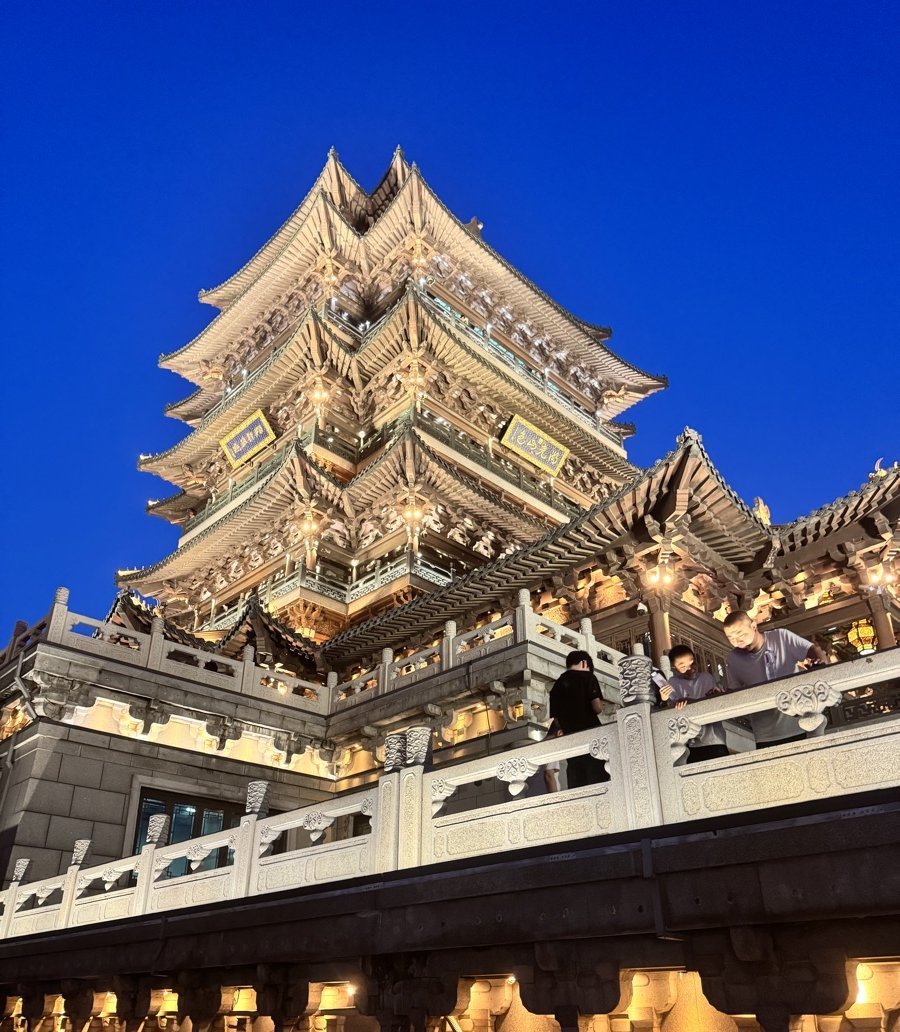
Daming Lake, in the north of the old city, is fed by water from the Baotu, Pearl and other spring groups and by the moat. Its water surface is about 0.5 km²; the water leaves through a sluice gate on the north side and flows north into the Xiaoqing River. The name “Daming Lake” already appears in the Northern Wei Shuijing Zhu, but it is generally thought to refer there to another body of water west of the city. The present lake was called Lianzi (Lotus Seed) Lake in the Tang; Zeng Gong, prefect of Qizhou in the Northern Song, called it West Lake and built causeways and bridges on it; from Yuan Haowen's Record of a Journey to Jinan in the Jin dynasty it has been called Daming Lake. It became a park in 1955 and was enlarged from 2007 to 2009 to about 103 ha. On a raised terrace on the north shore, the Beiji Pavilion is a Taoist temple first built in the Yuan and rebuilt in the Yongle reign of the Ming. On the south shore, the Jiaxuan Shrine, converted in 1961 from a shrine to Li Hongzhang, commemorates the Southern Song poet Xin Qiji, a native of Licheng in Jinan. On the east shore, the Chaoran Tower, built in 2009 and about 52 m high, takes its name from a Yuan-dynasty tower that once stood by the lake.
The present buildings of Lixia Pavilion, on an island in the lake, date from a rebuilding in the Kangxi reign of the Qing. In 745 Li Yong, governor of Beihai, gave a banquet for Du Fu at Lixia Pavilion, and Du Fu wrote the poem Attending Li Beihai's Banquet at Lixia Pavilion. Two of its lines, written by the Qing calligrapher He Shaoji, hang as a couplet in front of the pavilion: “West of the sea this pavilion is old; Jinan has many men of renown.” (The common text has “within the seas” for “west of the sea”.) On the north shore, the Tiegong Shrine, built in 1792, honours Tie Xuan, who held Jinan against Zhu Di, Prince of Yan, at the start of the Ming. A garden gate beside it carries a couplet by the Qing writer Liu Fenggao: “Lotus on all four sides and willows on three; mountain views across the city and lake over half of it.” In the second chapter of The Travels of Lao Can, Liu E has Lao Can see this couplet at the Tiegong Shrine, and the lines have been widely known ever since.
City Moat
The moat runs round the east, south and west sides of the old city of Jinan, and both ends join Daming Lake in the north; measured on the map, the three sides come to about 5 km. Its water comes mainly from the springs along its banks – the Black Tiger Spring group and Baotu Spring on the south side, Five Dragon Pool on the west – and flows north into Daming Lake. The city wall was later pulled down, and Huancheng (Ring-the-City) Park was laid out along the eastern and southern moat, completed in 1986. Liberation Pavilion at the south-east corner stands on the old wall at the point where the attackers broke through in the Battle of Jinan in 1948.
Boats run on the moat. Many visitors board at the pier on the moat a short way west of Black Tiger Spring. The boats go west along the southern moat past Quancheng Square and Baotu Spring, turn north up the western moat past Five Dragon Pool, and pass through a lock into Daming Lake. From the boat you can see the water of Black Tiger Spring gushing from the stone tiger heads and the spring pools along the banks running into the moat, willows and stone embankments on both sides, and, up at the south-east corner, Liberation Pavilion on the old city wall.
Travel tips
Location: all the sights are in or just around the old city of Jinan, which is about 2 km across in each direction. Jinan railway station is about 2.5 km north-west of Baotu Spring, and many city bus routes pass Quancheng Square and Daming Lake.
<b>Tickets</b>: Baotu Spring Park charges admission; Five Dragon Pool, Black Tiger Spring, Daming Lake and Pearl Spring are free.
On foot: from the north gate of Baotu Spring to Five Dragon Pool is about 300 m; from the east gate of Baotu Spring east along the southern moat, past Quancheng Square, to Black Tiger Spring is about 1.5 km; Black Tiger Spring to Pearl Spring is about 1 km; from the east gate of Baotu Spring north-east to Wangfu Pool is about 1 km, by way of the old Furong Street; Wangfu Pool to Pearl Spring is about 100 m; about 200 m north of Wangfu Pool is Qushuiting Street, about 300 m long, whose north end faces the south gate of Daming Lake; Five Dragon Pool north along the western moat to the south-west gate of Daming Lake is about 800 m. A circuit of Daming Lake is about 4.5 km.
Boats: there is a pier on the moat a short way west of Black Tiger Spring; boats go west past Quancheng Square and Baotu Spring, then north past Five Dragon Pool and through a lock into Daming Lake. There are also piers at Baotu Spring, Five Dragon Pool and elsewhere. Boats on the lake itself call at piers for Lixia Pavilion, the Tiegong Shrine, Beiji Pavilion, the Jiaxuan Shrine and others.
Route: from Black Tiger Spring walk west along the southern moat to Baotu Spring, leave by its north gate for Five Dragon Pool, then go east to Wangfu Pool and Pearl Spring, and north through Qushuiting Street to the south gate of Daming Lake and the lake. Alternatively, take a moat boat from Black Tiger Spring past Baotu Spring and Five Dragon Pool into Daming Lake, and walk back by Qushuiting Street, Wangfu Pool and Pearl Spring.
Time: half a day for Baotu Spring; a full day on foot to link Black Tiger Spring, Baotu Spring, Five Dragon Pool, Pearl Spring, Wangfu Pool, Qushuiting Street and Daming Lake, with another half day to see Daming Lake properly.
Season: groundwater is highest after the summer–autumn rains, when the springs flow strongest; the lotus on Daming Lake is at its best in July and August; in spring the willows along the moat and the lake come into leaf.
Jinan's Seventy-two Famous Springs
Jinan has long spoken of its seventy-two famous springs; the Jin-dynasty Stele of Famous Springs already listed 72. Below is the new list of Seventy-two Famous Springs selected by Jinan in December 2003 and published in April 2004, arranged by spring group. The Baotu Spring, Pearl Spring, Black Tiger Spring and Five Dragon Pool groups are in and around the old city; the others are outside the city centre, in Licheng, Zhangqiu, Changqing, Pingyin and elsewhere. (Quan = spring, Chi = pool, Tan = deep pool, Jing = well, Wan = bay.)
<b>Baotu Spring group (Baotu Quan Quanqun)</b> (14): 趵突泉 Baotu, 金线泉 Jinxian, 皇华泉 Huanghua, 柳絮泉 Liuxu, 卧牛泉 Woniu, 漱玉泉 Shuyu, 马跑泉 Mapao, 无忧泉 Wuyou, 石湾泉 Shiwan, 湛露泉 Zhanlu, 满井泉 Manjing, 登州泉 Dengzhou, 杜康泉 Dukang, 望水泉 Wangshui
<b>Pearl Spring group (Zhenzhu Quan Quanqun)</b> (10): 珍珠泉 Zhenzhu, 散水泉 Sanshui, 溪亭泉 Xiting, 濋泉 Chu, 濯缨泉(王府池子) Zhuoying (Wangfu Chizi), 玉环泉 Yuhuan, 芙蓉泉 Furong, 舜井 Shun Jing, 腾蛟泉 Tengjiao, 双忠泉 Shuangzhong
<b>Black Tiger Spring group (Heihu Quan Quanqun)</b> (5): 黑虎泉 Heihu, 琵琶泉 Pipa, 玛瑙泉 Manao, 白石泉 Baishi, 九女泉 Jiunü
<b>Five Dragon Pool group (Wulong Tan Quanqun)</b> (11): 五龙潭 Wulong Tan, 古温泉 Guwen, 贤清泉 Xianqing, 天镜泉(江家池) Tianjing (Jiangjia Chi), 月牙泉 Yueya, 西蜜脂泉 Ximizhi, 官家池 Guanjia Chi, 回马泉 Huima, 虬溪泉 Qiuxi, 玉泉 Yu, 濂泉 Lian
<b>Bai Spring group (Bai Quan Quanqun)</b> (2): 华泉 Hua, 白泉 Bai
<b>Yong Spring group (Yong Quan Quanqun)</b> (8): 涌泉 Yong, 苦苣泉 Kuju, 避暑泉 Bishu, 突泉 Tu, 泥淤泉 Niyu, 大泉 Da, 圣水泉 Shengshui, 缎华泉 Duanhua
<b>Yuhe Spring group (Yuhe Quan Quanqun)</b> (1): 玉河泉 Yuhe
<b>Baimai Spring group (Baimai Quan Quanqun)</b> (6): 百脉泉 Baimai, 东麻湾 Dong Mawan, 西麻湾 Xi Mawan, 墨泉 Mo, 梅花泉 Meihua, 净明泉 Jingming
<b>Jiasha Spring group (Jiasha Quan Quanqun)</b> (5): 袈裟泉 Jiasha, 卓锡泉 Zhuoxi, 清泠泉 Qingling, 檀抱泉 Tanbao, 晓露泉 Xiaolu
<b>Hongfan Pool group (Hongfan Chi Quanqun)</b> (4): 洪范池 Hongfan Chi, 书院泉(东流泉) Shuyuan (Dongliu), 扈泉 Hu, 日月泉 Riyue
<b>Others</b> (6): 浆水泉 Jiangshui, 砚池 Yan Chi, 甘露泉 Ganlu, 林汲泉 Linji, 斗母泉 Doumu, 无影潭 Wuying Tan
Map
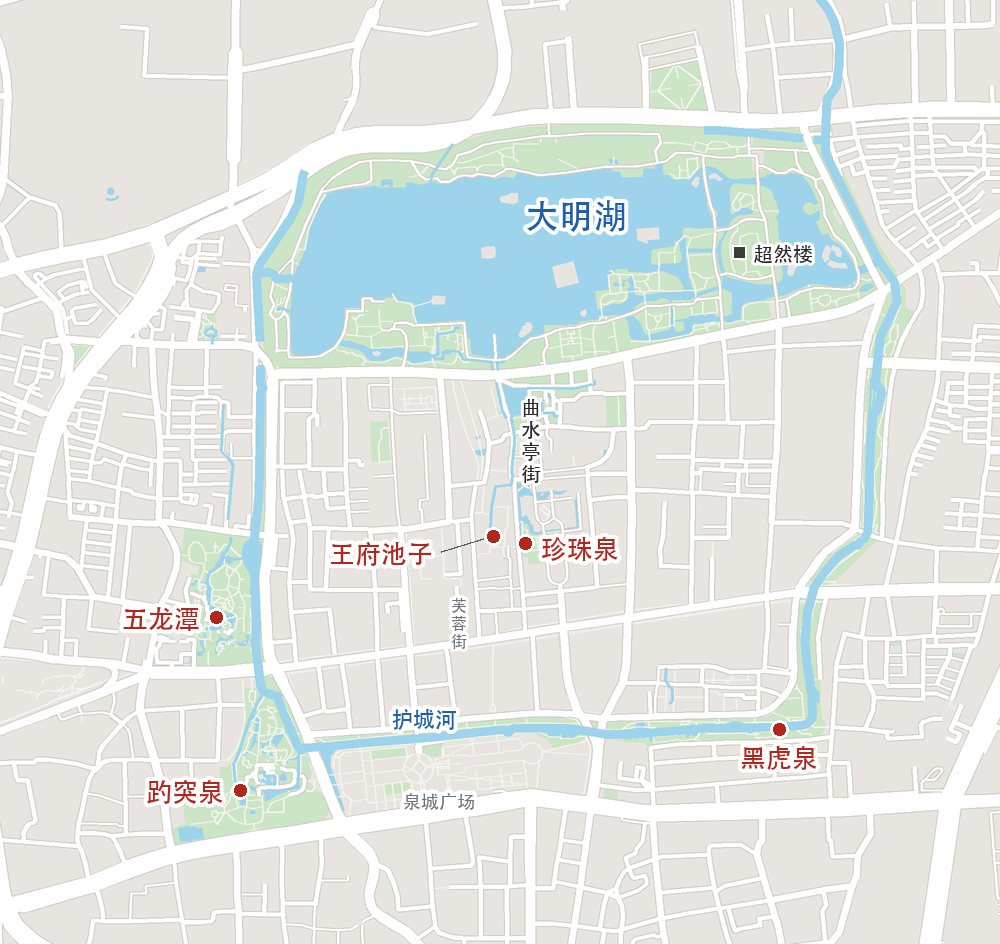
Roads and water from OpenStreetMap.
Nearby
| World Heritage | Mount Tai (Taishan) 46km, Temple, Mansion and Cemetery of Confucius, Qufu 118km, Yin Xu, Anyang 259km |
| National parks | Boshan 81km, Qingzhou 129km |
| Detailed guides | Lingyan Temple 33km |
| AAAAA attractions | First Spring Under Heaven Scenic Area <1km, Zhoucun Ancient Commercial City Scenic Area 75km, Yimeng Mountain Scenic Area 130km, Hengshui Lake Tourist Area 164km |
| AAAA attractions | Impression Jinan Spring World Tourism Scenic Area 10km, Jinan Fantawild Oriental Heritage 13km, Lianhuashan 14km, Quancheng Europa-Park Dreamland 19km |
| Historic cities | Jinan 2km, Tai'an 53km, Liaocheng 95km |
| Cities | Jinan 7km |
| Historical sites | Jinan Wanzhu Garden <1km, Former Cheeloo University Modern Building Complex <1km, Jinan Weier Road Modern Building Complex 2km, Former Jinan Station of the Jiaoji Railway Modern Building Complex 2km |