 National Parks of China
Overview
| Designation | UNESCO World Heritage (cultural, 2006) |
| Province | Henan |
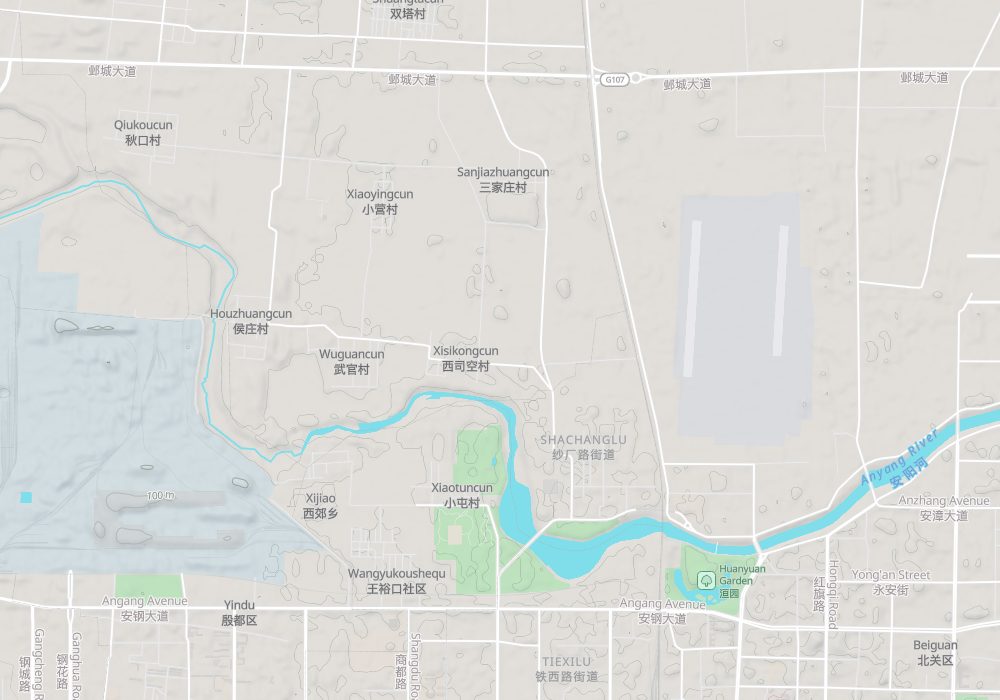
| Location | Both banks of the Huan River, north-west of Anyang, Henan |
| Latitude, longitude | 36.1, 114.2 Google Maps |
| Highlights | Capital of the late Shang dynasty |
| Nearby cities | Henan, Taiyuan, Zhengzhou, Shijiazhuang |
| Nearby sites | Mount Linlü, Mount Wangwu and Mount Yuntai, Mount Song, Longmen Grottoes, Luoyang, Xiangtangshan Grottoes, Taihang Grand Canyon |
| Themes | Culture & history, Cities, Tombs |
About
Yin Xu is the site of the capital of the late Shang dynasty, on both banks of the Huan River north-west of Anyang, Henan. From the late 14th to the 11th century BC, from the king Pan Geng’s move here until the fall of Di Xin (King Zhou), it was the Shang capital. It came to light at the start of the 20th century through the looting of oracle bones; excavation began in 1928. It became a national protected site in 1961 and was inscribed on the World Heritage List on 13 July 2006.
Discovery: in 1899 the epigrapher Wang Yirong noticed very ancient writing on “dragon bones” sold in a Beijing pharmacy, realised their value and began buying them. In 1900 his bones passed to Liu E, whose relative Luo Zhenyu learned that they came from Xiaotun village near Anyang, sent agents to buy more, deciphered some of the script and identified Xiaotun as the Yin Xu of the texts. Wang Guowei’s later study of the inscriptions confirmed it as the capital Pan Geng moved to.
From 1928 to 1937 the Academia Sinica carried out 15 scientific excavations in search of more bones, halted by the war with Japan. Work resumed after 1950, and by 1986 more than 20 excavations at over a dozen spots had yielded some 150,000 inscribed bones.
More than 5,000 distinct characters have been identified, about 1,700 of them read. The inscriptions push China’s reliably documented history back to the Shang, and modern Chinese characters descend from this script; its study has become a discipline of its own.
The site so far traced is about 6 km east–west and 4 km north–south, about 24 km², with the Huan River through the middle. It is the densest source of Shang bronzes and oracle bones, with many remains and tombs. The centre lies north-east of Xiaotun on the south bank, where the palaces and ancestral temples stood, ringed by workshops. Around Wuguan village on the north bank are the royal tombs: 13 great tombs, one of them empty, thought to have been built for King Zhou, who died with his kingdom and was never buried.
The tombs hold many sacrificed retainers. Tomb 1001 in the royal cemetery contained a hunting party of at least 68 people and 18 horses, led by a noble who had two sacrificial victims of his own. The sacrificial pits of the royal temple hold nearly 600 victims, most beheaded, cut in two or dismembered before being thrown in; infants of about a year old were among them.
In 1976, a hundred metres north of Xiaotun, the tomb of Fu Hao, consort of King Wu Ding, was found intact with 1,928 objects, among them 468 bronzes, 755 jades and nearly 7,000 cowries.
East of the royal tombs the Houmuwu ding was unearthed, the heaviest bronze vessel yet found. A huge ditch 200 m north-west of Xiaotun is thought to be a man-made defence.
Parts of this page are adapted from Wikipedia under the Creative Commons Attribution-ShareAlike licence (CC BY-SA).
Travel tips
Getting there: Anyang East station is on the Beijing–Guangzhou high-speed line; Anyang station has conventional trains. Yinxu is northwest of the city centre, reachable by bus or taxi.
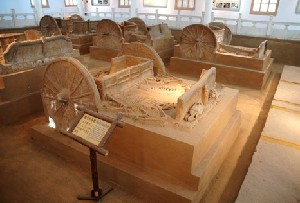
Palace and Temple Area: at Xiaotun on the south bank of the Huan River, with reconstructed palace foundations, oracle-bone storage pits, the Tomb of Fu Hao and chariot pits. This is the main area to visit.
Royal Tombs Area: near Wuguan village on the north bank, with the large Shang royal tombs and sacrificial pits. It is separate from the palace area and needs a short ride.
Museum: the new Yinxu Museum opened in February 2024 near the Palace and Temple Area, showing bronzes, pottery, jades and oracle bones from the site. On site you mostly see foundations and markers; the objects themselves are in the museum. Booking ahead is advised.
Time: about one day for both areas and the museum.
Nearby: the National Museum of Chinese Writing is in Anyang city. The original Houmuwu (Simuwu) Ding is in the National Museum of China in Beijing.
More photos
Map
© OpenStreetMap contributors · terrain © Copernicus · Map credits