 National Parks of China
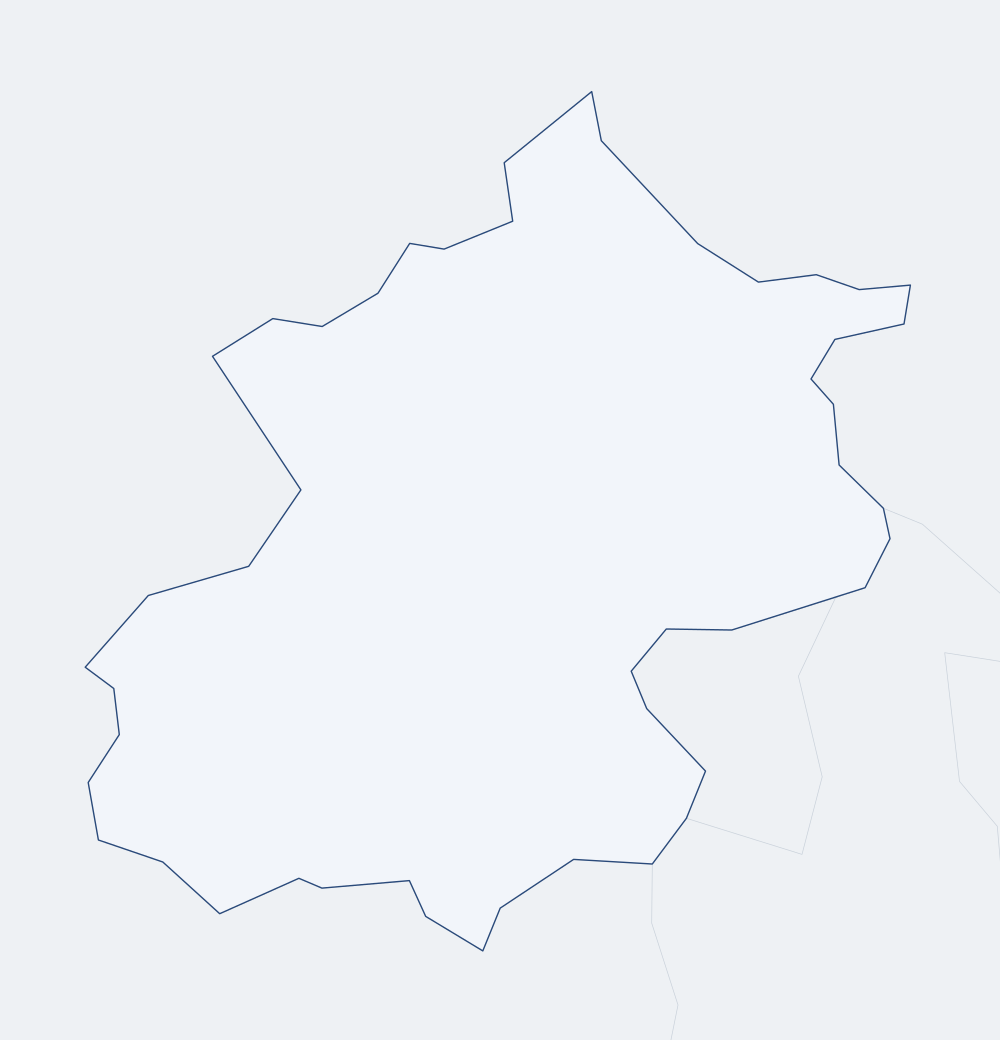
135 Major Historical and Cultural Sites Protected at the National Level in Beijing (batches 1–8, named by the State Council 1961–2019; 2 of them cross provincial borders, such as the Great Wall and the Grand Canal). Dots are coloured by category; click one to jump to its entry; sites inside the 3rd Ring Road are on the close-up map below. See also Beijing and all provinces.
Batch:
Xicheng District (42)
- White Pagoda of Miaoying Temple 妙应寺白塔Ancient buildings · first batch (1961)Tibetan-style stupa first built in the early Yuan; the earliest and largest surviving Tibetan-style pagoda in China.
- Beihai Park and the Round City 北海及团城Ancient buildings · first batch (1961)An imperial garden developed gradually since the Liao and Jin dynasties, centered on Qionghua Island and the White Pagoda on its summit; the Round City, originally an islet in Taiye Lake west of the south gate, was repeatedly built up in the Jin, Yuan, Ming and Qing dynasties.
- Soong Ching-ling's Former Residence in Beijing 北京宋庆龄故居Modern historic sites · second batch (1982)Residence of Soong Ching-ling in Beijing from 1963 to 1981, originally part of the garden of the Prince Chun mansion.
- Prince Gong's Mansion and Garden 恭王府及花园Ancient buildings · second batch (1982)Mansion and garden of Prince Gong, Yixin, in the late Qing; the western section was originally the mansion of Heshen.
- Former Residence of Guo Moruo 郭沫若故居Modern historic sites · third batch (1988)Residence of Guo Moruo from 1963 to 1978, later made a memorial hall displaying his life and his achievements in literature and history.
- Niujie Mosque 牛街礼拜寺Ancient buildings · third batch (1988)The oldest and largest mosque in Beijing, first built in the Liao; the present buildings were repaired and enlarged on the basis of a Ming rebuilding.
- Tianning Temple Pagoda 天宁寺塔Ancient buildings · third batch (1988)Octagonal dense-eave Buddhist pagoda, of Liao brick and stone construction; a Liao record stele found during repairs in 1991 and 1992 fixed the date of its construction.
- Dagaoxuan Hall 大高玄殿Ancient buildings · fourth batch (1996)Imperial Daoist temple of the Ming and Qing, mainly enshrining the Three Pure Ones and the Jade Emperor, commonly called the "Three Gateways" for the three side-by-side gates facing the street.
- Temple of Emperors of Successive Dynasties 历代帝王庙Ancient buildings · fourth batch (1996)Place where the Ming and Qing imperial court honored the Three Sovereigns, Five Emperors and emperors of successive dynasties, 188 emperors in all.
- South Church (Nantang) 南堂Ancient buildings · fourth batch (1996)The first Catholic church established in Beijing, commonly called the South Church, first built in 1605; the surviving three-story Baroque building dates from 1904.
- Jingshan 景山Ancient buildings · fifth batch (2001)An imperial garden of the Yuan, Ming and Qing, on Beijing's central axis; Jingshan was the highest point of Beijing in the Ming and Qing.
- Baiyun Temple 白云观Ancient buildings · fifth batch (2001)One of the three ancestral courts of the Quanzhen school of Taoism and the ancestral court of the Longmen sect, the "first grand monastery" of Quanzhen Taoism since the Yuan.
- Fayuan Temple 法源寺Ancient buildings · fifth batch (2001)Also called Minzhong Temple, the oldest surviving Buddhist temple within the city of Beijing.
- Xiannongtan 先农坛Ancient buildings · fifth batch (2001)Where Ming and Qing emperors worshipped Xiannong and Taisui deities and performed the ceremonial plowing; it faces the Temple of Heaven across the city from east to west.
- Matteo Ricci and Foreign Missionaries' Cemetery 利玛窦和外国传教士墓地Ancient tombs · sixth batch (2006)A Catholic cemetery of the Ming to the Qing in which missionaries who came to China are buried; only a small part survives, including Matteo Ricci's tomb.
- Arrow Tower of Deshengmen 德胜门箭楼Ancient buildings · sixth batch (2006)The arrow tower of Deshengmen on the west side of the northern wall of the inner city of Beijing in the Ming and Qing; only the arrow tower remains after the gate tower and barbican were demolished.
- Yuetan 月坛Ancient buildings · sixth batch (2006)Also called Xiyuetan, built in the 9th year of Jiajing of the Ming (1530), where Ming and Qing emperors worshipped the moon.
- Zhongnanhai 中南海Ancient buildings · sixth batch (2006)The collective name for Zhonghai and Nanhai, historically with Beihai the imperial gardens of the western Imperial City, now the offices of the Central Committee of the Party and the State Council.
- Guan-Yue Temple 关岳庙Ancient buildings · sixth batch (2006)Originally a temple built in the Guangxu reign for Prince Chun Yixuan, changed in the 3rd year of the Republic (1914) to worship Guan Yu and Yue Fei and called the Guan-Yue Temple.
- Prince Chun's Mansion 醇亲王府Ancient buildings · sixth batch (2006)The mansion of the Qing Prince Chun; after the Guangxu Emperor took the throne another was built at Houhai, and when Puyi succeeded this one was also called the "Dragon in Seclusion Residence".
- Guangji Temple 广济寺Ancient buildings · sixth batch (2006)An ancient imperial temple, one of the Eight Temples in the capital, named "Hongci Guangji Temple" in the 2nd year of Chenghua of the Ming (1466), now the seat of the Buddhist Association of China.
- Anhui Guild Hall 安徽会馆Ancient buildings · sixth batch (2006)The guild hall of people from Anhui in Beijing; its opera house is one of the four surviving private opera houses in Beijing.
- Baoguo Temple 报国寺Ancient buildings · sixth batch (2006)Originally named Ciren Temple and once with seven courtyards, the largest temple in the southern part of Beijing.
- Site of the Qing Agricultural Experiment Station 清农事试验场旧址Modern historic sites · sixth batch (2006)An experiment station laid out in the 32nd year of the Qing Guangxu reign (1906), which later developed into the Beijing Zoo.
- Xishiku Church 西什库教堂Modern historic sites · sixth batch (2006)Commonly called the North Church, opened in 1703 and one of the largest and oldest churches in Beijing; the cathedral of the Catholic Archdiocese of Beijing.
- Site of the National Mongolian and Tibetan School 国立蒙藏学校旧址Modern historic sites · sixth batch (2006)The site of the Mongolian and Tibetan School opened by the Republic of China's Mongolian and Tibetan Affairs Bureau in 1913.
- Site of the Beijing Parliament 北京国会旧址Modern historic sites · sixth batch (2006)The site of the House of Representatives of the parliament in the Beiyang government period; the parliament chamber, Renyi Building and Lizhi Building survive.
- Site of the Beijing Women's Normal School 京师女子师范学堂旧址Modern historic sites · sixth batch (2006)The former campus of the Beijing Women's Normal School, now Beijing Lu Xun Middle School.
- Site of the Printing Bureau of the Ministry of Finance of the National Government 国民政府财政部印刷局旧址Modern historic sites · sixth batch (2006)The former Printing Bureau of the Qing Ministry of Finance, now the location of Beijing Banknote Printing Co.
- Dashilar Commercial Buildings 大栅栏商业建筑Modern historic sites · sixth batch (2006)A traditional commercial district outside Qianmen with modern commercial buildings preserved along the street; Dashilar Street is 275 meters long.
- Site of the Peiping Library 北平图书馆旧址Modern historic sites · sixth batch (2006)The former site of the Peiping Library of the Republic, now the Ancient Books Hall of the National Library of China.
- Lu Xun's Former Residence in Beijing 北京鲁迅旧居Modern historic sites · sixth batch (2006)Lu Xun's former residence in Beijing, now part of the Beijing Lu Xun Museum.
- Pagoda of Elder Wansong 万松老人塔Ancient buildings · seventh batch (2013)Tomb pagoda of Wansong Xingxiu, a nine-story octagonal dense-eave brick pagoda and the only brick pagoda surviving in Beijing's inner city, from which Zhuanta Hutong gets its name.
- Prince Keqin's Mansion 克勤郡王府Ancient buildings · seventh batch (2013)Mansion of the descendants of Yuetuo, Prince Keqin, one of the eight "iron-hat" princes of the early Qing; also called Prince Ping's Mansion, and later the residence of Xiong Xiling.
- Church of the Chinese Anglican Church (Holy Catholic Church) 基督教中华圣公会教堂Modern historic sites · seventh batch (2013)The Anglican cathedral of Beijing completed in 1907, built with Chinese gray bricks and tiles on a European plan; it was the first church the Anglican Church built in Beijing.
- Xijiaomin Lane Modern Bank Building Complex 西交民巷近代银行建筑群Modern historic sites · seventh batch (2013)A street where banks were concentrated in the late Qing and early Republic, with the Daqing Bank (later the Bank of China), Continental Bank and Jincheng Bank among others.
- Site of the Main Campus of Fu Jen Catholic University 辅仁大学本部旧址Modern historic sites · seventh batch (2013)Originally Prince Yu's mansion, later Zaitao's Beile mansion, leased in 1925 to the Catholic Church to run Fu Jen University; the site now belongs to the continuing education college of Beijing Normal University.
- Site of Shengxin Middle School and Youzhen Girls' School 盛新中学与佑贞女中旧址Modern historic sites · seventh batch (2013)The site of two mission schools run by the French Catholic Congregation of the Mission; two teaching buildings and an auditorium survive.
- Former Residence of Li Dazhao 李大钊旧居Modern historic sites · seventh batch (2013)A three-sided courtyard rented by the Li Dazhao family from spring 1920 to January 1924, originally No. 35 Houzhai, Shi Fuma Street, the longest he lived in one residence in Beijing.
- Former Residence of Mei Lanfang 梅兰芳旧居Modern historic sites · seventh batch (2013)Mei Lanfang's residence after he returned to settle in Beijing in 1950, where he spent his last ten years and created his last new play, Mu Guiying Takes Command.
- Changchun Temple 长椿寺Ancient buildings · eighth batch (2019)Founded in the 20th year of Wanli of the Ming (1592) on the order of Empress Dowager Li Xiaoding; once called the "First Temple of the Capital," it is now the home of the Beijing Xuannan Culture Museum.
- Beijing Huguang Guildhall 北京湖广会馆Ancient buildings · eighth batch (2019)A Qing-dynasty guildhall in Beijing for natives of Huguang, first built in the Jiaqing era; its theater still stages traditional opera today.
Dongcheng District (35)
- Red Building of Peking University 北京大学红楼Modern historic sites · first batch (1961)One of Peking University's old campus buildings and a main venue of the May Fourth Movement, now part of the New Culture Movement Memorial Hall.
- Tiananmen 天安门Modern historic sites · first batch (1961)Main gate of the imperial city in the Ming and Qing dynasties, first built in the 15th year of the Yongle reign of the Ming (1417); the founding ceremony of the People's Republic was held here in 1949.
- Monument to the People's Heroes 人民英雄纪念碑Modern historic sites · first batch (1961)Monument whose foundation was laid in 1949 and which was completed in 1958; it is the first large national monument built after the founding of the People's Republic.
- Forbidden City 故宫Ancient buildings · first batch (1961)Imperial palace of the Ming and Qing dynasties, begun in the fourth year of the Yongle reign of the Ming (1406) and completed in the 18th year; the largest surviving palace complex.
- Temple of Heaven 天坛Ancient buildings · first batch (1961)Place where Ming and Qing emperors worshipped Heaven and prayed for harvests and rain, first built in the 18th year of the Yongle reign of the Ming (1420) and covering about 2.73 million square meters.
- Zhihua Temple 智化寺Ancient buildings · first batch (1961)Buddhist temple founded in the eighth year of the Zhengtong reign of the Ming (1443) by the eunuch Wang Zhen; its Ming-dynasty timber buildings are well preserved.
- Guozijian (Imperial Academy) 国子监Ancient buildings · first batch (1961)Seat of the highest national institution of learning in the Yuan, Ming and Qing dynasties, laid out as "temple on the left, school on the right," with the Confucius Temple immediately to its east.
- Yonghe Temple (Lama Temple) 雍和宫Ancient buildings · first batch (1961)Originally the mansion built by Emperor Kangxi for his fourth son Yinzhen, it was converted in the ninth year of the Qianlong reign (1744) into a Gelug-school Tibetan Buddhist temple, the largest of its kind in Beijing.
- Huangshi Cheng (Imperial Archives) 皇史宬Ancient buildings · second batch (1982)Imperial archive of the Ming and Qing dynasties, the oldest and most complete imperial archive building complex surviving in China.
- Ancient Observatory 古观象台Ancient buildings · second batch (1982)National observatory first built in the fourth year of the Zhengtong reign of the Ming (1442) on the site of the southeast corner tower of the Yuan capital Dadu, used through the Ming and Qing.
- Southeast Corner Tower of the Beijing City Wall 北京城东南角楼Ancient buildings · second batch (1982)Corner tower at the southeast of the Ming and Qing inner city of Beijing, built in the Zhengtong years; the largest and earliest surviving city-wall corner tower in China, with four rows of 144 arrow windows.
- Zhengyangmen Gate 正阳门Ancient buildings · third batch (1988)Commonly called Qianmen, the south gate of the Ming and Qing inner city of Beijing; its gate tower is the only one surviving of the nine inner-city gates, first built in the 17th year of the Yongle reign (1419).
- Imperial Ancestral Temple 太庙Ancient buildings · third batch (1988)Imperial ancestral temple of the Ming and Qing dynasties, first built in the 18th year of the Yongle reign of the Ming (1420), east of Tiananmen.
- Altar of Land and Grain 社稷坛Ancient buildings · third batch (1988)Altar where Ming and Qing emperors worshipped the gods of land and grain, the only surviving temple building for such worship, now Zhongshan Park.
- Beijing Confucius Temple 北京孔庙Ancient buildings · third batch (1988)First built in the sixth year of the Dade reign of the Yuan (1302), the second largest Confucius temple in China after the one in Qufu, where the state held Confucian rites in the Yuan, Ming and Qing.
- Chongli Residence 崇礼住宅Ancient buildings · third batch (1988)The residence of Chongli, a late Qing Grand Secretary, built in the Guangxu reign; it has three courtyard sections, east, middle and west, with the east and west for dwellings and the middle a garden, totaling 327.5 rooms and known as 'the best in the East City'.
- Beijing Drum Tower and Bell Tower 北京鼓楼、钟楼Ancient buildings · fourth batch (1996)Time-keeping buildings of Ming and Qing Beijing, originally built in the ninth year of the Zhiyuan reign of the Yuan (1272) and rebuilt on the present site in the Yongle years of the Ming.
- Ke Garden 可园Ancient buildings · fifth batch (2001)A private garden completed in the 11th year of Xianfeng of the Qing (1861), originally the garden section of the residence of Grand Secretary Wenyu.
- Prince Fu's Mansion 孚王府Ancient buildings · fifth batch (2001)Originally the new mansion of Prince Yi, bestowed in the 3rd year of Tongzhi on Yihui, Prince Fu, and later called Prince Fu's Mansion; its layout accords with the princely mansion rules of the Collected Statutes of the Great Qing, with east, middle and west sections.
- Dongjiaomin Lane Legation Buildings 东交民巷使馆建筑群Modern historic sites · fifth batch (2001)Dongjiaomin Lane, where the modern legation buildings of various countries are concentrated, is the longest hutong of old Beijing, 1,552 m long.
- Tomb and Shrine of Yuan Chonghuan 袁崇焕墓和祠Ancient tombs · sixth batch (2006)The tomb and shrine of Yuan Chonghuan, Ming Supervisor of Military Affairs for Ji and Liao in the late Ming, now a memorial hall.
- Ditan 地坛Ancient buildings · sixth batch (2006)Where Ming and Qing emperors worshipped the god of the Earth at the summer solstice, outside Andingmen, later made a park.
- Bailin Temple 柏林寺Ancient buildings · sixth batch (2006)Founded in the 7th year of Zhizheng of the Yuan (1347), one of the Eight Temples in the capital, to which the Kangxi Emperor gave the plaque "Wangu Bailin".
- Site of the Branch Colleges of the Imperial University of Peking 京师大学堂分科大学旧址Modern historic sites · sixth batch (2006)The campus of the branch colleges of the Imperial University of Peking, built 1905-1911 and designed by the Japanese architect Mamizu Hideo; five two-story buildings survive.
- Site of the Qing Ministries of Army and Navy 清陆军部和海军部旧址Modern historic sites · sixth batch (2006)A Western-style complex of government buildings begun in the late Qing, first the Ministries of Army and Navy and in the Republic the presidential palace and the Provisional Government Office, that is, the site of Duan Qirui's executive government.
- Asbury Church 亚斯立堂Modern historic sites · sixth batch (2006)Begun in 1870, the oldest surviving Protestant church in Beijing, now called Chongwenmen Church.
- Site of Peking Union Medical College 协和医学院旧址Modern historic sites · sixth batch (2006)Founded in 1917 with funds from the Rockefeller Foundation and modeled on Johns Hopkins University School of Medicine; the first medical school in China to offer an eight-year clinical medicine program.
- Sun Yat-sen's Residence 孙中山行馆Modern historic sites · sixth batch (2006)The headquarters where Sun Yat-sen moved in February 1925 when seriously ill, and the place where he died.
- Wen Tianxiang Shrine 文天祥祠Ancient buildings · seventh batch (2013)Shrine to Wen Tianxiang, chancellor of the Southern Song, first built in the ninth year of the Hongwu reign of the Ming (1376) on the site of a Yuan-dynasty military prison.
- Pudu Temple 普度寺Ancient buildings · seventh batch (2013)Gelug-school Tibetan Buddhist temple, one of the Eight Outer Temples of the Imperial Palace, converted from the northern part of Prince Rui's Mansion in the Kangxi reign of the Qing, enshrining Mahakala.
- East Cathedral 东堂Modern historic sites · seventh batch (2013)Formally the Church of St. Joseph and commonly called the East Cathedral; the surviving three-story Romanesque building incorporates many traditional Chinese architectural elements.
- Site of the Beijing Branch of the Christian China Bible Society 基督教中华圣经会北京分会旧址Modern historic sites · seventh batch (2013)The premises of the Beijing branch of the China Bible Society, completed in 1928, a center for distributing Bibles in North China.
- Site of the Peking University Geology Hall 北京大学地质学馆旧址Modern historic sites · seventh batch (2013)A modernist building designed by Liang Sicheng, begun in 1934 and completed in 1935, a three-story brick-concrete structure.
- Zhizhu Temple 智珠寺Ancient buildings · eighth batch (2019)A Gelug-school Tibetan Buddhist temple built in the Qianlong era of the Qing, forming a temple group with Songzhu Temple and Fayuan Temple.
- Beijing Railway Station Building 北京站车站大楼Modern historic sites · eighth batch (2019)The Beijing Railway Station building, completed in 1959, an important passenger station in the Beijing rail hub.
Haidian District (20)
- Vajra Throne Pagoda of Zhenjue Temple 真觉寺金刚宝座Ancient buildings · first batch (1961)Temple famed for its Vajra Throne pagoda, commonly called Wuta Temple; its pagoda is the earliest Vajra Throne pagoda in China and it is now the Beijing Art Museum of Stone Carvings.
- Summer Palace 颐和园Ancient buildings · first batch (1961)Qing imperial garden centered on Longevity Hill and Kunming Lake, originally named Qingyi Garden and rebuilt in the Guangxu years; inscribed as a World Cultural Heritage site in 1998.
- Yuanmingyuan (Old Summer Palace) Ruins 圆明园遗址Ancient sites · third batch (1988)Large Qing imperial garden made up of the Yuanming, Changchun and Qichun gardens, called the "garden of gardens," burned by Anglo-French forces in 1860.
- Juesheng Temple 觉生寺Ancient buildings · fourth batch (1996)Commonly called the Great Bell Temple, first built in the 11th year of the Yongzheng reign of the Qing (1733) and named for housing the Yongle Great Bell; now the Ancient Bell Museum.
- Jingtai Mausoleum 景泰陵Ancient tombs · fifth batch (2001)The tomb of the Jingtai Emperor Zhu Qiyu of the Ming, first built by Emperor Yingzong with the rites of a prince and later raised to imperial standard; a stele with a poem by Qianlong stands before Ling'en Hall.
- Biyun Temple 碧云寺Ancient buildings · fifth batch (2001)A Buddhist temple on Xiangshan, first built in the 2nd year of Zhishun of the Yuan (1331); in the Qianlong reign it was enlarged and a Vajrasana pagoda was added, and Sun Yat-sen's coffin once lay here.
- Dahui Temple 大慧寺Ancient buildings · fifth batch (2001)Commonly called Dafo Temple, first built in the 8th year of Zhengde of the Ming (1513); only the Dabei Hall survives.
- Shifang Pujue Temple 十方普觉寺Ancient buildings · fifth batch (2001)Commonly called Wofo Temple (Reclining Buddha Temple) because its reclining Buddha hall houses a bronze reclining Buddha, at the southern foot of Shou'an Mountain.
- Weiming Lake Yanyuan Buildings 未名湖燕园建筑Modern historic sites · fifth batch (2001)The campus of the former Yenching University, a comprehensive university founded jointly by American and British Christian missions in the early 20th century, now part of Peking University.
- Early Buildings of Tsinghua University 清华大学早期建筑Modern historic sites · fifth batch (2001)Twenty early buildings on the Tsinghua University campus completed before 1935, mainly in the western part of the campus.
- Dajue Temple 大觉寺Ancient buildings · sixth batch (2006)An ancient temple in the Western Hills, first built in the Liao and one of the Eight Great Water Courtyards of Emperor Zhangzong of Jin in the Western Hills; it is known for its old trees and magnolias.
- Jingming Garden 静明园Ancient buildings · sixth batch (2006)A Qing imperial garden on Yuquan Mountain, first named Chengxin Garden in the Kangxi reign and later renamed Jingming Garden, expanded to sixteen scenes in the Qianlong reign.
- Jianruiying Drill Hall 健锐营演武厅Ancient buildings · sixth batch (2006)The training ground of the Jianrui Battalion of the Qing, the only surviving Qing military review building complex in Beijing.
- Wanshou Temple 万寿寺Ancient buildings · sixth batch (2006)A Buddhist temple begun in the 5th year of Wanli of the Ming (1577) and completed the next year, built with funds led by the Empress Dowager Cisheng, now the Wanshou Temple Museum.
- Xinhai Luanzhou Uprising Memorial Park 辛亥滦州起义纪念园Modern historic sites · sixth batch (2006)A memorial complex built by Feng Yuxiang in April 1937 in memory of those who died in the Luanzhou Uprising, with a memorial archway, monument, cenotaph, cliff inscription and memorial pagoda.
- Moha Convent 摩诃庵Ancient buildings · seventh batch (2013)Buddhist temple first built in the 25th year of the Jiajing reign of the Ming (1546); the Main Hall keeps a coiled-dragon caisson ceiling and gilded bronze statues, and the Vajra Hall keeps stone tablets carved with the Diamond Sutra in 32 seal-script sections.
- Cishou Temple Pagoda 慈寿寺塔Ancient buildings · seventh batch (2013)Popularly called Balizhuang Pagoda, also known as the Linglong Pagoda, an octagonal 13-story dense-eave solid brick pagoda built in the Wanli reign of the Ming.
- Tomb of Prince Chun 醇亲王墓Ancient tombs · eighth batch (2019)Commonly called the Qiwangfen (Tomb of the Seventh Prince); the burial park of the Qing Prince Chun, Yixuan, and his principal wife, begun in the 7th year of Tongzhi (1868) and completed in the 25th year of Guangxu (1899).
- Shuangqing Villa 双清别墅Modern historic sites · eighth batch (2019)Originally the Songwu Yunzhuang of Jingyi Garden; Mao Zedong lived here from March to September 1949.
- Soong Ching Ling Children's Science and Technology Museum 宋庆龄儿童科学技术馆Modern historic sites · eighth batch (2019)Built with donations from home and abroad raised by the Soong Ching Ling Foundation; opened in 1986.
Fangshan District (10)
- Yunju Temple Pagodas and Stone Scriptures at Fangshan 房山云居寺塔及石经Ancient buildings · first batch (1961)Buddhist remains from the Sui to the Jin, including the Yunju Temple pagodas and stone scriptures, located at Yunju Temple in Fangshan District.
- Zhoukoudian Peking Man Site 周口店遗址Ancient sites · first batch (1961)A series of cave sites on Dragon Bone Hill that yielded many fossils of Peking Man; inscribed as a World Cultural Heritage site in 1987.
- Liulihe Site 琉璃河遗址Ancient sites · third batch (1988)The capital site of the Yan state of the early Western Zhou, including an ancient city site, burial area and residential area, which yielded many bronzes; the Western Zhou Yan Capital Site Museum stands on it.
- Wanfotang, Kongshuidong Stone Carvings and Pagodas 万佛堂、孔水洞石刻及塔Ancient buildings · fifth batch (2001)A group of Buddhist relics made up of the Tang Wanfotang, the Sui, Tang and Jin stone carvings of Kongshuidong, the Liao flower pagoda and a Yuan dense-eaved pagoda.
- Shizisi Site 十字寺遗址Ancient sites · sixth batch (2006)The site of a temple used successively by Buddhism and Nestorianism, a Nestorian place of worship in the Yuan, named Shizisi (Cross Temple) in the Jiajing reign of the Ming, evidence of Sino-Western cultural exchange.
- Jinling 金陵Ancient tombs · sixth batch (2006)The earliest imperial cemetery in Beijing; after the Prince of Hailing of the Jin moved the capital to Yanjing he reburied the ancestral tombs at Dafangshan, including the tomb of Emperor Taizu of Jin.
- Liangxiang Duobao Buddha Pagoda 良乡多宝佛塔Ancient buildings · seventh batch (2013)The only pavilion-style brick pagoda in Beijing, octagonal with five stories, first built in the Sui and rebuilt in the Liao.
- Tomb Pagoda of Yao Guangxiao 姚广孝墓塔Ancient buildings · seventh batch (2013)Tomb pagoda of Yao Guangxiao, a leading minister of the Yongle Emperor of the Ming; begun in the 16th year of the Yongle reign (1418) and completed in the first year of Xuande, it is octagonal, nine-tiered and 33 m high.
- Liulihe Bridge 琉璃河大桥Ancient buildings · seventh batch (2013)Ming-dynasty stone bridge, 165.5 m long with 11 arches, the largest among Beijing's stone bridges after the Marco Polo Bridge.
- Site of the Atomic Energy "One Reactor, One Accelerator" 原子能“一堆一器”旧址Modern historic sites · eighth batch (2019)Built in 1958; the "reactor" is China's first heavy-water reactor and the "accelerator" its first cyclotron.
Fengtai District (4)
- Lugou Bridge (Marco Polo Bridge) 卢沟桥Modern historic sites · first batch (1961)Stone multi-arch bridge first built in the 29th year of the Dading reign of the Jin dynasty (1189), where the Marco Polo Bridge Incident broke out in 1937.
- Jin Zhongdu Water Gate Site 金中都水关遗址Ancient sites · fifth batch (2001)Site of the water gate of Zhongdu, the Jin capital, on which the Beijing Archaeological Site Museum stands.
- Zhengang Pagoda 镇岗塔Ancient buildings · seventh batch (2013)Solid brick "flower pagoda"; its original construction date is unknown, but its style suggests the Jin dynasty, and it was repaired in the Ming.
- Site of the Changxindian February 7th Strike 长辛店“二七”大罢工旧址Modern historic sites · seventh batch (2013)A group of sites commemorating the 1923 February 7th Strike, including modern building remains of the Erqi Locomotive Works, the Workers' Club and the Labor Supplementary School.
Mentougou District (4)
- Jietai Temple 戒台寺Ancient buildings · fourth batch (1996)Known for its large ordination platform, ranked with those of Zhaoqing Temple in Hangzhou and Kaiyuan Temple in Quanzhou as the three great ordination platforms of China.
- Tanzhe Temple 潭柘寺Ancient buildings · fifth batch (2001)First built in the Western Jin and originally named Jiafu Temple, it is the earliest temple in Beijing; a folk saying goes, "First Tanzhe Temple, then the city of Beijing."
- Cuandixia Village Ancient Building Complex 爨底下村古建筑群Ancient buildings · sixth batch (2006)An ancient village first built in the Ming, preserving many Qing dwellings, one of the first batch of Famous Historical and Cultural Villages of China.
- Lingyue Temple 灵岳寺Ancient buildings · seventh batch (2013)The only fairly intact pre-Yuan timber-frame temple in the Beijing area.
Chaoyang District (4)
- Beijing Dongyue Temple 北京东岳庙Ancient buildings · fourth batch (1996)The largest monastery of the Zhengyi school of Daoism in North China, now the Beijing Folk Customs Museum, preserving many Daoist buildings and steles of various dynasties.
- Qingjing Huacheng Pagoda 清净化城塔Ancient buildings · fifth batch (2001)A Vajrasana-style pagoda in the pagoda courtyard of Xihuang Temple, one of the four surviving Vajrasana pagodas in Beijing.
- Ritan 日坛Ancient buildings · sixth batch (2006)Where ancient emperors worshipped the sun, also called Chaoritan, facing Yuetan, now Ritan Park.
- Site of Radio Station 491 四九一电台旧址Modern historic sites · seventh batch (2013)A radio station begun in 1918 and named "Station 491" in 1949, now a large medium- and short-wave broadcast transmitting station.
Changping District (3)
- Cloud Terrace at Juyongguan 居庸关云台Ancient buildings · first batch (1961)Base of a street-spanning pagoda built in the Zhiyuan years of the late Yuan, with many reliefs and inscriptions inside and outside the arched gateway; three Tibetan-style stupas once stood on it.
- Ming Tombs 十三陵Ancient tombs · first batch (1961)Tomb group of thirteen Ming emperors at the foot of Tianshou Mountain, in use from the seventh year of the Yongle reign (1409); inscribed as a World Cultural Heritage site in 2003.
- Yinshan Pagoda Forest 银山塔林Ancient buildings · third batch (1988)Group of monks' tomb pagodas built from the Jin to the Qing, eighteen in all, of dense-eave and Tibetan-style stupa types.
Shijingshan District (3)
- Fahai Temple 法海寺Ancient buildings · third batch (1988)Built with funds raised by the eunuch Li Tong in the Zhengtong years of the Ming and completed in the eighth year (1443); famed for its "five wonders" including its Ming murals.
- Cheng'en Temple 承恩寺Ancient buildings · sixth batch (2006)A Buddhist temple begun by the eunuch Wen Xiang of the Directorate of Ceremonial in the 5th year of Zhengde of the Ming (1510) and completed in the 8th year (1513).
- Babaoshan Revolutionary Cemetery, Beijing 北京市八宝山革命公墓Modern historic sites · seventh batch (2013)Originally the site of the Ming-dynasty Huguo Temple and the Ganggong Ancestral Hall; now a revolutionary cemetery.
Yanqing District (2)
- Great Wall at Badaling 万里长城-八达岭Ancient buildings · first batch (1961)The earliest section of the Ming Great Wall opened to visitors and well preserved; the east gate of the pass is inscribed "Outer Guard of Juyong" and the west gate "Key to the North Gate."
- Yanqing Ancient Cliff Dwellings 延庆古崖居Ancient sites · seventh batch (2013)The largest cliff-dwelling site, found in 1984; the date of excavation and the people who lived there are still undecided.
Tongzhou District (1)
- Tongzhou Modern School Building Complex 通州近代学校建筑群Modern historic sites · seventh batch (2013)Modern buildings of Luhe Middle School, Fuyu Girls' School and Huamei School, run by American missions.
Shunyi District (1)
- Jiaozhuanghu Tunnel Warfare Site 焦庄户地道战遗址Modern historic sites · seventh batch (2013)A site of tunnel warfare in Jiaozhuanghu Village in the Jidong anti-Japanese base area during the War of Resistance against Japan, where villagers linked individual hiding holes into tunnels.
Pinggu District (1)
- Shangzhai Site 上宅遗址Ancient sites · eighth batch (2019)A Neolithic site dating to about 7,500 to 6,000 years ago; the earliest known culture in the Beijing area, in an early stage of primitive agriculture.
Across several districts (3)
- Yuan Dadu City Wall Site 元大都城墙遗址Ancient sites · sixth batch (2006)Remains of the city wall of Dadu of the Yuan, with surviving walls over ten meters high, commonly called the "Earth Wall" in Beijing and now made a site park.
- Remains of the Ming Beijing City Wall 明北京城城墙遗存Ancient buildings · seventh batch (2013)Remains of the Ming and Qing Beijing city wall, with the main surviving stretches south of Beijing Railway Station, north of the southeast corner tower of the Inner City and near Xibianmen.
- Jingzhang Railway: Nankou to Badaling Section 京张铁路南口段至八达岭段Modern historic sites · seventh batch (2013)The first railway designed and built by Chinese themselves, with Zhan Tianyou as chief engineer, opened in 1909; the Badaling area uses a zigzag "人"-shaped line.
Across provinces (2)
- Great Wall 长城Ancient buildings · fifth batch (2001)A combined listing of Great Wall sections from the Spring and Autumn period to the Ming dynasty, across Beijing, Hebei, Shanxi, Inner Mongolia, Shaanxi, Shandong, Ningxia, Liaoning and other provinces and regions; the Beijing section is mainly Ming Great Wall.
- Beijing-Hangzhou Grand Canal 京杭大运河Ancient buildings · sixth batch (2006)An artificial canal 1,794 km long, from Tongzhou in Beijing in the north to Hangzhou in the south; inscribed on the World Heritage List in 2014 as part of the Grand Canal.